
Non-FictionSelf-HelpTime BatchingWorkflow Design
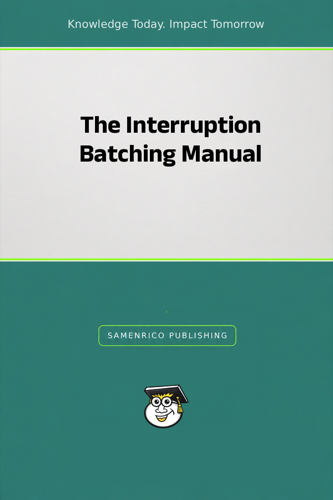
The Interruption Batching Manual eBook
Group all your interruptions into three daily resp
Group all your interruptions into three daily response blocks to preserve deep focus the rest of the day.
Formats
Free sample
Chapter 1: The 11-Minute Trap--–- Sarah cried in the stairwell at 2:17 PM on a Tuesday. Not because she had been fired. Not because her mother was sick. Sarah cried because she had just realized she had been “working” for six hours and had written exactly zero words of the presentation due tomorrow morning. Her Slack had buzzed forty-three times.
Her boss had “just popped by” twice. She had answered seventeen emails, “real quick,” and resolved three issues that weren’t hers to resolve. And now, at 2:17 PM, she had 243 minutes until she had to leave for daycare pickup. The math didn’t work. The crying started.This book is for Sarah.
It is for you, if you have ever felt busy all day but accomplished nothing. It is for anyone who has closed their laptop at 6 PM with a vague sense of shame, unable to name a single thing they actually finished. It is for the knowledge worker who is drowning not in work, but in interruptions.Let us begin with a number that will ruin your day: eleven.The Number That Explains Your Exhaustion Eleven minutes. That is how often the average knowledge worker is interrupted, according to research compiled in The Organized Mind by neuroscientist Daniel Levitin. Every eleven minutes — sometimes by email, sometimes by Slack, sometimes by a colleague’s head appearing over the cubicle wall, sometimes by your own phone buzzing in your pocket.
Every eleven minutes, on average, something pulls your attention away from whatever you were trying to accomplish.That is bad enough. Here is the part that should terrify you: after an interruption, it takes an average of twenty-three minutes to return to a state of deep focus.Let us do the math together, because the math is the only thing that will make you believe this. If you are interrupted at 9:00 AM, you lose focus until approximately 9:23 AM. Then you work for eleven minutes until the next interruption at 9:34 AM. Then you lose focus until 9:57 AM.
Then you work for eleven minutes until 10:08 AM. Then you lose focus until 10:31 AM.In a three-hour morning window, this pattern yields approximately thirty-three minutes of actual focused work. Not thirty-three minutes of “being at your desk.” Thirty-three minutes of the kind of work that actually advances your career, solves hard problems, and creates value that cannot be replicated by artificial intelligence or an overseas contractor.The other two hours and twenty-seven minutes are spent in what researchers call “context switching” — the cognitive tax of stopping one task, loading a different task into working memory, processing it, then trying to reload the original task. Your brain is not a computer. It does not save your state gracefully.
When you switch away from a task, you do not simply resume where you left off. You restart.Attention Residue: The Silent Killer of Your IQThe psychologist Sophie Leroy coined a term for this phenomenon: attention residue. Here is how it works. When you are working on Task A and you switch to Task B, a portion of your attention remains stuck on Task A. You cannot help it.
Your brain is wired to keep unfinished loops active in your working memory — a survival mechanism from our evolutionary past when an unfinished task (like “watch for the tiger”) might mean the difference between life and death.But in a modern office, this mechanism is a disaster.Leroy’s research found that even after switching away from a task, your performance on the new task is impaired for a significant period. Your brain is literally split — part of it processing the new thing, part of it still chewing on the old thing. This is not multitasking. Multitasking is a myth. Your brain does not parallel process cognitive tasks.
It serial processes them with expensive switching costs.The cognitive cost of attention residue is measurable. Researchers have found that heavy context switching can reduce your effective IQ by up to fifteen points in the moment. Fifteen points. That is the difference between “gifted” and “average.” That is the difference between catching a subtle error in a financial model and missing it. That is the difference between writing a compelling proposal and writing something that reads like it was assembled by committee at 4:45 PM on a Friday.Let me say this as clearly as I can: every time you check your email while writing a report, you are choosing to be dumber.
Every time you answer a Slack message while on a Zoom call, you are choosing to be dumber. Every time you let someone “just pop by” while you are in the middle of something, you are choosing to be dumber.Not metaphorically. Literally. IQ points. Measurable.
Real.The Myth of the Quick Question Here is where most productivity advice gets it wrong. Mainstream productivity culture tells you to “manage your distractions” and “build better habits” and “just say no to interruptions.” This advice assumes that interruptions are external events that happen to you, and that your willpower is the solution.This is a lie.Willpower is a finite resource. The psychologist Roy Baumeister demonstrated this in a series of famous experiments. Subjects who were asked to resist eating freshly baked chocolate chip cookies — sitting right there on the table, warm and fragrant — gave up on a subsequent puzzle task much faster than subjects who were allowed to eat the cookies. The act of resisting depleted their self-control.
They had nothing left for the puzzle.The same thing happens with interruptions. Every time you resist the urge to check your phone, you deplete your willpower. Every time you ignore a Slack notification, you deplete your willpower. Every time you say “not now” to a colleague who wants to chat, you deplete your willpower. By 2:00 PM, you have nothing left.
You check the phone. You answer the Slack. You say “sure, come in” when the colleague knocks. Not because you are weak. Because you are empty.This is what I call Cognitive Withdrawal.
It is the state of having exhausted your willpower reserves so thoroughly that you default to the path of least resistance — which is almost always the path of immediate responsiveness. You become a puppet whose strings are pulled by whoever last demanded your attention.Cognitive withdrawal is why New Year’s resolutions fail by January 12th. It is why you swear you will not check email before 10 AM tomorrow, and then you check it at 8:47 AM. It is why the Three-Block system exists — not to make you a productivity robot, but to eliminate the need for willpower entirely.A Typical Morning in the Interruption Economy Let me walk you through a real morning. This is not hypothetical.
This is the aggregate of hundreds of coaching sessions I have conducted with knowledge workers across technology, finance, healthcare, and education.8:00 AM: You arrive at your desk with good intentions. You have a plan. The first hour is for deep work on the quarterly report. You open your laptop.8:03 AM: Slack lights up. Your boss has posted a “quick question” in the team channel.
It is not actually quick — it requires looking up three numbers from last quarter. But you feel compelled to…
This is the end of the free sample. Get the eBook to keep going. Buy now
About this book
Details
- Author
- Avalos Margarite
- Publisher
- SamEnrico
- Language
- English
- Genre
- Non-Fiction, Self-Help, Time Batching, Workflow Design
- Released
- 2026-06-08
- Pages (approx.)
- 146
- Available as
- eBook, Audiobook

Read better in the ZLOADR app
Your eBooks on your phone or tablet. Sign in with your SamEnrico account and start reading.
More by Avalos Margarite
 The Freelance Income TrackerAvalos Margarite$11.99
 Battle Of Jena Auerstedt GuideAvalos Margarite$11.99
 Proprioceptive Neuromuscular Facilitation for PainAvalos Margarite$11.99
 Scheduling for Multiple ProjectsAvalos Margarite$11.99
 Geo Arbitrage for LawyersAvalos Margarite$11.99
 LGBTQ Teen Self EsteemAvalos Margarite$11.99
 Anger Medication ConsultationAvalos Margarite$11.99
 The Vanishing of Flight 1956: The Bermuda Triangle's Last VictimAvalos Margarite$11.99
 The Diamond Heist That Shook the World: The 1964 Great Train RobberyAvalos Margarite$11.99
 The Clockwork Code: Breaking the Enigma of the Antikythera MechanismAvalos Margarite$11.99
 Business Intelligence EngineerAvalos Margarite$11.99
 Understanding Ankyloglossia Heterochromia Clasped ThumbsAvalos Margarite$17.99
You may also like
 Hong Kong Handover 1997Dunn Johnnie$11.99
 Zumba For Postnatal Recovery CourseNeal Christian$11.99
 Zumba for BeginnersLadner Nikia$11.99
 YouTube Comment Mining GuideHumes Pandora$12.99
 Worry Box MeditationCarlin Rudy$11.99
 Workplace Stress MeditationNguyen Lynn$11.99
 Workplace Stress and Sleep RepairHawley Ivory$11.99
 Workplace Perfectionism CureDelaney Jeffry$11.99
 Workplace Injustice Anger GuideWallen Isabelle$11.99
 Work Addiction and Burnout LinkGreenwood Ester$11.99
 Women in Yoga and WellnessBeattie Galina$11.99
 Women in Stand Up ComedyChun Evangeline$11.99