
Non-FictionBiographyHardware Startup
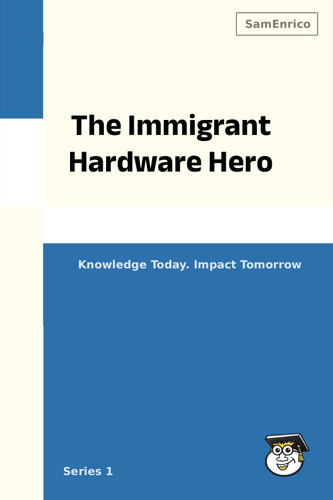
The Immigrant Hardware Hero eBook
Follows a foreign-born engineer who built a physic
by Tripp Tori
Follows a foreign-born engineer who built a physical product manufacturing empire.
Formats
Free sample
Chapter 1: The Visa Cliff--The pink slip landed on Jian Wei’s keyboard like a dead bird. He stared at it for three full seconds before his brain translated the English words into meaning. Your position has been eliminated. Effective immediately. The HR manager, a woman named Carol whose smile never reached her eyes, was still talking.
Something about severance. Something about COBRA. Something about the 60-day clock.Jian heard only the clock.Sixty days to find a new employer willing to sponsor his H1-B visa. Sixty days before his legal existence in the United States evaporated. Sixty days to pack thirteen years of his life into suitcases and explain to his mother in Penang why her engineer son was coming home with nothing but debt and failure.He drove home in silence.
The November Detroit sky was the color of old concrete. His apartment, a 600-square-foot box in Warren, smelled like last night’s instant noodles and the motor oil that had permanently soaked into his jeans. He sat on the edge of his bed and called his mother.“Everything is fine, Mama,” he said. “Just busy.”He lied because telling the truth would have killed her. She had mortgaged her tiny house to pay for his engineering degree at Universiti Sains Malaysia.
She had cried at the airport when he left for America, pressing a small envelope of cash into his palm. Study hard, she had said. Make us proud. He had promised her he would become a senior engineer at a big American company. He had promised her stability.
Security. A life.Now he had nothing.The Mathematics of Desperation Jian opened his laptop and did what any trained engineer would do: he ran the numbers.Option One: Find another H1-B sponsorship within 60 days. The odds, according to immigration forums he had been doom-scrolling for three hours, were grim. Most companies had stopped accepting transfers for the year. The ones that hadn’t would require interviews, technical screens, background checks.
Even in a boom economy, sixty days was a sprint. In November, with hiring freezes looming, it was a suicide run.Option Two: Leave voluntarily. Book a one-way ticket to Penang. Move back into his mother’s house. Try to find work at a local firm for one-tenth his US salary.
Explain to everyone he knew that the American dream had been a mirage.Option Three: Start a business.He almost laughed at the absurdity. He had no capital. No credit history. No green card. No network of wealthy uncles.
He had a 2012 Honda Civic with 180,000 miles, a toolbox full of beat-up wrenches, and an engineering degree that American HR departments had dismissed for years because it came from “some foreign university they’d never heard of.”But he also had something else: a landlord with a broken motor.The $500 Repair That Changed Everything Jian’s landlord was a retired autoworker named Earl who smelled like cigarettes and cheap coffee. Earl owned a small industrial building behind the apartment complex, where he stored random equipment he had collected over forty years in the factories. One of those machines was a 50-horsepower AC motor, the kind that ran conveyor belts in assembly plants. It had been sitting in Earl’s garage for three years, dead as a doorstop.“You’re an engineer, right?” Earl had asked him once, during a late-night leak repair. “Take a look at that motor sometime.
I’ll give you a hundred bucks if you can figure out what’s wrong with it.”Jian had forgotten about the offer. But that night, after the pink slip, after the call to his mother, after the spreadsheet of despair, he walked out to Earl’s garage with a multimeter and a headlamp.The motor was massive, easily 300 pounds of cast iron and copper windings. It was the kind of equipment that American factories threw away when something went wrong, because replacing it was cheaper than hiring someone to diagnose the problem. Jian crouched in the cold, blew dust off the nameplate, and started testing.Fifteen minutes later, he found it. A burned-out start capacitor.
The component cost $12 on Ali Express. The repair took twenty minutes, including the time it took to scrape off three years of grime.He plugged the motor into Earl’s improvised test rig—a heavy-duty extension cord and a lot of faith—and flipped the switch. The motor hummed to life, smooth as a sewing machine.Earl gave him $500. “You just saved me five grand,” he said. “That motor drives my whole parts washer.
I was about to scrap the whole operation.”Jian looked at the motor. He looked at the $500 in his hand. He looked at his visa clock, which now had 59 days left.And he understood something that no engineering textbook had ever taught him: a visa loves a job creator.The Scarcity Algorithm Most startup stories begin with a pitch deck and a venture capitalist. They begin with a “disruptive vision” and a “scalable platform.” They begin with millions of dollars and a team of Stanford MBAs.Jian’s story began with a broken motor, a borrowed multimeter, and a deportation deadline.That difference is not a bug. It is a feature.The Scarcity Algorithm is the mental framework that emerges when you have no safety net.
When you cannot fail because failure means deportation. When you cannot raise money because no bank will lend to someone with no credit history. When you cannot outsource because you cannot afford to trust anyone else.The Scarcity Algorithm has three rules:Design backward from what you already own. Jian could not afford a $50,000 injection mold, so he designed parts that could be made with a borrowed CNC router and scrap aluminum. He could not afford a $10,000 PCB assembly line, so he hand-soldered every board himself.
He did not dream of what he could buy. He inventoried what he already had.Optimize for cash velocity, not scale. Silicon Valley startups raise millions and burn it on marketing, offices, and headcount. They chase “growth at all costs.” Jian could not afford that model. He needed to sell something within 30 days—not because he was impatient, but because he would be on a plane to Penang in 60.
Every decision was filtered through a single question: Will this generate cash before my visa expires?Assume zero waste. When you have no margin for error, you design for repairability, reuse, and redundancy. Jian’s first prototype used a motor from a broken treadmill, a controller from a discarded 3D printer, and sensors from Ali Express. Nothing was new. Nothing was optimized for aesthetics.
Everything was optimized for function and cost.The Scarcity Algorithm is not a poverty mindset. It is a superpower. It forces you to build businesses that are capital-efficient, operationally lean, and relentlessly focused on the fundamentals.Most hardware startups fail because they raise too much money too early. They build products that are beautiful but unprofitable. They scale before they have proven their unit economics.
They burn through cash on things that do not matter.Jian could not afford any of those mistakes. His constraints forced him to be smarter. And being smarter…
This is the end of the free sample. Get the eBook to keep going. Buy now
About this book
Details
- Author
- Tripp Tori
- Publisher
- SamEnrico
- Language
- English
- Genre
- Non-Fiction, Biography, Hardware Startup
- Released
- 2026-06-09
- Pages (approx.)
- 137
- Available as
- eBook, Audiobook

Read better in the ZLOADR app
Your eBooks on your phone or tablet. Sign in with your SamEnrico account and start reading.
More by Tripp Tori
 Loneliness in Recovery from ReligionTripp Tori$11.99
 OCD and ADHD GuideTripp Tori$11.99
 Grief After Parent LossTripp Tori$11.99
 Virtual Meeting Distraction GuideTripp Tori$11.99
 Gestalt Therapy for ApathyTripp Tori$11.99
 Fear of Failure for Product ManagersTripp Tori$11.99
 The First Lady of Bones: Argentina's Forensic Pioneer in the Dirty WarTripp Tori$11.99
 Service Providers Guide to Cooking SchoolsTripp Tori$11.99
 How to Start a Antiseptics Business (Beginners Guide)Tripp Tori$11.99
 Risk and Return Excel GuideTripp Tori$12.99
 Microsoft DevOps Kanban GuideTripp Tori$12.99
 How to Produce Laptop PartsTripp Tori$11.99
You may also like
 Hong Kong Handover 1997Dunn Johnnie$11.99
 Zumba For Postnatal Recovery CourseNeal Christian$11.99
 Zumba for BeginnersLadner Nikia$11.99
 YouTube Comment Mining GuideHumes Pandora$12.99
 Worry Box MeditationCarlin Rudy$11.99
 Workplace Stress MeditationNguyen Lynn$11.99
 Workplace Stress and Sleep RepairHawley Ivory$11.99
 Workplace Perfectionism CureDelaney Jeffry$11.99
 Workplace Injustice Anger GuideWallen Isabelle$11.99
 Work Addiction and Burnout LinkGreenwood Ester$11.99
 Women in Yoga and WellnessBeattie Galina$11.99
 Women in Stand Up ComedyChun Evangeline$11.99