
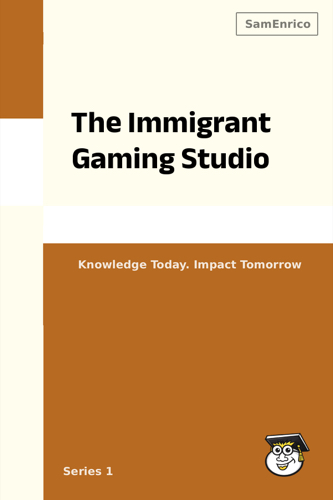
Non-FictionBiographyGame Development
The Immigrant Gaming Studio eBook
Follows a foreign-born game developer who built a
by Rupp Antione
Follows a foreign-born game developer who built a hit mobile game and studio.
Formats
Free sample
Chapter 1: The Version 2.0 Life...--The first time I realized I was playing a different game than everyone else, I was fourteen years old, standing in a cloud of humidity and cigarette smoke outside an internet café in Manila. The year was 2004. I had thirty minutes of prepaid time on a card I had saved for three weeks by skipping lunch. The dial-up tone screamed its mechanical apology. The connection failed.
The clock did not stop. Thirty minutes became twenty-eight, then twenty-five, while I watched a progress bar crawl across a CRT monitor like a dying insect.In my country, there were no refunds. No customer service number to call. No "we're sorry for the inconvenience." There was only the ticking clock and the knowledge that every minute wasted was a minute I could not get back. I learned something that day that would later become the foundation of a multimillion-dollar gaming studio: when resources are scarce, you stop complaining about the rules and start exploiting them.The man running the café saw me staring at the frozen screen.
He walked over, tapped the side of the monitor with his knuckle—a diagnostic technique that would have given any Western IT professional a seizure—and the connection resumed. He shrugged. "Sometimes you hit," he said. "Sometimes you wait."I wrote that phrase down in a notebook I still own. It is sitting on my desk as I type this chapter, the paper yellowed and the ink faded.
Sometimes you hit. Sometimes you wait. That is not a philosophy of resignation. It is a philosophy of probability. The immigrant understands that the game is never fair, but the game is always winnable if you are willing to play more moves than anyone else.The Education of a Version 2.0Let me explain what I mean by "Version 2.0." In software development, a version 2.0 is a rebuild.
It keeps the core functionality of version 1.0 but strips away the inefficiencies. It runs faster, crashes less, and does more with fewer resources. The immigrant is a version 2.0 of a person. We arrive in a new country with the same operating system—the same memories, the same accent, the same cultural reflexes—but we are forced to rebuild everything else. Our social network.
Our professional reputation. Our understanding of how to get a driver's license, open a bank account, negotiate a lease. We do all of this while speaking a language we learned from television and textbooks.The native-born founder, by contrast, is running version 1.0. They have never had to reinstall their entire identity. They have never had to learn that "let's grab coffee" means "I am not actually interested in coffee" or that "we should circle back" means "I have no intention of thinking about this again." They grew up with the source code of the culture already compiled in their heads.This sounds like a disadvantage.
It is. But it is also the greatest competitive advantage I have ever known.Let me give you a concrete example. In 2015, three years before I started building Last Bus, I attended a startup pitch event in San Francisco. I was not a founder yet. I was a data analyst on an H-1B visa, too afraid to even mention my side projects out loud.
I watched a twenty-two-year-old Stanford graduate pitch a mobile game about collecting virtual cats. He had a slide deck with forty-seven slides. He had a demo that crashed twice. He had a team of four designers, two engineers, and a community manager. He raised $2 million that night.I went home to my studio apartment—which I shared with a mattress on the floor and a laptop that overheated if I ran more than three tabs—and I built a prototype in one weekend.
It was ugly. It was broken. It was called Last Bus, and it was about the specific anxiety of missing the final bus home when you cannot afford a taxi.That prototype never crashed. Not because I was a better coder than the Stanford graduate. Because I could not afford for it to crash.
I tested it on three different devices. I ran the memory diagnostics manually. I treated every line of code like it might be the last line I ever wrote, because the alternative—building something that failed—meant going back to my day job and never trying again.The Stanford graduate is now a venture partner at a respectable fund. He is a good person. I do not begrudge him his success.
But he was playing a game with unlimited continues. I was playing a game with permadeath.The Scarcity Mindset as a Design Tool Here is something that most business books get wrong. They tell you that scarcity is a constraint to be overcome. They tell you to "think abundance" and "manifest success" and other phrases that sound profound in a TED Talk but mean nothing when you are staring at a negative bank balance at 2:00 AM.Scarcity is not a constraint. It is a design tool.When you have unlimited resources, you make different decisions than when you have limited resources.
This is not controversial. But what the business books do not tell you is that the decisions made under scarcity are often better than the decisions made under abundance.Consider the history of game design. Some of the most beloved games ever made—Tetris, Minecraft, Flappy Bird—were built by solo developers with almost no budget. Tetris was written on a Soviet computer with six kilobytes of RAM. Alexey Pajitnov did not have the luxury of adding particle effects or orchestral scores.
He had to make the core loop so addictive that you did not notice the absence of everything else.That is the scarcity mindset in action. When you cannot add features, you perfect the features you have. When you cannot buy users, you build a game that users want to share. When you cannot afford to fail, you test until failure is mathematically impossible.The immigrant founder operates in this mode permanently. Not because we are more virtuous or harder working than native-born founders.
Because we have no choice. The safety net that catches most entrepreneurs—family money, a spouse with a stable income, the option to move back home—does not exist for us. We are swinging from a rope we cut ourselves.The First Time I Saw the Seams There is a moment in every immigrant's life when they realize that the system they have entered is not a meritocracy. It is not a level playing field. It is a game with hidden rules, and the locals have been playing it since birth.My moment came in 2016, two years before I quit my day job.
I was working as a data analyst at a mid-sized tech company in Austin, Texas. My job was to look at spreadsheets and produce reports that no one read. I was good at it. I was also bored out of my mind.One day, a coworker showed me a mobile game he was playing. It was a freemium title with beautiful art, a compelling story, and a monetization system that seemed designed by a team of behavioral psychologists.…
This is the end of the free sample. Get the eBook to keep going. Buy now
About this book
Details
- Author
- Rupp Antione
- Publisher
- SamEnrico
- Language
- English
- Genre
- Non-Fiction, Biography, Game Development
- Released
- 2026-06-08
- Pages (approx.)
- 137
- Available as
- eBook, Audiobook

Read better in the ZLOADR app
Your eBooks on your phone or tablet. Sign in with your SamEnrico account and start reading.
More by Rupp Antione
 Leftover Reinvention GuideRupp Antione$11.99
 Social Security Caregiver GuideRupp Antione$11.99
 Loneliness in Accessible HousingRupp Antione$11.99
 SAD Versus Depression DiagnosisRupp Antione$11.99
 Grit for AccountantsRupp Antione$11.99
 Assumption Testing GuideRupp Antione$11.99
 Distraction Free Morning RoutineRupp Antione$11.99
 The Iron Fists of Pentridge: Australia's First Prison WarsRupp Antione$11.99
 Ragnarok’s Whisper: Odin’s Forgotten Lessons from the BifrostRupp Antione$11.99
 Service Providers Guide to Direct SalesRupp Antione$11.99
 How to Start a Agricultural Machinery Hire (without Operator) Business (Beginners Guide)Rupp Antione$11.99
 How to Produce Laundry BallsRupp Antione$11.99
You may also like
 Hong Kong Handover 1997Dunn Johnnie$11.99
 Zumba For Postnatal Recovery CourseNeal Christian$11.99
 Zumba for BeginnersLadner Nikia$11.99
 YouTube Comment Mining GuideHumes Pandora$12.99
 Worry Box MeditationCarlin Rudy$11.99
 Workplace Stress MeditationNguyen Lynn$11.99
 Workplace Stress and Sleep RepairHawley Ivory$11.99
 Workplace Perfectionism CureDelaney Jeffry$11.99
 Workplace Injustice Anger GuideWallen Isabelle$11.99
 Work Addiction and Burnout LinkGreenwood Ester$11.99
 Women in Yoga and WellnessBeattie Galina$11.99
 Women in Stand Up ComedyChun Evangeline$11.99