
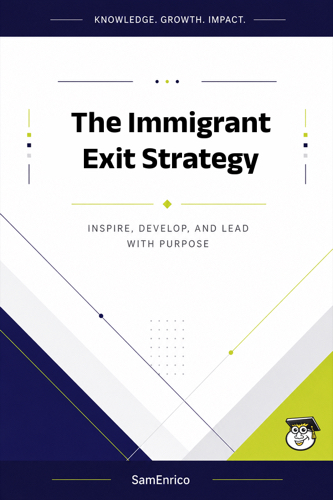
Non-FictionBiographyExit Strategy
The Immigrant Exit Strategy eBook
Details how a foreign-born founder built and sold
Details how a foreign-born founder built and sold a company for nine figures.
Formats
Free sample
Chapter 1: The 60-Day Death Clock...--The morning my H-1B visa termination letter arrived, I did not cry. I did not call my mother in Mumbai. I did not even tell my wife. Instead, I opened a spreadsheet and started calculating how many clients I would need to sign in the next fifty-nine days to make my side business into a real company. I was not brave.
I was not brilliant. I was simply out of options.Most founders begin their journey with a vision board, a pitch deck, and a venture capital term sheet. I began mine with a countdown timer on my phone and a legal pad full of questions I was afraid to answer. What happens if I incorporate while on a work visa? Can a foreigner own a Delaware C-Corp?
If my startup fails, do I get deported before or after I lose my savings? These are not the sexy questions of entrepreneurship. They are the immigrant's questions. And they are the reason this book exists.If you are holding this book because you are a foreign-born founder—or because you want to become one—you already know the feeling. It is the feeling of being a guest in the country where you are building your life.
Your status depends on a job. Your job depends on a visa. Your visa depends on an employer who can fire you tomorrow. And your dream of building a nine-figure company depends on navigating a legal system that was not designed for founders to exist.This chapter is about reframing that fear. Not eliminating it—fear is useful—but converting it from paralysis into propulsion.
The central argument of this book, and the first lesson you must internalize, is this: short, fixed deadlines are the best thing that can happen to a founder. The 60-day visa clock is not your enemy. It is your forcing function. It is the reason you will build a cash-flow-positive business while your native-born counterparts are still raising their first SAFE note and burning investor money on kombucha and ping-pong tables.I have seen this pattern play out again and again. The immigrant founder who knows she has sixty days to replace her job income signs her first client on day forty-eight.
The native founder with a two-year runway from family money spends the first six months "finding product-market fit" without actually selling anything. The immigrant founder incorporates as a Delaware C-Corp because her attorney warned her about the QSBS tax exclusion. The native founder starts as an LLC because it is easier, then pays millions in avoidable capital gains at exit. The constraints that terrify you are the same constraints that will make you rich.But let me be clear about what kind of constraints I am praising. This chapter introduces a framework we will use throughout the book: The Constraint Spectrum.The Constraint Spectrum: Fuel vs.
Friction Every constraint on a founder falls into one of two categories. Fuel constraints are short, fixed, transparent deadlines that you can see the end of. They force action, creativity, and prioritization. The 60-day visa clock is a fuel constraint. So is a 90-day customer pilot with a go/no-go decision.
So is a six-month runway before you run out of savings. These deadlines focus the mind. They eliminate the luxury of perfectionism. They make you sell before you are ready, which is the only way anyone ever sells anything.Friction constraints are the opposite. They are long, open-ended, controlled by someone else, and designed to create dependency.
The 24-month earn-out period after an acquisition (which we will cover in Chapter 8) is a friction constraint. So is an annual visa renewal with no guaranteed outcome. So is a "we will get back to you in six to eight months" from a government agency. These constraints do not clarify—they paralyze. They do not force action—they encourage waiting.
They do not build wealth—they transfer control to the person holding the deadline.The art of the immigrant exit strategy is converting friction constraints into fuel constraints wherever possible. You cannot eliminate all friction constraints—visa renewal is not optional—but you can structure your business and your exit to minimize them. The 60-day clock is already a fuel constraint. Use it. The earn-out can be renegotiated from time-based to milestone-based, which converts a friction constraint into a fuel constraint.
We will cover that in Chapter 8.For now, understand this: the visa clock is not your enemy. It is your first and most powerful fuel constraint. Now let us talk about how to use it.The Shadow Founder Trap: What Not to Do First Before I tell you how to incorporate legally on a visa, let me tell you how most immigrants do it wrong. They find a U.S. citizen friend, relative, or "business partner" who agrees to hold shares on their behalf.
The immigrant runs the company, makes all the decisions, and owns nothing on paper. The citizen is the "founder of record" for immigration and tax purposes. This is called a shadow founder arrangement, and it will destroy your exit.Here is why. When you go to sell your company for nine figures, the acquirer will conduct due diligence. They will ask for your cap table, your incorporation documents, and your shareholder registers.
When they discover that the person running the company for the last seven years does not legally own a single share, they will have two questions. First: "Is this legal?" (It is not.) Second: "Can we trust anything this founder has told us?" (They cannot.)I have seen this happen twice. The first founder had built a $40M logistics software company. His cousin, a U.S. citizen, held 100% of the shares.
When the acquirer discovered the arrangement during due diligence, they cut the offer from $40M to $12M—the value of the code and customer contracts, with zero premium for the founder's expertise. The founder could not argue because he was not legally the owner. He took the $12M, paid his cousin a finder's fee, and spent the next three years trying to get his green card through a different path.The second founder was luckier. He discovered the shadow founder trap before he incorporated. He restructured, put everything in his own name (legally, on a visa—we will cover how), and sold for $87M three years later.
The difference was not skill or market timing. It was legal structure.Do not be the first founder. There is no shortcut around owning your company. If you cannot legally own shares on your visa, you cannot build a company on that visa. Period.
Find another path—another visa category, another country, another co-founder arrangement that puts you on the cap table. But do not hide behind a citizen's name. That is not an exit strategy. That is an exit preclusion.The Legal Path: Incorporating as a Visa Holder Now for the good news. In most cases, you can legally incorporate and own shares of a Delaware C-Corporation while on an F-1 (OPT), H-1B, or O-1 visa.
The key is understanding what "active vs. passive" ownership means under immigration law.USCIS rules generally allow visa holders to own…
This is the end of the free sample. Get the eBook to keep going. Buy now
About this book
Details
- Author
- Wadsworth Mohamed
- Publisher
- SamEnrico
- Language
- English
- Genre
- Non-Fiction, Biography, Exit Strategy
- Released
- 2026-06-09
- Pages (approx.)
- 148
- Available as
- eBook, Audiobook

Read better in the ZLOADR app
Your eBooks on your phone or tablet. Sign in with your SamEnrico account and start reading.
More by Wadsworth Mohamed
 Future Self Visualization GuideWadsworth Mohamed$11.99
 CV 22 Osprey PilotWadsworth Mohamed$11.99
 Tina Reynolds Work PrisonsWadsworth Mohamed$11.99
 Cold Exposure for NumbnessWadsworth Mohamed$11.99
 Intrusive Thoughts OCD GuideWadsworth Mohamed$11.99
 Fear of Failure for Remote WorkersWadsworth Mohamed$11.99
 Do Not Disturb ProtocolWadsworth Mohamed$11.99
 Ashen Echoes: The Thera Cataclysm That Shaped CivilizationWadsworth Mohamed$11.99
 Gold and Glory: How Napoleon Bankrupted Europe to Fuel His WarsWadsworth Mohamed$11.99
 How to Produce Vehicle Steering Wheel LocksWadsworth Mohamed$11.99
 How to Start a Cooking Equipment for Commercial Catering (electric) Business (Beginners Guide)Wadsworth Mohamed$11.99
 How to Produce Landscape Pathway LightingWadsworth Mohamed$11.99
You may also like
 Hong Kong Handover 1997Dunn Johnnie$11.99
 Zumba For Postnatal Recovery CourseNeal Christian$11.99
 Zumba for BeginnersLadner Nikia$11.99
 YouTube Comment Mining GuideHumes Pandora$12.99
 Worry Box MeditationCarlin Rudy$11.99
 Workplace Stress MeditationNguyen Lynn$11.99
 Workplace Stress and Sleep RepairHawley Ivory$11.99
 Workplace Perfectionism CureDelaney Jeffry$11.99
 Workplace Injustice Anger GuideWallen Isabelle$11.99
 Work Addiction and Burnout LinkGreenwood Ester$11.99
 Women in Yoga and WellnessBeattie Galina$11.99
 Women in Stand Up ComedyChun Evangeline$11.99