
Non-FictionHealth & WellnessNutrition
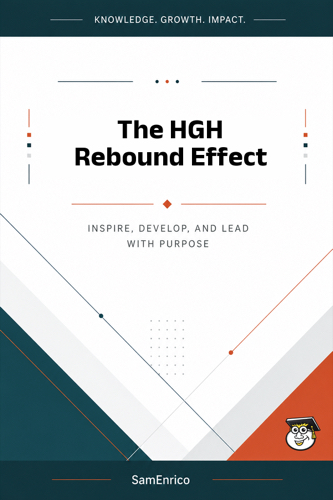
The HGH Rebound Effect eBook
Understand how carbohydrate restriction followed b
Understand how carbohydrate restriction followed by refeed can boost growth hormone.
Formats
Free sample
Chapter 1: The $100 Billion Lie--–- On a rainy Tuesday in Seattle, a 47-year-old software engineer named David did something he had not done in twelve years. He looked at himself in a full-length mirror without flinching. The man staring back had lost eighteen pounds of visceral fat, regained the sharp jawline of his thirties, and reported something his doctor found almost impossible to believe: his IGF-1 levels had increased by 40 percent without any pharmaceutical intervention. No injections. No peptides.
No $1,200 monthly clinic bills. Just three days of strategic carbohydrate restriction followed by two days of intentional refeeding, repeated in a cycle that mimicked the feast-famine rhythm human beings had followed for 99 percent of their evolutionary history.David’s story is not unique. It is not even rare. Over the past five years, a quiet rebellion has been taking place in the shadows of the $100 billion anti-aging industry—a rebellion built on a single, provocative question: What if everything we have been told about growth hormone decline is backward?This chapter will dismantle the foundational assumptions that have kept generations of men and women chasing the wrong solutions. You will learn why sleep optimization, high-intensity interval training, cold exposure, and expensive supplements are not enough—not because they are ineffective, but because they address the symptom rather than the cause.
You will discover the concept of the Rebound Effect, an evolutionary adaptation that your body already knows how to execute, waiting only for the right metabolic trigger. And you will be introduced to the 3+2 Protocol, a cyclical approach that will fundamentally change how you think about hormones, aging, and the relationship between scarcity and abundance.But first, we need to talk about the lie.The Silent Decline That Everyone Accepts Somatopause is the clinical term for something most people simply call "getting older." Beginning as early as the late twenties, the pituitary gland’s pulsatile release of growth hormone begins to decline. By age forty, the average person secretes approximately 40 percent less GH than they did at twenty. By age sixty, that number approaches 60 to 70 percent. This decline is so predictable, so universal, that the medical establishment has largely accepted it as an inevitable consequence of aging—like gray hair, like wrinkles, like the slow deceleration of a marathon runner who has simply run too many miles.But what if the marathon runner analogy is wrong?
What if the decline is not the result of mileage but of a specific set of metabolic conditions that can be reversed?Here is what the anti-aging industry does not want you to know. The decline in GH secretion is not primarily driven by a failure of the pituitary gland itself. The pituitary, that pea-sized master gland nestled at the base of the brain, remains perfectly capable of producing and releasing GH well into old age. Studies comparing pituitary function across age groups have consistently shown that the gland retains its synthetic capacity. The problem is not the factory; the problem is the signals reaching the factory.Think of your pituitary as a highly sophisticated manufacturing plant.
It has all the machinery, all the raw materials, all the skilled labor required to produce growth hormone. But the plant has a security system. It will only release its product when it receives the correct authorization codes. Those authorization codes come in the form of Growth Hormone-Releasing Hormone (GHRH) from the hypothalamus and the suppression of somatostatin, the hormone that puts the brakes on GH release.As we age, two things happen. First, the hypothalamus becomes less sensitive to the signals that should trigger GHRH release.
Second, and more critically, the metabolic environment becomes chronically flooded with two compounds that act as powerful suppressors of GH release: insulin and free fatty acids (FFAs). These two compounds are the biological equivalent of a factory lockdown. When insulin is high, somatostatin rises, and GH falls. When FFAs are high, they directly signal the pituitary to shut down production.The standard anti-aging approach—sleep more, exercise harder, take arginine, endure cold exposure—attempts to increase the demand for GH without addressing the suppression of GH. It is like trying to fill a bathtub with the drain wide open.
You can turn the faucet to maximum, but until you close the drain, the water level will never rise.Why Your $500 Monthly Supplement Stack Is Failing You Let us be specific about the failure modes of traditional GH optimization, because understanding why these methods fall short is essential to appreciating why the Rebound Effect succeeds.Sleep optimization is perhaps the most well-documented natural GH booster. During deep slow-wave sleep, the pituitary releases approximately 70 percent of its daily GH output. Sleep deprivation reliably reduces GH secretion. Therefore, improving sleep quality should increase GH levels. And it does—modestly.
Clinical studies show that optimizing sleep from poor to excellent increases nocturnal GH secretion by approximately 20 to 30 percent. This is not nothing. But it is also not a solution for someone whose baseline GH is suppressed by 60 percent due to metabolic factors.High-intensity interval training (HIIT) is another legitimate GH stimulus. Short bursts of all-out effort followed by brief recovery periods create a metabolic disturbance that triggers GH release, primarily through the accumulation of lactate and the associated drop in blood p H. A well-designed HIIT session can increase GH levels by 300 to 400 percent for a brief window of 30 to 60 minutes.
The problem is sustainability. That GH spike is transient, and it occurs in a metabolic environment that may still be dominated by high insulin and high FFAs. The spike is real, but it is a ripple on a turbulent sea.Cold exposure—ice baths, cold showers, cryotherapy—has gained popularity as a GH-boosting technique. The mechanism is plausible: cold stress activates the sympathetic nervous system, releases norepinephrine, and stimulates the pituitary. Acute cold exposure can double GH levels.
Again, the effect is temporary, and it does nothing to address the underlying metabolic suppression.Amino acid supplements, particularly arginine and ornithine, have been studied extensively for their GH-releasing effects. Intravenous arginine is a reliable GH stimulus. Oral arginine is less reliable, with studies showing inconsistent results, likely due to poor absorption and rapid metabolism. Even under optimal conditions, the effect is modest—perhaps a 30 to 60 percent increase lasting less than two hours.None of these methods are worthless. Combined, they might produce a meaningful improvement in GH status for someone who is already metabolically healthy.
But for the vast majority of adults over thirty—people with some degree of insulin resistance, elevated fasting insulin, and accumulated visceral fat—these methods are like throwing water on a house fire with a garden hose. They help, but they do not solve the problem.The problem is not low GH production. The problem is GH suppression. And suppression requires a different solution than stimulation.The Evolutionary Discovery That Changes Everything To understand the Rebound Effect, we must travel backward—not decades, not centuries, but millennia. We must understand the environment in which the human metabolic system evolved.For approximately 2.5 million years, human ancestors lived in conditions of oscillating food availability.
There were periods of relative abundance—after a successful hunt, during harvest seasons, when migrating animals passed through the territory. And…
This is the end of the free sample. Get the eBook to keep going. Buy now
About this book
Details
- Author
- Robbins Dixie
- Publisher
- SamEnrico
- Language
- English
- Genre
- Non-Fiction, Health & Wellness, Nutrition
- Released
- 2026-06-09
- Pages (approx.)
- 145
- Available as
- eBook, Audiobook

Read better in the ZLOADR app
Your eBooks on your phone or tablet. Sign in with your SamEnrico account and start reading.
More by Robbins Dixie
 The Argentine Immigrant SuccessRobbins Dixie$11.99
 Everyday Mindfulness MBSR GuideRobbins Dixie$11.99
 Instagram Reel Addiction WorkbookRobbins Dixie$11.99
 DoorDash Peak Hour Earnings GuideRobbins Dixie$11.99
 The Deep Blue Code: How the Ocean Almost Solved the InternetRobbins Dixie$11.99
 Understanding Melanoma Type 1Robbins Dixie$17.99
 Supply Chain Planning SkillsRobbins Dixie$12.99
 Notion Formulas For Project TrackingRobbins Dixie$12.99
 Rafting/canoeingRobbins Dixie$11.99
You may also like
 Hong Kong Handover 1997Dunn Johnnie$11.99
 Zumba For Postnatal Recovery CourseNeal Christian$11.99
 Zumba for BeginnersLadner Nikia$11.99
 YouTube Comment Mining GuideHumes Pandora$12.99
 Worry Box MeditationCarlin Rudy$11.99
 Workplace Stress MeditationNguyen Lynn$11.99
 Workplace Stress and Sleep RepairHawley Ivory$11.99
 Workplace Perfectionism CureDelaney Jeffry$11.99
 Workplace Injustice Anger GuideWallen Isabelle$11.99
 Work Addiction and Burnout LinkGreenwood Ester$11.99
 Women in Yoga and WellnessBeattie Galina$11.99
 Women in Stand Up ComedyChun Evangeline$11.99