
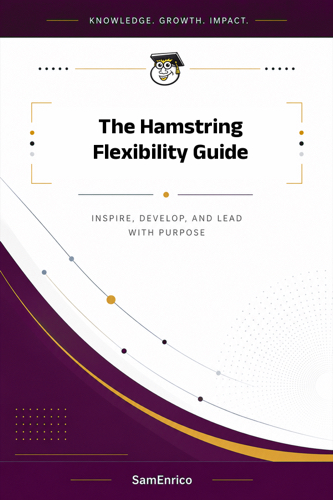
Non-FictionHealth & WellnessHamstrings
The Hamstring Flexibility Guide eBook
Targets tight backs of thighs for better mobility.
by Hyde Merle
Targets tight backs of thighs for better mobility.
Formats
Free sample
Chapter 1: The Hamstring Lie--–- You have been told a lie about your hamstrings. It is a lie repeated by well-meaning coaches, fitness influencers, and even some physical therapists. The lie sounds like this: Your hamstrings are tight because they are too short. You need to stretch them longer. This seems logical.
A rope that is too short cannot reach. A muscle that is too short cannot fully extend. So you stretch. You reach for your toes. You sit in forward folds.
You pull on a strap. And perhaps you gain a few inches of reach. But the tightness returns. Often, it returns within hours. Sometimes, it feels worse than before.
This is not because you are lazy or undisciplined. It is because you have been treating the wrong problem.The truth, revealed by decades of sports science research and clinical experience, is that chronically tight hamstrings are rarely a muscle length problem at all. They are a neurological protection response. Your nervous system has decided, for reasons we will explore in this chapter, that your hamstrings must remain braced, guarded, and shortened. Every time you try to lengthen them, your brain interprets that stretch as a threat—a potential tear—and reflexively contracts the muscle to stop you.
The tightness is not a flaw in your tissues. It is a feature of your nervous system's survival programming. And until you retrain that programming, stretching alone will never work.This chapter will reframe everything you think you know about your tight hamstrings. You will learn why modern life has turned a protective reflex into a chronic condition. You will discover the three primary drivers of hamstring tightness: the sitting epidemic, quadriceps overload, and neurological lock.
And you will complete a self-assessment that tells you, once and for all, whether your tightness is structural (genuinely short tissue requiring length-based work) or neurological (an overactive stretch reflex requiring nerve glides and tolerance training). By the end of this chapter, you will understand why your previous attempts at flexibility have failed—and why this book offers a completely different path forward.The 30% Solution: A 2021 Trial That Changes Everything In 2021, a research team published a study that should have shaken the fitness world. They took a group of office workers—people who sat for an average of eight hours per day and complained of chronic lower body fatigue and stiffness—and put them on a four-week hamstring intervention. The intervention was not extreme. It did not require hour-long yoga sessions or painful stretching routines.
It consisted of short, daily, targeted hamstring exercises totaling less than ten minutes per day.The results were remarkable. After four weeks, the participants reported a 30% reduction in lower body fatigue. They stood with better posture. They walked with less effort. They reported fewer episodes of lower back discomfort.
And their actual hamstring flexibility, measured by a straight leg raise test, increased by an average of 12 degrees.Here is what makes this study so important: the participants did not drastically change their sitting habits. They did not quit their desk jobs. They did not become marathon runners or yoga practitioners. They simply performed targeted hamstring work for a few minutes each day. Their tightness was not permanent.
It was not a genetic curse. It was a reversible adaptation to their environment.This book is built on that same premise. You do not need to overhaul your life. You do not need to spend hours stretching. You need to understand why your hamstrings are tight and then apply the specific interventions that address that cause.
For the office workers in the 2021 trial, the intervention worked because it targeted the neurological and postural drivers of tightness, not just the symptoms.Now, let us examine those drivers in detail.Driver #1: The Sitting Epidemic Human beings were not designed to sit for nine hours per day. Our bodies evolved for a life of varied movement: walking, squatting, climbing, reaching, and running. In that ancestral environment, the hamstrings functioned as powerful hip extensors and knee flexors. They worked in harmony with the glutes to propel the body forward, stabilize the pelvis during walking, and absorb shock during landing.Then came the chair.When you sit, your hips flex to 90 degrees. Your knees bend to 90 degrees.
Your hip flexors—the psoas and iliacus muscles on the front of your pelvis—shorten and become tonic (chronically active). Your hamstrings, attached to the sit bones (ischial tuberosities), are placed in a slackened, shortened position. They curl into a C-shape under your thighs. This is comfortable for a while. But after several hours, something insidious happens.Your nervous system begins to treat this shortened position as the new normal.
The muscle spindles—tiny stretch receptors embedded in your hamstring fibers—reset their baseline. What was once a neutral position (standing with straight legs) now feels like an extreme stretch. When you finally stand up at the end of the workday, your hamstrings reflexively resist lengthening. They have been trained, hour after hour, day after day, to stay short.This phenomenon is called adaptive shortening. It is not scar tissue.
It is not adhesions. It is your nervous system's remarkable ability to adapt to whatever position you spend the most time in. If you spend nine hours curled in a chair, your nervous system assumes that curled position is safe and any departure from it is dangerous.But there is a second, more subtle mechanism at play. Prolonged sitting also shortens and tightens the hip flexors. Tight hip flexors tilt the pelvis forward (anterior pelvic tilt), which places the hamstrings on a constant, low-grade stretch.
This paradoxical situation—hamstrings that are both shortened from sitting and stretched by a tilted pelvis—creates confusion in the nervous system. The hamstrings receive conflicting signals: "Stay short" from the seated position, but "You are being pulled long" from the anterior pelvic tilt. The nervous system resolves this conflict by tightening the hamstrings even further, locking them down as a protective measure.If you sit at a desk for work, drive a car for commuting, and then sit on a couch for evening relaxation, your hamstrings are under this conflicting input for twelve or more hours per day. It is no wonder they feel tight. They are doing exactly what your nervous system has asked them to do: brace for stability in an environment of conflicting postural demands.Driver #2: Quadriceps Overload The second driver of hamstring tightness is a muscle imbalance so common that most people never notice it.
Modern exercise patterns—and even modern walking on flat, hard surfaces—overdevelop the quadriceps (the muscles on the front of the thigh) while underusing the hamstrings and glutes.Consider how you walk on a flat sidewalk or treadmill. Your quadriceps fire to straighten your knee with each step. Your hamstrings, which would normally fire to decelerate the leg and pull it backward (hip extension), are largely passive. Now consider running. The quadriceps dominate knee extension.
Cycling? The quadriceps do most of the work on the downstroke. HIIT workouts? Squats, lunges, and box jumps are all quad-dominant movements. Even yoga, when practiced without attention to alignment, can become a quadriceps-heavy practice.The result is a predictable imbalance…
This is the end of the free sample. Get the eBook to keep going. Buy now
About this book
Details
- Author
- Hyde Merle
- Publisher
- SamEnrico
- Language
- English
- Genre
- Non-Fiction, Health & Wellness, Hamstrings
- Released
- 2026-06-07
- Pages (approx.)
- 147
- Available as
- eBook, Audiobook

Read better in the ZLOADR app
Your eBooks on your phone or tablet. Sign in with your SamEnrico account and start reading.
More by Hyde Merle
 Emotional Availability GuideHyde Merle$11.99
 Cash Runway CalculatorHyde Merle$11.99
 Persuasion for Political CampaignsHyde Merle$11.99
 The Rhodesian Double Cross: The Spy Who Betrayed a RevolutionHyde Merle$11.99
 Medical Admin AssistantHyde Merle$11.99
 How to Start a Bovine Hides and Skins Production From Knackers Business (Beginners Guide)Hyde Merle$11.99
 LinkedIn Headline for RecruitersHyde Merle$12.99
 Learn to Play the KomungoHyde Merle$11.99
You may also like
 Hong Kong Handover 1997Dunn Johnnie$11.99
 Zumba For Postnatal Recovery CourseNeal Christian$11.99
 Zumba for BeginnersLadner Nikia$11.99
 YouTube Comment Mining GuideHumes Pandora$12.99
 Worry Box MeditationCarlin Rudy$11.99
 Workplace Stress MeditationNguyen Lynn$11.99
 Workplace Stress and Sleep RepairHawley Ivory$11.99
 Workplace Perfectionism CureDelaney Jeffry$11.99
 Workplace Injustice Anger GuideWallen Isabelle$11.99
 Work Addiction and Burnout LinkGreenwood Ester$11.99
 Women in Yoga and WellnessBeattie Galina$11.99
 Women in Stand Up ComedyChun Evangeline$11.99