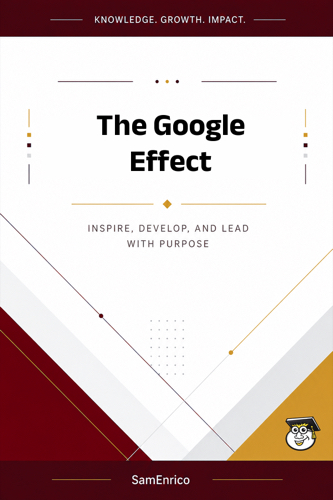
The Google Effect eBook
Understand how easy access to information changes
Understand how easy access to information changes memory and learning.
Formats
Free sample
Chapter 1: The Forgetting Reflex...--–- The dinner table had gone silent. Not the comfortable silence of a family eating together, but the eerie quiet of four humans who had just reached for their phones simultaneously. My nephew, age twelve, had asked a simple question: "Who was the twelfth president?" Instead of guesses, arguments, or that delightful moment when an older relative confidently says the wrong name and everyone laughs, we did what we always do. We Googled. The answer—Zachary Taylor—appeared on four screens in under four seconds.
We read it, nodded, and returned to our plates. No one remembered the answer ten minutes later. No one cared to.That night, I lay awake counting the phone numbers I could still recite from memory. My mother's cell? Yes.
My father's? He passed away three years ago, but yes, that one was burned in. My own office line? I had to think for a moment. My best friend since childhood?
No. I text him every day. Our phones have replaced the need for numbers. I could not recall his number, but I could find it in two thumb-swipes. My wife's number?
I hesitated for six seconds before it came to me. Six seconds. I have been married for eleven years.Something had changed. Not gradually, like the slow erosion of a coastline, but invisibly, like the way you cannot feel your hair grow. Somewhere between the first i Phone and the rise of Chat GPT, my memory had outsourced itself.
And I was not alone.This is not a book about how technology is making us stupid. That argument is boring, lazy, and largely false. The humans of 2026 are not less intelligent than the humans of 1996. We solve more complex problems, navigate more information, and communicate across greater distances than any generation before us. But we have traded one cognitive currency for another.
We have exchanged the what of knowledge for the where. We no longer remember facts; we remember how to find them. And that trade, as it turns out, comes with a hidden interest rate that most of us never saw coming.This chapter is about the discovery of that trade. It is about the first scientist who named the phenomenon, the experiments that proved it, and the quiet horror of realizing that your brain has been lying to you about what it still holds. It is about the moment you discover that you have been Googled.The Woman Who Forgot Her Mother's Number Let me introduce you to Sarah.
She is not a real person—or rather, she is a composite of dozens of people I interviewed while researching this book. But her story is true in the way that all aggregated stories are true. Sarah is thirty-four years old, a corporate lawyer in Chicago, married with two young children. She is successful, articulate, and by every measure, highly intelligent. She also cannot remember her mother's phone number.When I met Sarah in a coffee shop near her office, she laughed about this.
"I just say, 'Hey Siri, call Mom,'" she told me. "Why would I need to memorize it?" It was a reasonable question. I asked her to try anyway. She closed her eyes. Her lips moved silently.
After twenty seconds, she opened her eyes and said, "It starts with 773. That's the area code. Then… I think there's a 5? No. I honestly don't know."Then I asked her a different question.
"Where is the 'save' button in your email client?" She answered immediately. "Top right. It's a floppy disk icon. Third from the left." She described its exact location, its color (blue), and what happens when you hover over it (the word "Save" appears). She knew the location of a button she clicks dozens of times per day with perfect precision.
She did not know eleven digits that would connect her to the woman who raised her.This is the Google Effect in miniature. Your brain has not become worse at remembering. It has become exquisitely efficient at deciding what not to remember. And the primary criterion for deletion is simple: if information can be retrieved from an external source in under three seconds, your hippocampus—the seahorse-shaped structure deep in your brain responsible for forming new memories—will not bother encoding it.I call this The Forgetting Reflex.The Birth of a Phenomenon: 2011To understand how we got here, we need to travel back to 2011. Barack Obama was in his first term.
Osama bin Laden had been killed two months earlier. The i Phone 4S had just been released, and with it, Siri—the first voice assistant that made searching feel like conversation. And a young social psychologist at Columbia University named Betsy Sparrow published a paper that should have stopped us all cold.The paper was called "Google Effects on Memory: Cognitive Consequences of Having Information at Our Fingertips." It appeared in the journal Science, one of the most prestigious publications in the world. The finding was so counterintuitive that Sparrow herself was surprised by the results. She had not set out to prove that the internet was destroying memory.
She had simply wanted to understand how people adapt to new tools.What she found changed how we think about thinking.Sparrow and her colleagues ran four experiments. The first was deceptively simple. Participants typed forty trivia statements into a computer. Each statement was a fact that most people would not know—for example, "An ostrich's eye is bigger than its brain." Half of the participants were told that the computer would save everything they typed. The other half were told that their work would be erased.
Then, after a brief distraction, all participants were asked to recall as many facts as they could.The results were unambiguous. Participants who believed the computer had saved their work made almost no effort to remember. They performed significantly worse on the recall test. Participants who believed the facts would be erased remembered far more. The mere expectation of future access—not actual access, just the belief that the information was stored somewhere—was enough to trigger forgetting.Your brain, Sparrow discovered, is constantly asking a silent question: Do I need to keep this, or can I find it later?
When the answer is "I can find it later," the brain releases its grip on the memory. It is not laziness. It is efficiency. A brain that remembered everything would be paralyzed by the weight of its own data. Forgetting is not a bug; it is a feature.
The problem is that Google has become the most reliable "later" ever invented.The second experiment was even more revealing. Participants typed facts and were told that the computer would save them in specific folders—"Facts about animals," "Facts about history," and so on. Later, they were tested on both the facts themselves and the folders where each fact was stored. The result: participants forgot the facts but remembered the folders. They could tell you exactly where to find the information even if they could not tell you the information itself.Sparrow summarized it perfectly: "We are becoming experts at knowing where to find information, even as we forget the…
This is the end of the free sample. Get the eBook to keep going. Buy now
About this book
Details
- Author
- Grossman Garland
- Publisher
- SamEnrico
- Language
- English
- Genre
- Non-Fiction, Business Brief, Digital
- Released
- 2026-06-08
- Pages (approx.)
- 124
- Available as
- eBook, Audiobook

Read better in the ZLOADR app
Your eBooks on your phone or tablet. Sign in with your SamEnrico account and start reading.
More by Grossman Garland
 Elizabeth I Speechwriting ManualGrossman Garland$11.99
 Workplace Stress and Sabbatical PlanningGrossman Garland$11.99
 Vitamin D Emotional HealthGrossman Garland$11.99
 The Scipionic Gambit: Rome's Desperate Stand at ZamaGrossman Garland$11.99
 A Beginners Guide to Kinomichi (Volume 1)Grossman Garland$11.99
 Intercompany Transaction NettingGrossman Garland$12.99
 Business Process ExpertGrossman Garland$11.99
 How to Produce ArtworkGrossman Garland$11.99