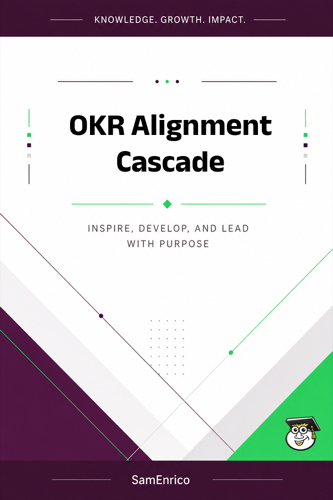
The Goal Cascade Method eBook
Connect company OKRs to department and individual
Connect company OKRs to department and individual goals seamlessly.
Formats
Free sample
Chapter 1: The Alignment Mirage--It was 10:47 on a Tuesday morning when the CEO of a $200 million software company—let’s call her Sarah—realized her organization was lying to itself.She had just finished the quarterly leadership review. Every department head had presented their numbers. Sales grew 12%. Engineering shipped 47 features. Marketing generated 3,000 new leads.
Customer support closed 92% of tickets within 24 hours. By any traditional measure, the company was thriving.And yet, for the fourth quarter in a row, the company had missed its top strategic priority: reducing enterprise customer churn.Sarah turned to her VP of Product. “Why are we still losing enterprise customers?”The VP pointed to the VP of Sales. “We’re selling to the wrong segments.”The VP of Sales pointed to the VP of Customer Success. “They’re not onboarding properly.”The VP of Customer Success pointed to the VP of Product.
“The product is missing key features they promised.”Round and round it went. Everyone was busy. Everyone had their own goals. Everyone was hitting their numbers. And yet, the company was failing at its most important objective.This is the alignment mirage.The Busyness Trap: Why Effort Is Not Progress The alignment mirage is one of the most deceptive and expensive problems in modern management.
It looks like progress. It feels like productivity. But it produces the opposite of what organizations actually need: coherent, coordinated movement toward a shared destination.Here is the brutal truth that most leaders discover too late: being busy is not the same as being effective.In Sarah’s company, every department was working hard. Engineers pulled late nights. Salespeople made hundreds of calls.
Marketers launched campaigns. But because their efforts were not aligned around the same strategic objective, they were effectively pulling in different directions. The engineering team was building features for small businesses while the sales team was chasing enterprise deals. The support team was measured on ticket closure rates while customers needed deep technical troubleshooting. Everyone was rowing.
No one was rowing together.The cost of this misalignment is staggering. According to a Harvard Business Review study of over 500 organizations, employees spend an average of 40% of their time on low-priority tasks that do not directly contribute to strategic objectives. That is two full days per week. Two days of effort that looks like work, feels like work, but does not move the needle.Worse, a Mc Kinsey survey of 1,200 executives found that the average company has ten times more strategic initiatives than it can actually complete. Ten times.
Leaders say they have ten priorities; they have capacity for one. The result is a phenomenon called “initiative bloat”—a slow death by a thousand projects, none of which receive the focus or resources they need to succeed.Sarah’s company had fifteen active strategic initiatives. They had the resources for perhaps three. The other twelve were zombies—undead projects that consumed time and attention but produced no real outcomes. No one wanted to kill them because someone, somewhere, had championed them.
So they lingered. And the company continued to miss its most important goal.The Waterfall Lie: How Traditional Cascading Breaks Everything How does this happen? How do smart, well-intentioned leaders end up with organizations that are simultaneously busy and misaligned?The answer lies in a deeply flawed but widely accepted model of goal-setting: top-down cascading.Here is how traditional cascading works in most organizations. The CEO and executive team gather for an annual or quarterly offsite. They emerge with a set of high-level strategic goals.
These goals are then “cascaded” down to the next level: VPs are told to create sub-goals that support the CEO’s goals. Those sub-goals are cascaded to directors. Directors cascade to managers. Managers cascade to individual contributors.On paper, this seems logical. Strategy flows from top to bottom.
Every level supports the level above. In practice, the cascade fails in three predictable and catastrophic ways.Failure 1: Context Loss The first failure is the most subtle and the most destructive. It is called context loss.When the CEO sets a goal, they have a rich mental model of why that goal matters. They know about the market pressures, the investor concerns, the competitive threats, the customer feedback. They have read the reports, sat through the briefings, absorbed the nuance.But by the time that goal reaches the front lines—the individual contributor writing code, answering support tickets, or assembling products—the “why” has disappeared.
Each layer of cascading strips away context. The VP translates the CEO’s goal into a metric. The director translates the metric into a project. The manager translates the project into tasks. The individual contributor gets a task with no understanding of its strategic purpose.Here is what that looks like in practice.
The CEO says: “We need to reduce enterprise churn because our largest customers are leaving due to slow support response times.” That is a rich, contextual statement. It contains the what (reduce churn), the why (customers are leaving), and the mechanism (slow support).By the time that goal reaches the customer support agent, it has become: “Close 50 tickets per day.” The agent has no idea that their real job is to keep enterprise customers from leaving. They just know they need to hit a number. So they close easy tickets quickly and escalate hard ones. The hard ones are often from enterprise customers.
The enterprise customers get frustrated. They leave. The agent hit their number. The company failed its goal.This is context loss. And it is the single greatest enemy of alignment.Failure 2: The Ownership Vacuum The second failure of traditional cascading is the ownership vacuum.When goals are handed down from above, teams do not own them.
They rent them. There is a profound psychological difference between “I chose to do this” and “I was told to do this.” When a team rents a goal, they will do exactly what they are told—no more, no less. When a team owns a goal, they will problem-solve, adapt, and push beyond the minimum.In Sarah’s company, the VP of Product was told to “improve product adoption.” He rented that goal. He created a project plan, assigned tasks, and tracked completion. But when adoption metrics did not improve, he did not feel a personal responsibility to figure out why.
He had done what he was told. The failure was not his; it was the plan’s.By contrast, when a team chooses their goals in response to a strategic challenge, they feel accountable for the outcome. They ask different questions: “What are we missing?” “Who else needs to be involved?” “What assumption might be wrong?” Ownership transforms compliance into commitment.Failure 3: Silos and Local Optimization The third failure is the most visible and the most painful: silos.When each department cascades goals independently, they optimize for their own metrics at the expense of the whole organization. The engineering team is measured on “features shipped,” so they ship features—even if those features do not address customer needs. The sales team is measured on “revenue closed,” so they chase any deal—even if those deals bring in the wrong customers.
The support team is measured on “ticket closure rate,” so they close tickets fast—even if customers remain frustrated.Each team, acting…
This is the end of the free sample. Get the eBook to keep going. Buy now
About this book
Details
- Author
- Jenkins Alfred
- Publisher
- SamEnrico
- Language
- English
- Genre
- Non-Fiction, Self-Help, Alignment
- Released
- 2026-06-09
- Pages (approx.)
- 140
- Available as
- eBook, Audiobook

Read better in the ZLOADR app
Your eBooks on your phone or tablet. Sign in with your SamEnrico account and start reading.
More by Jenkins Alfred
 Engineering Imagination BlueprintJenkins Alfred$11.99
 Growth Mindset For PerfectionistsJenkins Alfred$11.99
 Outsourcing for Customer SupportJenkins Alfred$11.99
 Creative Team Warm UpJenkins Alfred$11.99
 Autonomous Vehicles LogisticsJenkins Alfred$11.99
 Assertiveness for Sexual BoundariesJenkins Alfred$11.99
 Mindfulness Journal for BeginnersJenkins Alfred$11.99
 The Phantom of Dettingen: Prussia's Ghostly GambitJenkins Alfred$11.99
 Merlin’s Lost Apprentice: The Forgotten Sorcerer of AvalonJenkins Alfred$11.99
 The Essential Guide to Hip-hopJenkins Alfred$11.99
 Scorzonera: Black Root VegetableJenkins Alfred$11.99
 How to Start a Art Supply Store BusinessJenkins Alfred$11.99