
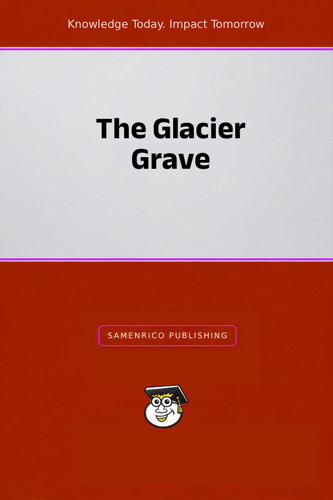
Non-FictionTrue CrimeCold Case
The Glacier Grave eBook
Documents the 70-year mystery of a man who walked
Documents the 70-year mystery of a man who walked into the ice field and was never seen again, until his boot melted out.
Formats
Free sample
Chapter 1: The Thing in the Ice...--The sun had not yet touched the Rupal Face when Karim Ali first saw the boot.It was late August on Nanga Parbat, which meant the monsoon had already scraped itself raw against the southern flanks of the Himalayas and collapsed into a thin, exhausted drizzle. The sky above the glacier was the color of old bone—pale, streaked, indifferent. Karim had been walking this moraine since he was twelve years old, first as a porter carrying loads for foreign expeditions, later as a certified high-altitude guide with a laminated card in his wallet and a satellite phone in his pack. He knew the Rupal Glacier the way a carpenter knows the grain of his workbench. He knew where the crevasses opened in spring and where they healed shut by autumn.
He knew which boulders were stable and which would roll. He knew the smell of the ice when it was dying.And the ice was dying.He could feel it through the soles of his boots—a softness, a give, where there had once been the unyielding hardness of permanent frost. The glacier was retreating faster than his father had ever seen, faster than his grandfather's stories had ever warned. Each year, the terminal moraine—that great bulldozed heap of rock and debris marking the glacier's historic edge—lay fifty meters farther down-valley, stranded and irrelevant, like a shoreline abandoned by a retreating sea. The ice itself had pulled back into the shadows of the mountain, leaving behind a landscape of raw, grey bedrock that had not seen sunlight for ten thousand years.
It was, Karim thought, like watching a corpse decompose in fast-forward.He was leading three Austrian trekkers that day—a middle-aged couple and their adult son, all wearing matching expedition jackets and the slightly dazed expressions of people who had paid a great deal of money to be moderately uncomfortable. They had flown into Skardu two days earlier, driven for six hours on roads that were barely more than ledges, and were now huffing their way across the lower Rupal Glacier at 4,200 meters, taking photographs of everything and understanding nothing. Karim did not resent them. They were the reason he could afford to send his daughter to university in Islamabad. But he also did not expect them to notice anything unusual about the landscape.
They did not know how the glacier was supposed to look. They had no memory of the ice.He stopped to let them catch their breath, leaning against a house-sized boulder of gneiss that had been carried down from the Diamir Face sometime in the nineteenth century. The trekkers collapsed onto a flat rock, uncorking water bottles and fanning themselves with their hats. Karim looked west, toward the snout of the glacier, where the ice ended in a jagged wall of dirty white and the meltwater river emerged, milky with ground-up rock, to begin its long journey to the Indus. And that was when he saw it.Something dark.
Something that did not belong.It was half-buried in the silt of the newly exposed moraine, maybe fifty meters beyond the current ice edge, in a zone that had been covered by glacier until the previous summer. At first glance, Karim thought it was a piece of old expedition trash—an abandoned gas canister, perhaps, or a torn chunk of a tent. The mountain was littered with such things. Climbers came, climbed, and left behind their debris like offering. But as he walked closer, his boots crunching on the angular shards of freshly fractured rock, the shape resolved into something else.It was a boot.A single leather boot, high-cut, brown, with the stitching still visible along the seams.
It was lying on its side, half-sunk into a bed of grey glacial silt, as if someone had taken it off and set it down gently. The leather was dark with moisture but otherwise intact—supple, even. Karim knelt beside it. The trekkers had noticed his movement and were watching from a distance, their cameras now pointed at him instead of the mountain.He reached out and touched the boot. The leather was cold and slick, like the skin of a fish.
He hooked his fingers inside the opening and lifted.It was heavy.Heavier than an empty boot should be.He turned it over, and something shifted inside with a dull, dry sound—the sound of stones knocking together, but softer, more organic. He looked into the boot's opening and saw, in the dim light filtered through the leather, the pale gleam of bone. A complete set of foot bones, still articulated, still connected by desiccated tendon and the mummified remnants of flesh. A wool sock, hand-knitted, with a darned repair at the heel, still encased the bones. The sock was brown with age but the knit pattern was still visible—a simple rib stitch, the kind a grandmother might make on winter evenings.Karim set the boot down carefully.
He did not scream. He did not run. He had been working in the mountains for thirty-six years, and he had seen death before—the frozen bodies of climbers who had fallen, the bleached bones of porters who had been buried in avalanches, the empty camps of expeditions that had never come home. But he had never seen a body emerge from the ice like this. He had never held a dead man's foot in his hand.He looked up at the glacier snout, at the dirty ice that was weeping water in a thousand tiny streams, and he understood, in a way he had not fully understood before, that the mountain was giving up its dead.
The ice was melting. And whatever had been buried inside it was coming out.The Archaeology of Ice The discovery that launched the modern field of glacial archaeology happened not in the Himalayas but in the Alps, on September 19, 1991, when two German hikers, Erika and Helmut Simon, decided to take a slight detour from the normal route across the Hauslabjoch pass on the Austrian-Italian border. They were not looking for a body. They were looking for a quicker path to the Similaun hut, where they had reserved beds for the night. What they found instead was a corpse sprawled face-down in a shallow gully, the upper body exposed by summer melt, the lower body still frozen in the ice.They assumed it was a modern climber.
The equipment suggested otherwise: a copper axe, a leather quiver of arrows, a pair of birch-bark containers, and shoes stuffed with grass for insulation. The body was so well preserved that the skin still had wrinkles. The eyes were closed. The mouth was slightly open, as if the man had died in the middle of a word.Radiocarbon dating would later reveal that the man—dubbed Ötzi after the Ötztal Alps where he was found—had died approximately 5,300 years earlier, during the Copper Age. He had been murdered.
An arrowhead lodged in his left shoulder had severed a major artery, and he had bled to death on a mountain pass at 3,200 meters, where the cold had frozen his body within hours. The ice…
This is the end of the free sample. Get the eBook to keep going. Buy now
About this book
Details
- Author
- Deaton Krystina
- Publisher
- SamEnrico
- Language
- English
- Genre
- Non-Fiction, True Crime, Cold Case
- Released
- 2026-06-06
- Pages (approx.)
- 145
- Available as
- eBook, Audiobook

Read better in the ZLOADR app
Your eBooks on your phone or tablet. Sign in with your SamEnrico account and start reading.
More by Deaton Krystina
 Recurring Dreams and RelationshipsDeaton Krystina$11.99
 Stress Allergic Response GuideDeaton Krystina$11.99
 Loneliness Texting BoundariesDeaton Krystina$11.99
 Mentorship for Visual ArtistsDeaton Krystina$11.99
 Crucial Conversations GuideDeaton Krystina$11.99
 Zumba Confidence for Shy DancersDeaton Krystina$11.99
 Road Rage JournalingDeaton Krystina$11.99
 Notarbartolo ConfessionDeaton Krystina$11.99
 The Great Barbie Backlash: Dolls, Dollars, and Cultural WarsDeaton Krystina$11.99
 Maui's Fishhook: The Birth of the PacificDeaton Krystina$11.99
 Whispers of the Last Great Forest: The Silent Rebellion of the PenanDeaton Krystina$11.99
 The Mineral Guide to StilbiteDeaton Krystina$11.99
You may also like
 Hong Kong Handover 1997Dunn Johnnie$11.99
 Zumba For Postnatal Recovery CourseNeal Christian$11.99
 Zumba for BeginnersLadner Nikia$11.99
 YouTube Comment Mining GuideHumes Pandora$12.99
 Worry Box MeditationCarlin Rudy$11.99
 Workplace Stress MeditationNguyen Lynn$11.99
 Workplace Stress and Sleep RepairHawley Ivory$11.99
 Workplace Perfectionism CureDelaney Jeffry$11.99
 Workplace Injustice Anger GuideWallen Isabelle$11.99
 Work Addiction and Burnout LinkGreenwood Ester$11.99
 Women in Yoga and WellnessBeattie Galina$11.99
 Women in Stand Up ComedyChun Evangeline$11.99