
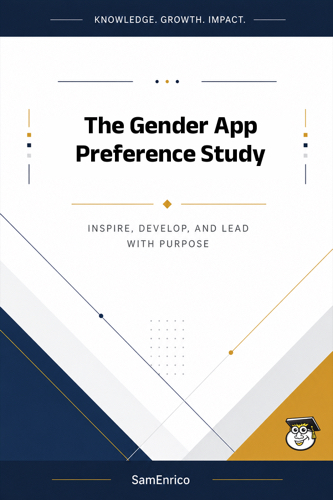
The Gender App Preference Study eBook
Differences in gaming, social, and lifestyle app u
Differences in gaming, social, and lifestyle app usage.
Formats
Free sample
Chapter 1: The Pink Tax Trap–- In 2018, a mid-sized mobile game studio called Fabled Pixel burned through $12 million of venture capital on a single bet: that women would flock to a city-builder “designed just for them.” They added pastel color palettes, replaced gritty textures with smooth gradients, and inserted customizable avatars with flowing hair and floral crowns. They changed the icon from a sword to a butterfly. They called it Aether Gardens.The launch day was a disaster.Not because women don’t like city-builders. They do. Sim City and Cities: Skylines have millions of female players.
The problem was that Fabled Pixel had painted a male-coded skeleton in pink nail polish. The core mechanics remained aggressively agentic: zero-sum resource competition, ruthless expansion, leaderboards that punished kindness, and a combat system that forced players to raid neighbors or be raided. The studio had assumed that “female-friendly” meant softer colors, not softer systems. Within three weeks, female retention had cratered by 40 percent. Male retention, never strong, fell even faster—because the men who did enjoy agentic city-builders found the pastel aesthetic infantilizing.Aether Gardens was quietly shuttered six months later.
The post-mortem blamed “insufficient female demand.” But the real failure was not demand. It was a framework.That framework—the belief that gender differences in app usage boil down to superficial preferences for colors, avatars, or “ladylike” mechanics—has cost the industry billions. It has also blinded developers to a far more interesting truth. The differences between how men and women use gaming, social, and lifestyle apps are real. But they are not about pink and blue.
They are about two fundamental motivational axes that run through every human being: the drive to compete, achieve, and control (what this book calls agentic motivation) and the drive to connect, care, and curate (communal motivation). These axes are not binary. They are not fixed by biology. And they certainly do not align neatly with the gender binary that most app designers still carry around like a faded map to a country that never existed.This chapter lays the groundwork for everything that follows. It dismantles the lazy binary that has dominated app design for a decade.
It introduces the agentic-communal framework that will replace it. And it makes a promise that the rest of the book will keep: by the final chapter, you will understand not just that men and women use apps differently, but why—and, more importantly, how to build apps that serve both without betraying either.The Myth of the Universal User For most of app history, designers operated under a quiet, unexamined assumption: the default user was a young, urban, technically literate man with disposable income and uninterrupted leisure time. This “universal user” had certain tastes. He liked competition. He tolerated or enjoyed violence.
He valued efficiency over aesthetics. He discovered apps through forums and expert reviews. And he spent money to win.When women showed up in usage data—usually in categories like social media, shopping, or puzzle games—they were treated as a niche. A special interest group. A demographic to be “targeted” with separate products, separate marketing, and separate (almost always smaller) budgets.
This segmentation seemed logical. After all, women and men do show different aggregate patterns. The 2025 Newzoo Global Gamer Study found that while 76 percent of women and 83 percent of men play games, women are overrepresented in simulation, puzzle, and social casino genres, while men dominate first-person shooters and real-time strategy. On social media, women spend 40 percent more time on image-heavy platforms like Instagram and Pinterest; men spend 30 percent more time on text-heavy forums like Reddit and X. In lifestyle apps, women use period trackers and meal planners at three times the rate of men.These differences are not imaginary.
The mistake has been to treat them as essential—as if women’s brains are wired for puzzles and men’s for shooting. That error has produced two toxic outcomes. First, it has led to the “shrink it and pink it” approach that sank Aether Gardens: superficial cosmetic changes that leave underlying mechanics untouched. Second, it has created a valuation hierarchy where agentic genres (strategy, FPS, competitive sports) are treated as “core” or “hardcore,” while communal genres (simulation, life management, social deduction) are dismissed as “casual” or “female.” This hierarchy is not neutral. It determines where venture capital flows, which studios acquire which talent, and ultimately what kinds of apps get built.The result is a market failure.
Communal genres are systematically underfunded, not because they are unprofitable—Stardew Valley has sold over 20 million copies, Animal Crossing: New Horizons moved 40 million—but because they are undervalued. And that undervaluation begins with a misunderstanding of what gender differences actually mean.What Gender Differences Are Not Before we can build a better framework, we must clear away three persistent myths.Myth One: Gender differences are about biology, not socialization. This is the “hardwired” theory: men evolved as hunters, so they like first-person shooters; women evolved as gatherers, so they like farming simulators. The evidence does not support this. Cross-cultural studies show that gender gaps in app usage shrink dramatically in societies with greater economic equality and less rigid gender roles.
In Iceland, for example, the gap between men’s and women’s preference for competitive vs. cooperative games is half that of the United States. In Scandinavia, women play first-person shooters at nearly the same rate as men—but they report doing so secretly at lower rates, because the social stigma is weaker. If biology were destiny, these cultural variations would not exist.Myth Two: Gender differences are universal across age and context. They are not.
As Chapter 3 will show in detail, young users (18–30) show much smaller gender gaps than older users, because they have grown up with more fluid gender norms and because they prioritize time efficiency (which compresses behavioral differences). In the Global South, where multiple family members share a single smartphone, gender gaps are often reversed or erased entirely by access constraints. The idea that “women prefer X, men prefer Y” is always qualified by which women, where, and at what age.Myth Three: Gender differences mean men and women want different apps. This is the most damaging myth because it leads directly to the segmentation trap. The truth is subtler: men and women often want the same app outcomes—entertainment, connection, status, relief from boredom—but they want to achieve those outcomes through different paths.
A man and a woman playing the same mobile game may both want to feel competent. The man may seek competence through leaderboard position (agentic path). The woman may seek it through mastering a complex crafting system (communal path). The game that offers both paths serves both players. The game that offers only one loses half its potential audience.These three myths have persisted because they are convenient.
They allow developers to build one kind of app (agentic, competitive, violent) and then blame “female preferences” when women don’t show up. They allow investors to fund what they already understand. And they allow the industry to avoid the harder work of designing for motivational diversity.Introducing the Agentic-Communal Framework This book replaces the gender binary with a binary of a…
This is the end of the free sample. Get the eBook to keep going. Buy now
About this book
Details
- Author
- Renteria Anamaria
- Publisher
- SamEnrico
- Language
- English
- Genre
- Non-Fiction, Consumer Mind Report, Gender
- Released
- 2026-06-06
- Pages (approx.)
- 143
- Available as
- eBook, Audiobook

Read better in the ZLOADR app
Your eBooks on your phone or tablet. Sign in with your SamEnrico account and start reading.
More by Renteria Anamaria
 Born Standing Up MemoirRenteria Anamaria$11.99
 Cognitive Restructuring MDDRenteria Anamaria$11.99
 Foster Care Therapy CouchRenteria Anamaria$11.99
 Failure Resilience for TeensRenteria Anamaria$11.99
 Arachne's Web: The Weaver Who Defied the GodsRenteria Anamaria$11.99
 Multiple Domain StrategyRenteria Anamaria$12.99
 Interim CTO GuideRenteria Anamaria$12.99
 The Breeder's Guide to Romeldale SheepRenteria Anamaria$11.99
 Park InterpreterRenteria Anamaria$11.99
 How to Become a Oven OperatorRenteria Anamaria$11.99