
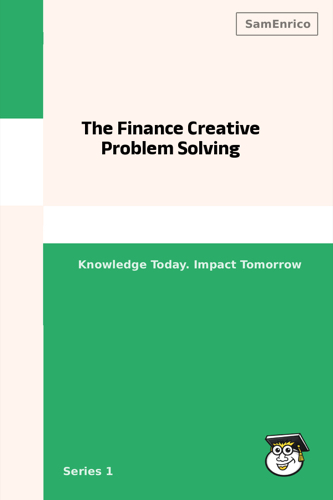
The Finance Creative Problem Solving
Innovate in budgeting, forecasting, and capital al
by Tan Lonna
Innovate in budgeting, forecasting, and capital allocation using non-financial analogies.
Formats
About this book
Free sample
Chapter 1: The Garden Audit--–- Every February, the CFO of a $2 billion retail chain did something she never told the board about. She took the annual budget—347 pages, three months of work, blessed by every department head, signed off by the CEO—and she drew a single line through the middle of it. Not because the numbers were wrong. Because they were already obsolete.The budget had been finalized in November. Between then and February, a competitor had launched a price war, a supplier had gone bankrupt, and a Tik Tok video featuring one of their products had unexpectedly gone viral, creating demand nobody had forecast.
The annual budget, that sacred document, was about as useful as a weather forecast from last season.She didn't throw it away entirely. That would have been career suicide. Instead, she did something quieter: she reallocated. She took 10 percent of the operating budget—money that had been assigned to a legacy catalog mailer that nobody under forty had ever opened—and moved it into a "Tik Tok shop" experiment run by two interns. She took another 5 percent from a trade show that had lost 40 percent of its attendance and put it into a buy-now-pay-later pilot.
She didn't ask permission. She just did it. Then she reported the results three months later: 18 percent higher marketing ROI on the same total spend.The board never asked how she did it. They just praised her "strong quarter."This chapter is for that CFO. And for every finance professional who has ever looked at an annual budget and thought: This was dead the moment we printed it.The Factory That Never Was Traditional budgeting treats the organization like a factory.
A factory has fixed inputs, predictable outputs, scheduled maintenance, and a production line that runs the same way every day. If you run a factory, you know roughly how many units you will produce next month, how much raw material you will need, and when your machines will need servicing. The factory model works beautifully for repetitive, predictable, low-variance environments.But your company is not a factory.Your company is…
This is the end of the free sample. Get the eBook to keep going. Buy now
Contents
- Chapter 1
- Chapter 2
- Chapter 3
- Chapter 4
- Chapter 5
- Chapter 6
- Chapter 7
- Chapter 8
- Chapter 9
- Chapter 10
- Chapter 11
- Chapter 12
Details
- Author
- Tan Lonna
- Publisher
- SamEnrico
- Language
- English
- Genre
- Non-Fiction, Self-Help, Finance
- Released
- 2026-06-07
- Pages (approx.)
- 159
- Available as
- eBook, Audiobook

Read better in the ZLOADR app
Your eBooks on your phone or tablet. Sign in with your SamEnrico account and start reading.
More by Tan Lonna
 Self Hypnosis For Grief Processing GuideTan Lonna$11.99
 Iranian Bahai EscapeTan Lonna$11.99
 Spouse Cancer Grief GuideTan Lonna$11.99
 Work Addiction And HobbiesTan Lonna$11.99
 The Ruler Dream ArchetypeTan Lonna$11.99
 Body Sanctuary VisualizationTan Lonna$11.99
 Dreams About Baby SiblingsTan Lonna$11.99
 The Last Stand of the Iron Lady: Thatcher’s 1984 Miners’ Strike ShowdownTan Lonna$11.99
 The Last Telegram: The Day the Cold War Almost Went HotTan Lonna$11.99
 Mozart’s Fire: The Genius Who Defined an EraTan Lonna$11.99
 Retail Store Credit Building GuideTan Lonna$12.99
 SAM Registration For Minority Owned FirmsTan Lonna$12.99
You may also like
 The OKR for Finance TeamsStratton Jed$11.99
 Financial Confidence HypnosisStanley Jean$11.99
 Workaholism in FinanceMattos Dorathy$11.99
 Workaholism and Financial SuccessLeone Queen$11.99
 Venture Capitalist StressRatcliff Delcie$11.99
 The Financial Presentation GuideClanton Abe$11.99
 Senior Financial Self EsteemCotton Arminda$11.99
 Investment Banker Stress GuideNiles Freeda$11.99
 Financial Stress of Terminal IllnessHouck Mitchel$11.99
 Financial Abundance ScriptsMurdock Eugenie$11.99
 Daily Review for Financial AdvisorsLilley Vanna$11.99
 Remote Financial Advising CommunicationChapin Broderick$11.99