
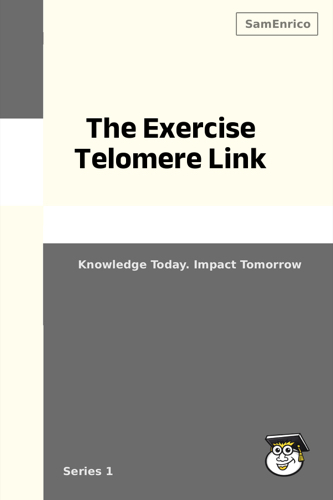
Non-FictionHealth & WellnessExercise
The Exercise Telomere Link eBook
Physical activity that preserves telomere length.
Physical activity that preserves telomere length.
Formats
Free sample
Chapter 1: The Twin Experiment...--–- In 1999, a pair of identical twin sisters walked into a research lab in Seattle. They were forty-three years old, shared the same DNA, had grown up in the same house, attended the same schools, and even married men from the same small town in Washington State. On paper, they were biological duplicates. But when the researchers drew their blood and measured their telomeres—the protective caps at the ends of their chromosomes—the results were astonishing. One sister had telomeres typical of a thirty-five-year-old.
The other had telomeres closer to a sixty-year-old. Same genetics. Same upbringing. But a twenty-five-year difference in biological age. The researchers asked the obvious question: what was different about their lives?
The answer changed everything we understand about aging, exercise, and the human body's capacity for renewal.This single study—part of a larger longitudinal project that would eventually follow over 1,200 twin pairs—revealed a truth that the medical establishment had resisted for decades: your chronological age, the number of candles on your birthday cake, is a lie. A convenient fiction. A administrative convenience for census takers and insurance adjusters. But your biological age, the actual state of your cells, tissues, and organs, tells a completely different story. And the single most powerful variable separating the younger twin from the older twin was not genetics, not luck, not some expensive supplement or secret clinic in Switzerland.
It was movement. Specifically, it was the type, intensity, and consistency of physical activity that each sister had pursued across her adult life. The younger-telomere twin had walked briskly for forty-five minutes nearly every day, had taken up light resistance training in her thirties, and had never missed more than a week of exercise in two decades. The older-telomere twin had been sedentary for most of her adult years, believing that "moderation" meant occasional weekend walks and that aging was simply inevitable.This book exists because that twin study was not an anomaly. Over the past twenty years, since Elizabeth Blackburn and her colleagues won the Nobel Prize for discovering telomerase, the scientific literature has produced thousands of studies examining how lifestyle factors affect telomere length.
And a clear pattern has emerged: exercise is the single most powerful non-pharmaceutical intervention for preserving and, in some cases, modestly lengthening telomeres. But—and this is crucial—not all exercise is created equal. The wrong kind of exercise, performed at the wrong intensity, with insufficient recovery, can actually shorten your telomeres faster than being sedentary. The right kind of exercise, performed strategically, can turn back the cellular clock. This chapter will establish the fundamental framework for everything that follows: what biological age actually means, why telomeres are the most accurate biomarker we have, and how the twin study became the cornerstone of a revolution in our understanding of aging.The Great Deception of Chronological Age Before we dive into telomeres, telomerase, and the molecular machinery of aging, we need to confront a basic assumption that most of us never question.
When someone asks you how old you are, you answer with a number. Forty-seven. Fifty-two. Thirty-eight. That number comes from a calendar, from the earth's orbit around the sun, from the arbitrary division of time into years.
But your cells do not know what year it is. Your mitochondria do not count birthdays. Your chromosomes do not check a calendar before deciding to divide or die. Chronological age is a social construct, not a biological reality. And treating it as if it were the latter has caused incalculable harm to human health.Consider two fifty-year-old men.
One runs marathons in under four hours, has a resting heart rate of fifty-two beats per minute, takes no medications, and reports feeling energetic and vital. The other is sedentary, takes blood pressure medication and a statin, experiences chronic back pain, and reports feeling "old" and tired. If you met both men, you would never guess they were the same age. Yet our healthcare system treats them identically: annual physicals, age-based screening recommendations, and a default assumption that decline is inevitable. This is the tyranny of chronological age.
It flattens individual variation into a statistical average and convinces millions of people that feeling terrible is normal because "that's what happens when you get older."The Whitehall II study, which followed over ten thousand British civil servants for more than three decades, quantified this variation. Researchers measured biological age using multiple biomarkers: telomere length, epigenetic clocks, inflammatory markers, and metabolic health. They found that among people with the same chronological age, biological age varied by as much as twenty years. A sixty-year-old in the top decile of health had a biological age of forty-eight. A sixty-year-old in the bottom decile had a biological age of seventy-seven.
These were not outliers. They were the rule. The study also identified the strongest predictors of a younger biological age: regular physical activity, adequate sleep, a diet rich in whole foods, and low levels of chronic stress. Genetics explained only about twenty percent of the variance. Lifestyle explained the rest.This is either terrifying or liberating, depending on your perspective.
Terrifying because it means that your habits have consequences that most people never see or measure. Liberating because it means you are not a prisoner of your birth certificate. You have agency. You can change your biological age. And the most powerful tool you have for doing so is not a pill, not a supplement, not a genetic therapy—it is the strategic application of physical activity.
That is what this book will teach you.What We Talk About When We Talk About Aging Before we can understand how exercise affects telomeres, we need to understand what aging actually is at the cellular level. Most people think of aging as a single process: getting older, feeling slower, accumulating wrinkles and aches. But aging is not one thing. It is a constellation of interconnected processes that unfold across different timescales and biological systems. In 2013, a landmark paper in the journal Cell proposed nine "hallmarks of aging"—the fundamental biological processes that drive age-related decline.
These include genomic instability (damage to your DNA), epigenetic alterations (changes in how your genes are expressed), loss of proteostasis (misfolded proteins accumulating in your cells), mitochondrial dysfunction (your cellular power plants losing efficiency), and cellular senescence (cells that have stopped dividing but refuse to die, becoming inflammatory and toxic to surrounding tissue). Telomere attrition—the shortening of your chromosome caps—is one of the nine hallmarks, but it is not the only one. And here is where most popular books on aging get it wrong: they treat telomeres as if they are the whole story. They are not. But they are uniquely valuable as a biomarker because they integrate information from almost all of the other hallmarks.Think of telomere length as the dashboard of your biological age.
When your mitochondria are dysfunctional, you produce more reactive oxygen species (we will return to these in Chapter 2), which directly damage telomeres. When your cells become senescent, they secrete inflammatory signals that suppress telomerase, the enzyme that rebuilds telomeres. When your epigenetic landscape shifts, it changes how your telomere-related genes are expressed. When…
This is the end of the free sample. Get the eBook to keep going. Buy now
About this book
Details
- Author
- Byrne Arlinda
- Publisher
- SamEnrico
- Language
- English
- Genre
- Non-Fiction, Health & Wellness, Exercise
- Released
- 2026-06-05
- Pages (approx.)
- 154
- Available as
- eBook, Audiobook

Read better in the ZLOADR app
Your eBooks on your phone or tablet. Sign in with your SamEnrico account and start reading.
More by Byrne Arlinda
 WFH Meal Prep Time SavingByrne Arlinda$11.99
 The Comparison and Body DysmorphiaByrne Arlinda$11.99
 Remote Team Communication GuideByrne Arlinda$12.99
 Financial Stress Medication ManagementByrne Arlinda$11.99
 The Phantom of Prague: The Case of the Vanishing Witnesses (1990s)Byrne Arlinda$11.99
 How to Become a Panel InstallerByrne Arlinda$11.99
 Partner Relations ManagerByrne Arlinda$11.99Remote Team Communication GuideByrne Arlinda$12.99
 Learn to Play the VeenaByrne Arlinda$11.99
You may also like
 Hong Kong Handover 1997Dunn Johnnie$11.99
 Zumba For Postnatal Recovery CourseNeal Christian$11.99
 Zumba for BeginnersLadner Nikia$11.99
 YouTube Comment Mining GuideHumes Pandora$12.99
 Worry Box MeditationCarlin Rudy$11.99
 Workplace Stress MeditationNguyen Lynn$11.99
 Workplace Stress and Sleep RepairHawley Ivory$11.99
 Workplace Perfectionism CureDelaney Jeffry$11.99
 Workplace Injustice Anger GuideWallen Isabelle$11.99
 Work Addiction and Burnout LinkGreenwood Ester$11.99
 Women in Yoga and WellnessBeattie Galina$11.99
 Women in Stand Up ComedyChun Evangeline$11.99