
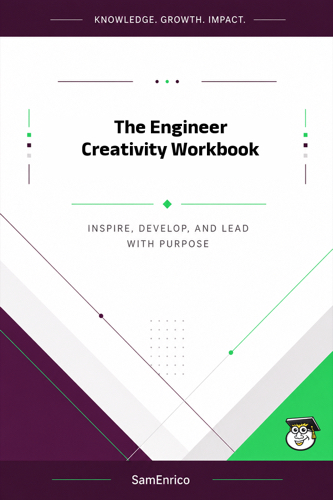
The Engineer Creativity Workbook eBook
Practice creative exercises focused on mechanical,
by Doe Shaneka
Practice creative exercises focused on mechanical, electrical, and software engineering challenges.
Formats
Free sample
Chapter 1: The Wrong Answer--–- You are staring at a blank page. Not an exam booklet with four neat questions and a three-hour time limit. Not a problem set with well-defined inputs and a single correct output. A blank page. The prompt, if you can call it that, is vague to the point of uselessness: "Move a 10-pound box 10 feet across a room."That's it.
No specifications. No constraints. No right answer.Your engineering education has not prepared you for this. Every exam you aced, every problem set you completed, every equation you derived—all of it trained you for a world that does not exist. In school, every problem has a correct solution.
In the real world, every problem has a thousand possible solutions, and the only wrong answer is the one you never consider because you stopped thinking too soon.This chapter is about unlearning the most damaging lesson that engineering school taught you: that being wrong is failure. In reality, being wrong is the fastest path to being right. And being afraid of being wrong is the fastest path to being平庸.The Exam Hall Lie You know the feeling. The clock is ticking. You read the problem, recognize the pattern, apply the formula, arrive at the answer.
Clean. Certain. Correct. That feeling is addictive. It is also a lie.Real engineering problems do not look like exam problems.
No client hands you a perfectly worded specification with all the necessary data and a single unambiguous output. No safety board asks you to "solve for x" when x is clearly labeled. No manufacturing crisis arrives with a neat box for your final answer.Real engineering looks like this: a customer complaint that three different technicians cannot reproduce; a production line shutting down with an error message that nobody has ever seen; a budget cut that eliminates your primary material with two weeks to redesign; a regulatory change that invalidates six months of work.These problems have no single correct answer. They have trade-offs. They have unknowns.
They have constraints that contradict each other. And the engineers who succeed in this chaos are not the ones who find the right answer fastest. They are the ones who generate the widest range of possibilities before committing to a path.The exam hall trained you to converge—to narrow down to one answer as quickly as possible. The real world requires you to diverge first—to expand outward into possibility space, to entertain absurd solutions, to delay judgment until you have exhausted your imagination. The most creative engineers are not the ones who are never wrong.
They are the ones who are wrong faster, who generate more bad ideas, who fail more quickly and learn more deeply.The Speed of Wrong Here is a surprising truth from the research literature on creative problem-solving: the most innovative engineers and designers generate roughly five times as many ideas as their less creative peers before selecting a solution. They do not have better ideas initially. They have more ideas. And because they have more ideas, they have a higher chance of encountering a genuinely novel solution.This is not speculation. This is measured, replicated, and taught at the world's most innovative design firms.
IDEO, the company that designed the first Apple mouse, does not start brainstorming with judgment. They start with Post-it notes—hundreds of them—each containing a single idea, no matter how absurd. They generate first. They evaluate later. The evaluation phase is brutal.
But it comes after the generation phase, not during it.The speed of wrong is the speed of learning. Every bad idea you generate and discard teaches you something about the problem space. It reveals an assumption you were making. It uncovers a constraint you didn't know existed. It illuminates a physical principle you hadn't considered.
The engineer who generates twenty bad ideas in ten minutes knows more about the problem than the engineer who generated one good idea in the same time—because the first engineer has explored twenty paths, while the second has walked only one.This is the first law of creative engineering: You cannot find the good ideas without going through the bad ones. The bad ideas are not obstacles to creativity. They are the raw material of creativity. They are the coal that, under pressure, becomes diamond.The Einstellung Trap There is a famous experiment in cognitive psychology. Researchers gave expert chess players a position from a game and asked them to find the best move.
The position was carefully constructed so that a familiar pattern suggested a strong move—but an even stronger, less obvious move existed. The expert players almost always chose the familiar move. They could not see the better option because their past experience blocked it.This is the Einstellung effect (German for "attitude" or "set"). Your previous solutions become mental ruts. The deeper the rut, the harder it is to climb out.
The more expertise you have in a domain, the more vulnerable you are to this effect—because you have more ruts.Engineers are exquisitely vulnerable to the Einstellung effect. You have solved hundreds of problems before. Each solution carved a neural pathway. Those pathways are efficient. They are also blinding.
When a new problem resembles an old one, your brain automatically reaches for the old solution. The old solution might be good. But it is almost never the best—because the best solution requires seeing the problem differently, and your brain is actively preventing you from seeing differently.The only known way to break the Einstellung effect is to force yourself to generate solutions that violate your own assumptions. You must deliberately consider absurd, impossible, ridiculous approaches. Not because you will implement them.
Because they will disrupt the neural ruts long enough for a novel solution to emerge.This chapter's exercise is designed to break your Einstellung effect. It will feel uncomfortable. It will feel like a waste of time. That discomfort is the feeling of your brain resisting change. Push through it.The Anatomy of a Bad Idea What makes an idea "bad"?
Usually, it violates a constraint that you assume is fixed. But many of those constraints are not actually fixed. They are habits. They are conventions. They are "the way we've always done it." And violating them is precisely how breakthroughs happen.Consider the following "bad ideas" for moving a 10-pound box across a room:Bad idea #1: Train ants to carry it.Violated assumption: The mover must be large.Hidden principle: Distributed load-bearing.
Many small agents can collectively transport an object that no single agent could move. This principle appears in swarm robotics, parallel computing, suspension bridges, and organizational design.Bad idea #2: Use a magnetic explosion.Violated assumption: Force must be applied continuously.Hidden principle: Impulsive force. A brief, intense force can overcome static friction and initiate motion using far less energy than continuous application. This principle appears in impact wrenches, pile drivers, and some spacecraft docking mechanisms.Bad idea #3: Wait for the floor to tilt.Violated assumption: The mover must act on the box.Hidden principle: Potential energy conversion. Raising the box stores gravitational potential energy, which converts to kinetic energy when released.…
This is the end of the free sample. Get the eBook to keep going. Buy now
About this book
Details
- Author
- Doe Shaneka
- Publisher
- SamEnrico
- Language
- English
- Genre
- Non-Fiction, Self-Help, Engineering
- Released
- 2026-06-06
- Pages (approx.)
- 148
- Available as
- eBook, Audiobook

Read better in the ZLOADR app
Your eBooks on your phone or tablet. Sign in with your SamEnrico account and start reading.
More by Doe Shaneka
 Cortisol Body Damage GuideDoe Shaneka$11.99
 Egyptian Copt EscapeDoe Shaneka$11.99
 Jet Lag Dream JournalingDoe Shaneka$11.99
 Business Credit Utilization GuideDoe Shaneka$12.99
 The Neemuch Mutiny StoryDoe Shaneka$11.99
 Labyrinth Walking PracticeDoe Shaneka$11.99
 Workaholism Recovery For ExecutivesDoe Shaneka$11.99
 Toys In Dream AnalysisDoe Shaneka$11.99
 Mosul Dam EngineerDoe Shaneka$11.99
 Whispers of the Silk Road: A Family’s Journey Through TimeDoe Shaneka$11.99
 The Unseen Symphony: How a Blind Pianist Conquered the WorldDoe Shaneka$11.99
 The Phantom Gold: The 1976 Olympic Boycott and the Forgotten ChampionsDoe Shaneka$11.99
You may also like
 Relationship Building for EngineersGetz Cordie$11.99
 Dreaming for Engineering DesignKline Sharee$11.99
 Constraints for EngineersSlaughter Birgit$11.99
 Emotional Intelligence For EngineersWorth Zina$11.99
 Personal Branding for EngineersKimmel Cletus$11.99
 Failure Fear in EngineeringSpalding Richard$11.99
 TRIZ Problem SolvingMcdade Refugio$11.99
 NVC for EngineersCrump Krysta$11.99
 Workaholism in EngineeringHughes Derrick$11.99
 Fear of Failure for EngineersSchott Charline$11.99
 Engineering Student StressBurris Trinh$11.99
 Engineer Imposter SyndromeMoreau Melodee$11.99