
Non-FictionSelf-HelpDisability
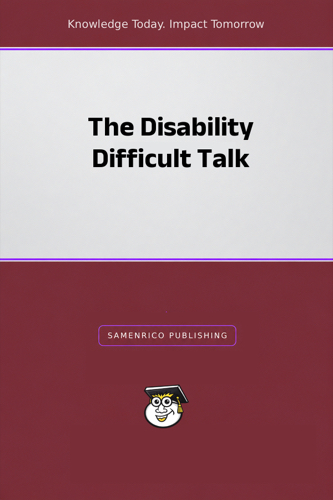
The Disability Difficult Talk eBook
Discuss accommodations, needs, or accessibility re
by Beale Andera
Discuss accommodations, needs, or accessibility respectfully.
Formats
Free sample
Chapter 1: Unlearning the Script...–- Most people freeze. Not because they are cruel, not because they don't care, but because they have been handed a script for how to talk about disability—and that script is wrong. It tells them to look away, to whisper, to offer pity disguised as kindness, or to say nothing at all. This chapter deconstructs that script and hands you a new one.The Moment of Silence Imagine you are standing in an elevator. The doors open, and a person using a wheelchair rolls in.
You have approximately four seconds before something happens. In those four seconds, a battle rages inside your head: Should I say something? Should I smile? Should I offer to press the button? What if I say the wrong thing?
What if I say nothing and seem rude? What if I say something and seem condescending?Most people choose silence. Not hostile silence—anxious silence. The kind of silence that comes from a genuine fear of messing up. You tell yourself, Better to say nothing than to offend.
And on the surface, that seems reasonable. Polite, even.But here is the problem that this entire book will challenge: Silence is not neutral. When you avoid talking about disability altogether, you are not being polite. You are participating in a system that treats disability as unspeakable, as taboo, as something to be hidden or pitied. And that silence?
It is louder than any clumsy word you could ever utter.This chapter is called "Unlearning the Script" because before we can learn how to talk about disability well, we must first identify and discard the bad scripts we have been given. These scripts come from movies, news stories, charity commercials, and even well-meaning teachers and parents. They are so deeply embedded in our culture that we often do not recognize them as scripts at all. We think we are being kind. We think we are being empathetic.
But too often, we are being something else entirely.We are performing pity disguised as admiration.Inspiration Porn: The Most Dangerous Script of All In 2012, the late Australian comedian and activist Stella Young gave a TEDx talk that would change the way many people think about disability representation. The title was simple: "I'm not your inspiration, thank you very much." In that talk, she coined a term that has since become foundational to disability discourse: Inspiration Porn.Let us be very clear about what this term means, because it is often misunderstood. Inspiration porn is not about finding genuine inspiration in someone's achievements. If a disabled athlete wins a gold medal, and you are inspired by their years of training, discipline, and skill—that is not inspiration porn. That is normal human admiration for excellence.Inspiration porn is something different.
It is the portrayal of disabled people as inspirational simply for existing while disabled. It is the viral video of a teenager with Down syndrome asking his date to prom, shared with the caption "This will restore your faith in humanity." It is the news story about a wheelchair user who "bravely" went grocery shopping by herself. It is the friend who tells you, "I don't know how you do it. I could never handle what you go through."Here is what makes these moments so damaging: they reduce a disabled person's entire existence to a prop for your emotional edification. You are not seeing them.
You are seeing a symbol of your own gratitude that your life is not that hard.Stella Young put it this way: "We are not trying to make you feel inspired. We are trying to get to work, buy groceries, and live our lives."Let us break down the mechanics of inspiration porn so you can recognize it when you see it.First, inspiration porn requires a baseline assumption of tragedy. You cannot be inspired by a disabled person going about their day unless you secretly believe that being disabled is so terrible that any ordinary act becomes extraordinary. The message embedded in that viral video is not "What a lovely moment between two teenagers." The embedded message is "Look at this poor disabled kid who managed to find love despite his condition." That is not celebration. That is condescension wrapped in a warm blanket.Second, inspiration porn is always about the nondisabled viewer's feelings, never about the disabled person's actual life.
Ask yourself: who is the intended audience of that "inspirational" Facebook post? It is not disabled people. Disabled people do not need to be reminded that they exist. The audience is nondisabled people who want to feel good about themselves for being moved. The disabled person in the video becomes a tool for someone else's emotional journey.Third, inspiration porn erases systemic barriers.
When you frame a disabled person's success as a triumph of individual will, you never have to ask why the world is so hard for them in the first place. You never have to think about the lack of ramps, the inaccessible transit, the employers who won't hire them, the doctors who don't believe them. Individual inspiration is cheap. Structural change is expensive. Guess which one our culture prefers?Pity vs.
Empathy: The Critical Distinction Now that we have named the problem, let us draw a line that will serve as a compass for the rest of this book. The line is between pity and empathy.These two words are often used interchangeably, but they are opposites in practice.Pity looks at a disabled person and thinks, How sad. How unfortunate. I am glad that is not me. Pity is a feeling of sorrow for someone else's presumed suffering.
It is a feeling about them that keeps you separate from them. Pity says, "You are broken, and I feel sorry for you." Pity requires a power imbalance: the person feeling pity is above, the person receiving pity is below. Pity changes nothing. It is an emotion that costs you nothing and gives the other person nothing except the heavy weight of being seen as a tragedy.Empathy looks at a disabled person and thinks, I see the barriers you face. I want to understand what those barriers feel like.
What can be done to remove them? Empathy is not about feeling sorry for someone. It is about trying to understand their experience without centering your own emotions. Empathy says, "The world is not built for you, and that is a problem all of us need to solve." Empathy requires humility and listening. It costs you the comfort of looking away.
But it can lead to real change.Here is a concrete example to make this distinction stick.Imagine you see a colleague using a cane, and they mention that they had to take a different route to the meeting because the elevator was broken.The pity response: "Oh, you poor thing. That must be so hard for you. I don't know how you manage. You are so brave."The empathy response: "That sounds frustrating. The broken elevator is a real problem.
I will mention it to building management. Is there anything that would make the meeting space more accessible for you going forward?"Do you feel…
This is the end of the free sample. Get the eBook to keep going. Buy now
About this book
Details
- Author
- Beale Andera
- Publisher
- SamEnrico
- Language
- English
- Genre
- Non-Fiction, Self-Help, Disability
- Released
- 2026-06-07
- Pages (approx.)
- 134
- Available as
- eBook, Audiobook

Read better in the ZLOADR app
Your eBooks on your phone or tablet. Sign in with your SamEnrico account and start reading.
More by Beale Andera
 Joy of SolitudeBeale Andera$11.99
 Feature Parity Mapping GuideBeale Andera$11.99
 Pension Loss Job TransitionBeale Andera$11.99
 Self Esteem and Difficult CoworkersBeale Andera$11.99
 Five Kingdoms Timeline ChartBeale Andera$11.99
 Public Speaking for ClergyBeale Andera$11.99
 Improv for LeadersBeale Andera$11.99
 The Lost Heir of Blackwood: A Victorian Amnesia EnigmaBeale Andera$11.99
 Silk & Sabotage: The War of the Parisian CouturiersBeale Andera$11.99
 How to Produce Computer Inverter BoardsBeale Andera$11.99
 A Collector's Handbook to the Talbot 14Beale Andera$11.99
 Overtime Pay Rules for First ManagersBeale Andera$12.99
You may also like
 Hong Kong Handover 1997Dunn Johnnie$11.99
 Zumba For Postnatal Recovery CourseNeal Christian$11.99
 Zumba for BeginnersLadner Nikia$11.99
 YouTube Comment Mining GuideHumes Pandora$12.99
 Worry Box MeditationCarlin Rudy$11.99
 Workplace Stress MeditationNguyen Lynn$11.99
 Workplace Stress and Sleep RepairHawley Ivory$11.99
 Workplace Perfectionism CureDelaney Jeffry$11.99
 Workplace Injustice Anger GuideWallen Isabelle$11.99
 Work Addiction and Burnout LinkGreenwood Ester$11.99
 Women in Yoga and WellnessBeattie Galina$11.99
 Women in Stand Up ComedyChun Evangeline$11.99