
Non-FictionSelf-HelpJournaling
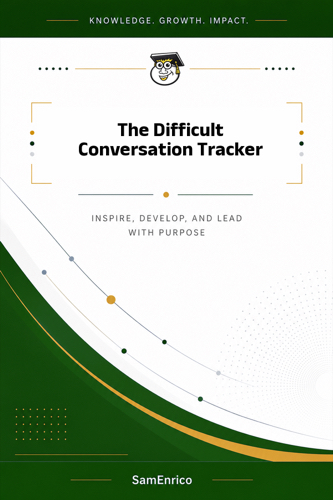
The Difficult Conversation Tracker eBook
Journal for logging challenging talks, outcomes, a
Journal for logging challenging talks, outcomes, and lessons for continuous improvement.
Formats
Free sample
Chapter 1: The Pre-Mortem Hypothesis--–- The first time Elena sat down to prepare for a difficult conversation, she did what most people do. She rehearsed her opening line seventeen times in the shower. She imagined her boss’s possible objections and crafted clever rebuttals. She practiced her “calm but firm” face in the bathroom mirror until her jaw ached. Then she walked into the meeting, delivered her perfectly rehearsed opening, and watched her boss’s eyes go cold and defensive within seven seconds.
The conversation lasted forty-five minutes. Nothing changed. Elena left feeling exhausted, slightly humiliated, and completely convinced that the problem was her boss—a man she privately described as “emotionally allergic to feedback.”Here is what Elena did not do. She did not ask herself: Why am I dreading this conversation? She did not wonder: What is this really about, beneath the surface?
And most critically, she did not consider the possibility that her carefully rehearsed opening—which she thought was about “a missed deadline”—was actually about something entirely different. She was fighting a fact battle. Her boss was fighting an identity war. Neither of them knew it. The conversation was doomed before Elena said a single word.This chapter introduces the single most important pre-conversation practice in this book: the pre-mortem hypothesis.
It is a deceptively simple exercise that takes ten minutes and will save you hours of frustration, weeks of resentment, and the uniquely awful feeling of being right but still losing. The pre-mortem is borrowed from project management, where teams imagine a project has already failed and then work backward to find the cause. Applied to difficult conversations, it asks you to imagine the conversation has already gone badly—and then to identify why before you even begin.But here is the crucial nuance that most advice gets wrong. The pre-mortem is not a prediction. It is not a verdict.
It is a hypothesis—a temporary, testable guess about what is really driving your anxiety. You are not trying to be right. You are trying to become aware. Because until you know what kind of conversation you are actually having, you will keep using the wrong tools for the wrong job. And that, more than anything else, is why difficult conversations fail.The Three Conversations You Didn’t Know You Were Having To understand the pre-mortem hypothesis, you first need to understand a framework that comes from the Harvard Negotiation Project, specifically the work of Douglas Stone, Bruce Patton, and Sheila Heen in their landmark book Difficult Conversations.
They discovered that beneath nearly every difficult conversation, there are not one but three separate conversations happening simultaneously. Most people only see the surface conversation. The masters see all three.The first is the “What Happened?” conversation. This is the fight over facts. Who said what.
Who did what. Who is right and who is wrong. Who started it. Who is to blame. This is where most people instinctively go because it feels safe and concrete.
You can argue about a deadline, a budget number, a missed email, or a specific phrase someone uttered. The problem is that the “What Happened?” conversation is almost never the real problem. It is the decoy.The second is the “Feelings” conversation. This is the emotional reality underneath the facts. Every difficult conversation has an emotional dimension, whether you acknowledge it or not.
You might feel disrespected, ignored, anxious, guilty, or afraid. The other person might feel the same. The “Feelings” conversation asks: Are my emotions valid? Do I have permission to feel this way? Will I be punished for expressing what I actually feel?
Most people suppress this conversation entirely. They pretend to be purely rational. And then their suppressed emotions leak out as sarcasm, passive aggression, or sudden explosions.The third is the “Identity” conversation. This is the quietest and most powerful of the three. It asks: What does this conversation say about me?
Am I a good person? Am I competent? Am I worthy of respect? Am I a pushover? Am I a bully?
The Identity conversation is the one you have with yourself, often without realizing it. It is the voice in your head that whispers, “If I don’t win this argument, everyone will think I’m weak.” Or, “If I admit I made a mistake, that means I’m a failure.” Or, “If I apologize, I’m betraying myself.” Identity conversations are high-stakes because they threaten your sense of self. And when your identity feels threatened, your brain’s fight-or-flight response activates. You stop listening. You stop reasoning.
You start surviving.Here is the devastating truth: most people walk into a difficult conversation thinking they are having a “What Happened?” conversation. They prepare facts, timelines, and evidence. They rehearse their logical arguments. Then they open their mouths, and within sixty seconds, they are drowning in Feelings and Identity issues they never saw coming. They wonder why the other person is being “so emotional” or “so defensive” or “so irrational.” The answer is not that the other person is broken.
The answer is that you were playing chess while they were playing a completely different game.Why the Pre-Mortem Works (And What It Is Not)The pre-mortem solves this problem by forcing you to name your assumptions before the conversation locks them in. You sit down with your journal—or a blank page—and you ask yourself a single question: If this conversation goes badly, what will be the cause?But you do not answer superficially. You do not write, “Because they are difficult.” That is not a cause; that is a judgment. You dig deeper. You ask the pre-mortem questions in sequence.First: What am I absolutely certain about regarding this situation?
List every fact you believe to be true. Be specific. “They missed the deadline.” “They said they would do X and they did Y.” “I have an email proving I’m right.” Write it all down.Second: What am I feeling about this situation? Do not censor yourself. Write the raw emotion.
“I feel angry because I worked late to meet my deadline and they didn’t.” “I feel scared that if I don’t say something, this will keep happening.” “I feel hurt because I thought we were a team.” Name it.Third: What is at stake for me here? This is the Identity question. “If I don’t speak up, I am a doormat.” “If I do speak up and they get angry, I am a troublemaker.” “If I apologize, I am admitting I was wrong, and that means I’m not as competent as I think.” Write the worst-case identity fear.Now you have a hypothesis. You believe the conversation is about a fact (the missed deadline). You feel angry.
And your identity is tied to not being seen as a doormat. This is your starting hypothesis.But here is the critical move that separates the pre-mortem from mere worry. You then ask: What might I be wrong about? Not “What am I wrong about?”—you do not know that yet. But what might you be missing?
What would a neutral observer see that you cannot see? Could the other person have a different interpretation of the…
This is the end of the free sample. Get the eBook to keep going. Buy now
About this book
Details
- Author
- Willoughby Bernarda
- Publisher
- SamEnrico
- Language
- English
- Genre
- Non-Fiction, Self-Help, Journaling
- Released
- 2026-06-09
- Pages (approx.)
- 147
- Available as
- eBook, Audiobook

Read better in the ZLOADR app
Your eBooks on your phone or tablet. Sign in with your SamEnrico account and start reading.
More by Willoughby Bernarda
 Email Folder Structure GuideWilloughby Bernarda$11.99
 Recovery From Burnout JournalWilloughby Bernarda$11.99
 Bidis and Kretek Cessation GuideWilloughby Bernarda$11.99
 The Lucid Mask Device GuideWilloughby Bernarda$11.99
 The Silk and Scalpel Dynasty: The Healers of the Kingdom of KongoWilloughby Bernarda$11.99
 Taylor Swift: The Eras of a Global PhenomenonWilloughby Bernarda$11.99
 Understanding X-linked Mental Retardation and MacroorchidismWilloughby Bernarda$17.99
 User Testing Alternative PlatformsWilloughby Bernarda$12.99
 Delaware C Corp AdvantagesWilloughby Bernarda$12.99
 How to Become a Loading-shovel OilerWilloughby Bernarda$11.99
You may also like
 Hong Kong Handover 1997Dunn Johnnie$11.99
 Zumba For Postnatal Recovery CourseNeal Christian$11.99
 Zumba for BeginnersLadner Nikia$11.99
 YouTube Comment Mining GuideHumes Pandora$12.99
 Worry Box MeditationCarlin Rudy$11.99
 Workplace Stress MeditationNguyen Lynn$11.99
 Workplace Stress and Sleep RepairHawley Ivory$11.99
 Workplace Perfectionism CureDelaney Jeffry$11.99
 Workplace Injustice Anger GuideWallen Isabelle$11.99
 Work Addiction and Burnout LinkGreenwood Ester$11.99
 Women in Yoga and WellnessBeattie Galina$11.99
 Women in Stand Up ComedyChun Evangeline$11.99