
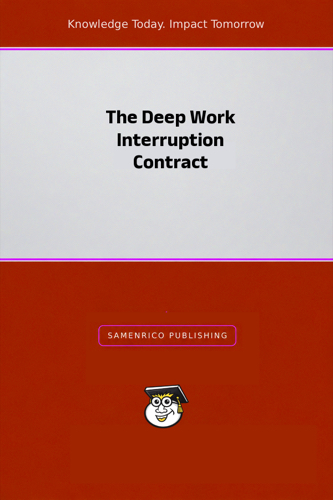
Non-FictionSelf-HelpAgreement Design
The Deep Work Interruption Contract eBook
Drafts a mutual agreement with colleagues or famil
by Murillo Hoyt
Drafts a mutual agreement with colleagues or family defining focus hours and response windows.
Formats
Free sample
Chapter 1: The Interruption Tax--–- It begins not with a bang, but with a ping.You are sitting at your desk, finally. The coffee is hot. The cursor blinks patiently on a document that needs your full attention—a proposal, a piece of code, a budget model, a creative brief. You take a breath. You begin to sink into the work, that rare and precious state where the outside world falls away and the problem before you becomes the only thing that exists.Then it happens.A Slack message slides into view.
The icon is red. Someone has used the @here tag. Your peripheral vision catches the movement. Your brain, wired to notice novelty and social signaling, jerks your attention away from the document. You glance at the message.
It is not urgent. It is not even important. Someone wants to know if you saw the email they sent ten minutes ago.You sigh. You type a quick reply: “Yes, got it. Will review this afternoon.”You return to the document.
But something has changed. The flow is gone. The words that were coming easily now feel stuck. You read the last paragraph again, then again. Where were you going with that argument?
You spend the next six minutes trying to reorient yourself, scrolling back, rereading, reconstructing the thread of thought you had woven so effortlessly just moments ago.That single ping cost you not ten seconds, but ten minutes.And that was just the first one of the day.The Hidden Tax You Didn’t Know You Were Paying Let us name this phenomenon. Let us call it the Interruption Tax.Every time your focus is broken, you pay a toll. That toll is not measured in the seconds it takes to glance at a message or answer a question. It is measured in the minutes—sometimes twenty or more—that your brain requires to return to a state of deep concentration. And here is the cruelest part: the tax compounds.
The more you are interrupted, the more you anticipate the next interruption, and that anticipation itself becomes a constant, low-grade distraction that prevents you from ever reaching depth in the first place.Most professionals believe they are good at multitasking. They are wrong. The human brain is physically incapable of processing two cognitively demanding tasks simultaneously. What we call multitasking is actually task-switching, and task-switching carries a heavy metabolic cost. Every switch forces your brain to disengage from one set of neural networks, suppress that context, activate a new set of networks, and then—when you return to the original task—do it all over again.
Each switch burns glucose, depletes attention, and leaves you a little more exhausted than you were before.Research from the University of California, Irvine, quantified this cost. The study found that after an interruption, it takes an average of twenty-three minutes and fifteen seconds to return to the original task with the same level of focus. Twenty-three minutes. Not two or three. Twenty-three.That means a single interruption in a ninety-minute focus block doesn’t cost you ninety minutes of productive work.
It costs you the entire block. You lose the first twenty-three minutes to recovery, and the remaining time is spent in a shallower state, constantly braced for the next disruption.Now multiply that by the average knowledge worker’s daily reality. Gloria Mark, a researcher at the same institution, found that knowledge workers switch tasks every eleven minutes on average. Eleven minutes. Before they can even reach the twenty-three-minute recovery mark, they are interrupted again.
This creates a vicious cycle: most professionals never achieve deep focus at all because they are interrupted too frequently to ever enter that state.You are paying this tax every single day, in every single hour, whether you realize it or not.Attention Residue: The Ghost of Interruptions Past The cost of interruption does not end when you return to your original task. There is a second, more insidious toll: attention residue.Sophie Leroy, a business professor at the University of Washington, coined this term after studying how people transition between tasks. She discovered that when you stop working on Task A to handle Task B, a cognitive shadow of Task A remains in your working memory. Your brain continues to process fragments of the abandoned task—unresolved questions, next steps, lingering emotions—even as you try to focus on Task B.This residue reduces your cognitive capacity. Leroy’s research showed that people with high attention residue performed significantly worse on subsequent tasks, made more errors, and took longer to complete their work.
In effect, you are never fully present for the interruption or for the work you return to. You are split between two worlds, fully inhabiting neither.Here is a concrete example. You are writing a quarterly report. Your colleague interrupts with a question about an upcoming meeting. You answer the question (poorly, because your mind is still on the report), then return to the report.
But now, fragments of the meeting question linger: Did you give the right answer? Should you have asked for more context? What time was that meeting again?Those fragments are attention residue. They occupy what cognitive scientists call “working memory capacity”—a finite resource. Your working memory can hold roughly four discrete items at once.
When residue from previous tasks takes up two or three of those slots, you have only one or two left for the task in front of you. That is why you feel mentally foggy after a morning of scattered interruptions. You are not tired. You are full. Your working memory is clogged with the ghosts of tasks past.The Urgency Trap Now let us examine the content of most interruptions.
What are people actually asking you?The vast majority of workplace interruptions fall into a category we might call “manufactured urgency.” These are requests that feel urgent because of social pressure—a Slack message marked @here, a colleague standing at your desk, a phone call that rings insistently—but are not actually time-sensitive or important.A study by the Mc Kinsey Global Institute found that the average knowledge worker spends 60 percent of their workweek on communication and collaboration tools: email, chat, meetings, calls. Of that time, only a fraction involves information that is genuinely critical to their core responsibilities. The rest is coordination for coordination’s sake.Think about the last ten interruptions you experienced. How many of them truly could not have waited an hour? How many required your specific, immediate attention?
How many were simply someone else’s preference for an instant answer over a thoughtful response?The Eisenhower Matrix, named for President Dwight D. Eisenhower, divides tasks into four quadrants based on urgency and importance. Urgent tasks demand immediate attention. Important tasks contribute to long-term goals and values. The ideal is to spend most of your time on important but not urgent work—deep strategic thinking, creative problem-solving, relationship building.But interruptions drag you into the opposite quadrant: urgent but not important.
They feel pressing because someone is waiting. They demand a response because the notification is red. Yet they do not move your most important projects forward.…
This is the end of the free sample. Get the eBook to keep going. Buy now
About this book
Details
- Author
- Murillo Hoyt
- Publisher
- SamEnrico
- Language
- English
- Genre
- Non-Fiction, Self-Help, Agreement Design
- Released
- 2026-06-09
- Pages (approx.)
- 120
- Available as
- eBook, Audiobook

Read better in the ZLOADR app
Your eBooks on your phone or tablet. Sign in with your SamEnrico account and start reading.
More by Murillo Hoyt
 Growth Hormone and mTOR BalancingMurillo Hoyt$11.99
 OCD Thought Stopping Self TalkMurillo Hoyt$11.99
 Ibogaine Treatment GuideMurillo Hoyt$11.99
 Uber EV Incentives GuideMurillo Hoyt$11.99
 Travel Goal Action PlanMurillo Hoyt$11.99
 Grief and Siblings After Parent DeathMurillo Hoyt$11.99
 Equifax Credit Freeze FailuresMurillo Hoyt$11.99
 Crowns of the New World: How Europe Charted the GlobeMurillo Hoyt$11.99
 Baba Yaga’s Bone House: The Witch of the Forest’s Dark BargainMurillo Hoyt$11.99
 A Collector's Handbook to the Opel Manta CoupeMurillo Hoyt$11.99
 Growing Aira (Hair Grass)Murillo Hoyt$11.99
 Termination Legal Trap HandbookMurillo Hoyt$12.99
You may also like
 Hong Kong Handover 1997Dunn Johnnie$11.99
 Zumba For Postnatal Recovery CourseNeal Christian$11.99
 Zumba for BeginnersLadner Nikia$11.99
 YouTube Comment Mining GuideHumes Pandora$12.99
 Worry Box MeditationCarlin Rudy$11.99
 Workplace Stress MeditationNguyen Lynn$11.99
 Workplace Stress and Sleep RepairHawley Ivory$11.99
 Workplace Perfectionism CureDelaney Jeffry$11.99
 Workplace Injustice Anger GuideWallen Isabelle$11.99
 Work Addiction and Burnout LinkGreenwood Ester$11.99
 Women in Yoga and WellnessBeattie Galina$11.99
 Women in Stand Up ComedyChun Evangeline$11.99