
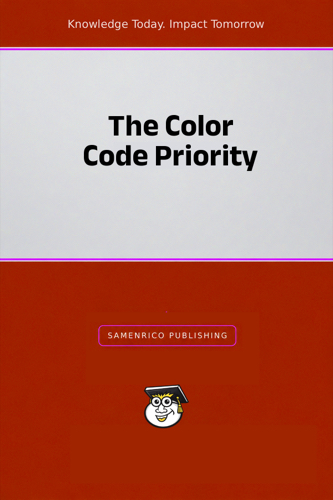
The Color Code Priority eBook
Use colors to mark A through E tasks for quick vis
by Taylor Ellen
Use colors to mark A through E tasks for quick visual scanning.
Formats
Free sample
Chapter 1: The Gray Fog...--–- The average professional touches their to-do list 37 times per day. Each touch lasts only 11 seconds. Together, that is nearly seven minutes of daily list-fiddling—not doing, not deciding, just re-reading. Seven minutes of staring at the same gray words, hoping they have rearranged themselves into clarity while you were away. They never do.This is not a productivity problem.
This is a visual processing problem. And it is costing you far more than seven minutes.Let us begin with a confession. I spent twelve years building to-do lists the way my grandmother taught me: a yellow legal pad, a black pen, and a sinking feeling that grew longer as the list grew longer. I tried every system. I color-coded by project.
I used symbols—stars, arrows, checkboxes in three sizes. I migrated unfinished tasks from Monday to Tuesday to Wednesday, watching the same fifteen items haunt me like ghosts I could not bury. Nothing worked.Then I discovered something obvious in hindsight. The problem was never my discipline, my motivation, or the complexity of my work. The problem was that every task on my list looked exactly the same.
Same font. Same color. Same visual weight. My brain had to read each item to know what to do with it. And reading takes time.
Reading takes context. Reading is slow.What if you did not have to read? What if you could glance at your list and know—instantly, without a single word—what to do next? That is the promise of this chapter. And to get there, we must first understand the enemy.
The enemy is not laziness, distraction, or even procrastination. The enemy is the gray fog.The Anatomy of the Gray Fog Look at any standard to-do list. Not the idealized version you imagine creating after reading a productivity book, but the actual list on your phone or desk right now. What do you see? A wall of text.
Black ink on white paper. Dark mode gray on black. The words blend together into a uniform texture, like bricks in a wall. Each item has the same visual urgency. Each item demands the same cognitive attention.
Each item requires you to read it before you can prioritize it.This is the gray fog: the visual monotony that buries important tasks inside a sea of trivial ones.The term “fog” is deliberately chosen. Fog does not block your vision entirely. It obscures. It softens edges. It makes distant objects—like a 5 PM deadline—look as hazy as a next-week task.
In fog, you cannot tell what is close and what is far. You cannot tell what is dangerous and what is safe. You can only move slowly, carefully, repeatedly checking your position.Your brain treats a monochrome to-do list exactly like fog. Research in visual search psychology shows that when all items share the same contrast, color, and font weight, the brain’s parietal lobe—the region responsible for attention and pattern recognition—must work continuously to differentiate targets from non-targets. This is called “visual noise.” The more items on your list, the more noise.
The more noise, the more effort required to find signal.By the time you have twenty items on a monochrome list, your brain is doing heavy computational work just to scan. You are not planning. You are not deciding. You are filtering. And filtering is exhausting.The Hidden Tax of Re-Reading Let me ask you a question.
When you look at your to-do list, how many times do you read the same item before acting on it?If you are like the professionals I have coached, the answer is between three and seven times. You read an item, decide it is not urgent, skip it, come back later, read it again, reconsider, defer again. Each re-reading costs you a sliver of attention. Each re-reading forces your brain to re-answer the same question: “What is this, and what should I do with it?”Cognitive psychologists call this “repetitive task evaluation.” It is the opposite of automaticity. When a stimulus is familiar and unambiguous, your brain processes it automatically—you see a red light and brake without thinking.
But your to-do list offers no such automaticity. Every item is a question mark. Every item requires a fresh judgment call.The cost is measurable. Studies on task switching—pioneered by Joshua Rubinstein and David Meyer in the 1990s and replicated dozens of times since—show that each time you interrupt a task to evaluate something else, you lose an average of 15 to 20 minutes of productive flow. But there is a subtler cost that these studies often miss: the cost of evaluating a task without even switching to it.
Simply reading an item and deciding not to do it still incurs a cognitive toll. You have not switched tasks, but you have switched mental contexts from “doing” to “evaluating” and back again. That switching happens in milliseconds, but it adds up.Over a ten-hour workday, the average person spends 47 minutes purely re-reading and re-evaluating tasks they have already seen. Forty-seven minutes. Every day.
That is nearly four hours per workweek. One hundred and ninety hours per year. That is five full workweeks spent re-reading your own lists.The gray fog is not innocent. It is stealing your time in plain sight.Gray Tasks: The Invisible Clog Not all items in the fog are equal. Some are urgent.
Some are important. Some are neither. But when everything is gray, they all look the same. And when they all look the same, your brain defaults to a lazy heuristic: do whatever feels most recent, loudest, or easiest.This is where Gray Tasks enter the picture. A Gray Task is an item that is neither urgent nor important but feels mandatory.
It has no deadline that matters. It has no consequence if delayed. But it carries an emotional weight—often from obligation, habit, or anxiety—that makes it linger on your list for weeks.Examples of Gray Tasks: “Organize desktop folders.” “Read that article someone sent.” “Update the shared drive.” “Brainstorm ideas for a project that has no start date.” “Research vacation options for a trip you have not booked.”Gray Tasks are dangerous because they are easy. They require no heavy lifting, no hard decisions, no risk of failure. So your brain, exhausted by the gray fog, reaches for them first.
You organize your desktop instead of writing the proposal. You read the article instead of making the phone call. You feel productive. You are not. You are avoiding.In a color-coded system, Gray Tasks would be immediately visible as impostors.
They would not fit any priority color. But in the gray fog, they hide. They look exactly like your real work. And they multiply.The Emotional Weight of Monochrome There is a reason most people feel a small pang of anxiety when they open their to-do list. It is not the tasks themselves—at least, not entirely.
It is the visual presentation.Color psychology research has long established that monochrome environments feel more serious, more formal, and more draining than polychrome ones. Hospital waiting rooms are intentionally beige because beige is calming. But…
This is the end of the free sample. Get the eBook to keep going. Buy now
About this book
Details
- Author
- Taylor Ellen
- Publisher
- SamEnrico
- Language
- English
- Genre
- Non-Fiction, Self-Help
- Released
- 2026-06-06
- Pages (approx.)
- 136
- Available as
- eBook, Audiobook

Read better in the ZLOADR app
Your eBooks on your phone or tablet. Sign in with your SamEnrico account and start reading.
More by Taylor Ellen
 Grandparent Anger Management GuideTaylor Ellen$11.99
 Cash Flow for FoundersTaylor Ellen$11.99
 The Optometrist Who Gave GlassesTaylor Ellen$11.99
 Sobriety Quarter Life Crisis GuideTaylor Ellen$11.99
 Strava Athlete ComparisonTaylor Ellen$11.99
 Design Thinking For Human ResourcesTaylor Ellen$11.99
 Oldest Child Responsibility LoadTaylor Ellen$11.99
 The Shadow of the Minstrel: Jazz’s Forgotten Renaissance RootsTaylor Ellen$11.99
 The Siege of Sydney: The Private Eye Who Outmaneuvered a KillerTaylor Ellen$11.99
 Chinese Supplier Rework and Penalty ClausesTaylor Ellen$12.99
 Production Deployment GuideTaylor Ellen$12.99
 Mastering The Art of Mizongyi (迷蹤拳; Mízōngquán) Lost Track Fist (Also Known As My Jong Law Horn; 迷蹤羅漢拳)Taylor Ellen$11.99
You may also like
 Hong Kong Handover 1997Dunn Johnnie$11.99
 Zumba For Postnatal Recovery CourseNeal Christian$11.99
 Zumba for BeginnersLadner Nikia$11.99
 YouTube Comment Mining GuideHumes Pandora$12.99
 Worry Box MeditationCarlin Rudy$11.99
 Workplace Stress MeditationNguyen Lynn$11.99
 Workplace Stress and Sleep RepairHawley Ivory$11.99
 Workplace Perfectionism CureDelaney Jeffry$11.99
 Workplace Injustice Anger GuideWallen Isabelle$11.99
 Work Addiction and Burnout LinkGreenwood Ester$11.99
 Women in Yoga and WellnessBeattie Galina$11.99
 Women in Stand Up ComedyChun Evangeline$11.99