
Non-FictionArtificial World Voice
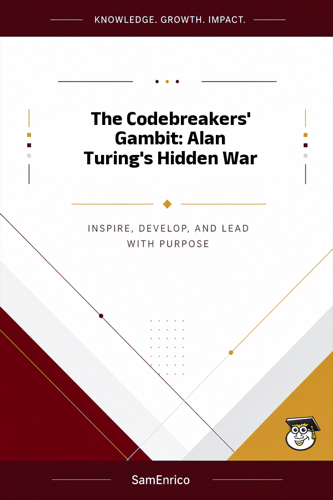
The Codebreakers' Gambit: Alan Turing's Hidden War eBook
Unravel the untold story of how Alan Turing's revo
Unravel the untold story of how Alan Turing's revolutionary codebreaking at Bletchley Park reshaped history, blending cryptography, war, and a tragic legacy.
Formats
Free sample
Chapter 1: The Ghost in the Machine...--The letter arrived on a Tuesday, tucked inside a plain government envelope with no return address. Alan Turing tore it open standing in the doorway of his King's College rooms, still wearing his dressing gown at half past two in the afternoon—a detail that would have surprised no one who knew him. Inside was a single sheet of paper, typed in the clipped, impersonal language of the British civil service. It said, in essence: Report to Euston Station on Thursday. Bring a warm coat and a toothbrush.
Do not tell anyone where you are going.He read it twice. Then he folded it carefully, placed it in his breast pocket, and returned to the half-finished chess game he had been playing against himself on the windowsill. The white king was in trouble. Turing was playing white, and white was losing—which, given that he was also playing black, meant that Alan Turing was losing to Alan Turing. This was not unusual.
He had been losing to himself for years.The year was 1939. The world was on the edge of a cliff, and most of England was too exhausted from the last war to look down. Neville Chamberlain had returned from Munich the previous year waving a piece of paper and promising "peace for our time." Turing had watched the newsreel in a Cambridge cinema and felt a cold certainty settle into his bones: the paper was worthless, the peace was a lie, and the only question that mattered was how much time remained before the guns began again.He was twenty-seven years old. He had no military training, no political connections, and no particular interest in the affairs of nations. What he had was a mind that worked differently from almost any other mind on earth.
Four years earlier, at the age of twenty-three, he had published a paper called "On Computable Numbers" that most of his colleagues at Cambridge did not fully understand and that the rest of the world had largely ignored. In that paper, he had imagined a machine—a theoretical machine, a machine that existed only on paper—that could compute anything that was computable, given enough time and enough tape. He had called it a "universal machine." He had no idea, in that quiet academic moment, that he had just invented the future.The universal machine was a ghost. It had no physical form, no gears or levers or glowing lights. It was a mathematical idea, a thought experiment, a way of asking what it meant for something to be calculated.
But Turing had always been comfortable with ghosts. His first love, Christopher Morcom, had died of tuberculosis when Turing was eighteen, and for years afterward Turing had wondered whether the mind could survive the death of the body—whether consciousness was just another kind of computation, running on the hardware of the brain. The universal machine was, in a strange way, an answer to that question. If a machine could think, then perhaps the dead were not entirely gone. Perhaps Christopher was still running somewhere, on some hidden hardware, inside some unseen machine.He never spoke of this to anyone.
He kept it locked inside his chest, alongside the other secrets he had learned to keep.The Boy Who Counted Everything To understand Alan Turing, you have to start with the numbers. He was not born counting—no one is—but by the age of six, he was already arranging his world into patterns that made sense only to him. He arranged his toys by size, then by color, then by some internal taxonomy that his mother, Ethel, never quite deciphered. He taught himself to read in three weeks, not because he was eager for stories but because he wanted to understand the instructions on a package of breakfast cereal. The instructions were about nutrition.
The nutrition was about chemistry. The chemistry was about mathematics. And mathematics, for Alan Turing, was about everything.His parents were not mathematicians. Julius Turing was a civil servant in the Indian Civil Service, a man of routine and propriety who spent most of his adult life in Madras while his wife and children remained in England. Ethel was the daughter of a railway engineer, a woman of fierce propriety who believed that good manners were the foundation of civilization and that her second son lacked them entirely.
She was not wrong. Alan was a difficult child—not disobedient, precisely, but deeply indifferent to the rules that governed ordinary social life. He could not understand why one wore a tie to dinner or why one said "please" before asking for more potatoes. These rituals seemed to him arbitrary, inefficient, and unnecessary. He said so, aloud, at the dinner table, on multiple occasions.His older brother, John, learned to navigate this world of social expectations with the casual ease of a born diplomat.
Alan never learned. He tried, sometimes, with the same intensity he brought to a difficult proof, but the results were always awkward, mis-timed, slightly off-key. He smiled too late. He laughed when no one else was laughing. He made jokes that no one understood and then, when no one laughed, made jokes about no one laughing, which also no one understood.
He was, by any conventional measure, a lonely child. But he did not seem to mind the loneliness. He had his numbers. The numbers were enough.At thirteen, he was sent to Sherborne School, a venerable institution that valued classics and character over science and mathematics. The headmaster wrote to his parents: "If he is to be solely a Scientific Specialist, he is wasting his time at a Public School." This was meant as a criticism.
Turing, reading the letter years later, took it as a compliment. He had no interest in being what Sherborne wanted him to be. He was already becoming something else.The Death of Christopher Morcom And then came Christopher.Christopher Morcom was a year older than Turing, taller, more confident, and possessed of a scientific mind that matched Alan's own. They met at Sherborne, in the laboratory, where both had come to escape the tedium of Latin conjugation. Christopher was working on an experiment involving static electricity.
Turing was reading a book about relativity. They did not speak much that first day—neither was naturally chatty—but something passed between them, some recognition of kindred spirits, that would transform the rest of Turing's life.Over the next two years, they became inseparable. They walked together across the Dorset hills, arguing about the nature of time. They stayed up late in Christopher's dormitory, plotting experiments that neither would ever build. They wrote each other long letters during the holidays, letters that Turing would later burn, leaving behind only the faintest trace of what passed between them.
But the evidence of their friendship survives in the mathematics. Turing's work, from this period forward, is marked by a new intensity, a new willingness to push against the boundaries of the possible. Christopher had shown him that thinking was not a solitary pursuit—that ideas could be shared, tested, improved, expanded.Then Christopher got sick.Tuberculosis was a slow executioner in…
This is the end of the free sample. Get the eBook to keep going. Buy now
About this book
Details
- Author
- Sylvester Rudy
- Publisher
- SamEnrico
- Language
- English
- Genre
- Non-Fiction, Artificial World Voice
- Released
- 2026-06-04
- Pages (approx.)
- 144
- Available as
- eBook, Audiobook

Read better in the ZLOADR app
Your eBooks on your phone or tablet. Sign in with your SamEnrico account and start reading.
More by Sylvester Rudy
 Anticipatory Grief and GuiltSylvester Rudy$11.99
 The Farmer Overdose SurvivorSylvester Rudy$11.99
 The Feet Under ChairSylvester Rudy$11.99
 Multi Platform Gig ArbitrageSylvester Rudy$11.99
 Psychological Relapse Prevention for Cannabis Use DisorderSylvester Rudy$11.99
 Managing Remote MisunderstandingsSylvester Rudy$11.99
 From M'Bera Camp To ViennaSylvester Rudy$11.99
 Stadium Concession SurvivalSylvester Rudy$11.99
 Running Stride Lengthening RoutinesSylvester Rudy$11.99
 The Kingmaker's Gambit: How a Mobster Built a Vegas EmpireSylvester Rudy$11.99
 The Algorithm That Changed Everything: The Untold Story of Andrew Ng and AI’s BreakthroughSylvester Rudy$11.99
 The Complete Guide to the Total Wellness Cleanse DietSylvester Rudy$11.99
You may also like
 Hong Kong Handover 1997Dunn Johnnie$11.99
 Zumba For Postnatal Recovery CourseNeal Christian$11.99
 Zumba for BeginnersLadner Nikia$11.99
 YouTube Comment Mining GuideHumes Pandora$12.99
 Worry Box MeditationCarlin Rudy$11.99
 Workplace Stress MeditationNguyen Lynn$11.99
 Workplace Stress and Sleep RepairHawley Ivory$11.99
 Workplace Perfectionism CureDelaney Jeffry$11.99
 Workplace Injustice Anger GuideWallen Isabelle$11.99
 Work Addiction and Burnout LinkGreenwood Ester$11.99
 Women in Yoga and WellnessBeattie Galina$11.99
 Women in Stand Up ComedyChun Evangeline$11.99