
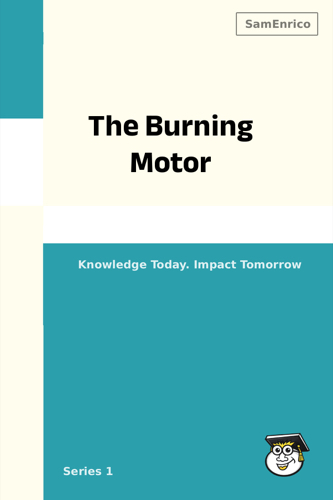
Non-FictionBiographyFire Safety
The Burning Motor eBook
An engine fire and the extinguisher that saved the
by Tran Preston
An engine fire and the extinguisher that saved the boat.
Formats
Free sample
Chapter 1: The Smell of Complacency...--The first time I nearly died, I was standing on a dock in Marathon, Florida, drinking a beer I hadn't earned and ignoring a smell I should have recognized.It was March of 2019, a month before the fire that would rewrite everything I thought I knew about boats, safety, and my own mortality. The sun had just set behind the Seven Mile Bridge, painting the sky in shades of orange and purple that made the water look like molten gold. I had just finished a long day of charter fishing—eight hours on the water, four happy clients, a cooler full of yellowtail snapper, and the kind of tired that feels like accomplishment. My boat, Reel Time II, was tied off at her slip, rocking gently against the dock lines. I was leaning against a piling, beer in hand, watching the other captains clean their boats and tell their own versions of the same stories I had.That's when I smelled it.Faint.
Acrid. Like hot electrical insulation—the kind of smell you get when a wire gets too much current and the plastic casing starts to cook from the inside out. I had smelled it a hundred times before, usually from shore power pedestals that had gone bad or from a neighbor's boat running a space heater on an undersized extension cord. I sniffed once, twice, then dismissed it. Not my problem.
Not my boat. I finished my beer, walked up the dock, and went home to bed.That smell was a warning. And I ignored it.The Dockside Epiphany That Wasn't Looking back now, with the clarity that only near-death can provide, I understand what that smell really was. It wasn't a random electrical fault from a neighboring vessel. It was a message from the universe, a test of my attention, a small sign that I was supposed to notice.
But I didn't notice. I normalized it. I told myself it was nothing, that someone else would deal with it, that the world was full of strange smells and most of them didn't kill you.This is the single most dangerous psychological trait in boating: the normalization of deviance.I first heard that term from a Coast Guard investigator years after the fire, but I had lived it my entire career. Normalization of deviance is what happens when you start ignoring small problems because they haven't killed you yet. It's what happens when you run your blower for two minutes instead of five, because you've done it a hundred times and nothing bad happened.
It's what happens when you let a frayed wire sit for another season, because it's too hot to work in the engine room and you'll get to it next winter. It's what happens when you smell something wrong and you tell yourself it's someone else's problem.Every boater does it. Every single one. And every boater who has ever lost their vessel to fire has done it one time too many.I was no different. In 2016, three years before that night on the dock, I had a near-miss that should have scared me straight.
I was running my previous boat—a 32-foot center console named Reel Time—back from the Dry Tortugas, a chain of islands seventy miles west of Key West. The day had been perfect: flat seas, screaming drags, a cooler full of blackfin tuna. I was pushing the boat hard, 4,000 RPM, trying to beat an approaching squall. That's when I smelled raw gasoline.Not the faint electrical smell from the dock. This was strong, immediate, the kind of smell that makes your eyes water and your throat tighten.
I killed the engine instantly—a reaction born not of training but of pure animal fear—and opened the engine hatch. What I saw turned my blood cold.A fuel line clamp had cracked. The line had worked itself loose from the fitting. Raw gasoline was spraying directly onto the exhaust manifold, which was hot enough to glow dull red in the afternoon light. The fuel was evaporating as fast as it leaked, creating an invisible cloud of explosive vapor that filled the bilge and surrounded the engine.
One spark. One tiny spark from a starter solenoid, a bilge pump switch, or even a loose alternator connection, and I would have been a fireball forty miles from shore.The Coast Guard says that 75 percent of all boat fires start with fuel leaks. Seventy-five percent. And most of those leaks are exactly what I found: a cracked hose, a loose clamp, a fitting that vibrated loose over time. The fuel spray atomizes into the engine compartment, mixes with air, and waits for an ignition source.
That ignition source is almost always electrical—a chafed wire, a corroded terminal, a bilge blower motor that throws a spark. The fire triangle becomes a fire tetrahedron, and your boat becomes a bomb.I fixed the clamp. I replaced the hose. I ran the engine for an hour to make sure everything was tight. And then I did nothing else.
I made no changes to my inspection routine. I installed no upgrades. I bought no new extinguishers. I didn't even tell my wife what had happened, because I didn't want her to worry. I normalized the near-miss.
I told myself I had been lucky, that I had caught it in time, that it wouldn't happen again.That lie almost killed me three years later.Why Boat Fires Are Different Before we go any further, I need to explain something fundamental: a fire on a boat is not like a fire in a house. It is not like a fire in a car. It is not like a fire on land at all. And if you carry land-based assumptions onto the water, you will die.The fire tetrahedron—heat, fuel, oxygen, and the chemical chain reaction—is the same everywhere. But the marine environment supercharges every element in ways that house fires cannot match.Fuel.
A house has combustible materials: wood framing, drywall, furniture, carpet. A boat has all of those things, plus fiberglass resin (which burns hot and fast), fuel tanks holding dozens or hundreds of gallons of gasoline or diesel, propane cylinders for cooking, and oil-filled hydraulic systems. The typical 40-foot sport fisher contains the equivalent energy of twenty sticks of dynamite. When that energy releases as fire, it releases fast.Oxygen. A house fire will eventually consume the oxygen in a room, slowing the burn.
A boat has natural airflow through the hull, forced ventilation from engine room blowers, and open hatches that act as chimneys. Marine fires grow five times faster than house fires. In a house, you might have three to five minutes to escape. On a boat, you have ninety seconds—maybe less.Confinement. A house has multiple exits: front door, back door, windows.
A boat has one or two escape routes, and those routes are narrow. If a fire breaks out between you and the companionway, you are trapped. If smoke fills the cabin, you cannot see those narrow passages. If the fire reaches the fuel tank, you have nowhere to go but the water.Isolation. When a…
This is the end of the free sample. Get the eBook to keep going. Buy now
About this book
Details
- Author
- Tran Preston
- Publisher
- SamEnrico
- Language
- English
- Genre
- Non-Fiction, Biography, Fire Safety
- Released
- 2026-06-07
- Pages (approx.)
- 127
- Available as
- eBook, Audiobook

Read better in the ZLOADR app
Your eBooks on your phone or tablet. Sign in with your SamEnrico account and start reading.
More by Tran Preston
 Reverse Brainstorming Team GuideTran Preston$11.99
 NVC for IntrovertsTran Preston$11.99
 Migraine Workplace AccommodationsTran Preston$11.99
 The Stress Liver Damage LinkTran Preston$11.99
 Blue Zone Seasonal EatingTran Preston$11.99
 Apple Music InfluencerTran Preston$11.99
 Social Media Blocker SetupTran Preston$11.99Social Media Blocker SetupTran Preston$11.99
 Nap and Heart Health GuideTran Preston$11.99
 The Day the Beatles Never Broke Up: A Musical Timeline That Changed the WorldTran Preston$11.99
 The Timbuktu Code: The Heist of the Lost ManuscriptsTran Preston$11.99
 Steel and Steam: The Forge of the Industrial RevolutionTran Preston$11.99
You may also like
 Hong Kong Handover 1997Dunn Johnnie$11.99
 Zumba For Postnatal Recovery CourseNeal Christian$11.99
 Zumba for BeginnersLadner Nikia$11.99
 YouTube Comment Mining GuideHumes Pandora$12.99
 Worry Box MeditationCarlin Rudy$11.99
 Workplace Stress MeditationNguyen Lynn$11.99
 Workplace Stress and Sleep RepairHawley Ivory$11.99
 Workplace Perfectionism CureDelaney Jeffry$11.99
 Workplace Injustice Anger GuideWallen Isabelle$11.99
 Work Addiction and Burnout LinkGreenwood Ester$11.99
 Women in Yoga and WellnessBeattie Galina$11.99
 Women in Stand Up ComedyChun Evangeline$11.99