
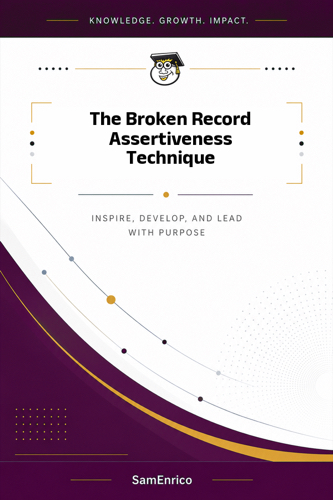
Non-FictionSelf-HelpVerbal Tactics
The Broken Record Assertiveness Technique eBook
Teaches repeating your position calmly without get
Teaches repeating your position calmly without getting sidetracked.
Formats
Free sample
Chapter 1: The JADE Trap--–- You are about to say something that will lose the argument before it has even begun. You will not know you said it. The other person will not know you said it. But somewhere in the exchange, you will offer a reason, and that reason will become a rope they pull to drag you off your position. This is not a failure of confidence or character.
It is a failure of a specific verbal behavior, and it can be unlearned in the next ten minutes.Every day, millions of people lose arguments, give in to requests they should have refused, and walk away feeling resentful—not because they were wrong, but because they explained themselves. The belief that explanations are polite, transparent, or necessary is the single most destructive myth in interpersonal communication. When you explain why you said no, you are not being helpful. You are handing the other person a weapon.This chapter introduces the single most important concept in the entire book: the JADE trap. JADE is an acronym that stands for four behaviors that will destroy your ability to say no and make it stick.
Those behaviors are Justifying, Arguing, Defending, and Explaining. Every time you engage in any of these four, you transfer control of the conversation to the other person. You step out of your frame and into theirs. And once you are in their frame, you have already lost.Understanding the JADE trap is not optional for using the broken record technique. It is the foundation upon which everything else is built.
The remaining eleven chapters of this book assume you have mastered the distinction between stating your position and falling into the JADE trap. This chapter will teach you that distinction so thoroughly that you will begin to hear yourself doing it in real time—and then, crucially, stop.Let us begin with a scene that will feel familiar.The Anatomy of a Failed No You are at work. Your desk is full. Your to-do list has fourteen items, three of which are already overdue. A colleague appears.
Let us call her Sarah. Sarah is not a bad person. She is simply busy and needs help.Sarah says, "Hey, can you take a look at this report? I need it by noon."You have your own deadlines. You say, "I can't.
I'm swamped."This is a clean no. It is short. It states your position. It does not apologize. So far, so good.Then Sarah says, "It'll only take ten minutes."And here is where the trap springs.
Most people, at this moment, will offer a reason. They will say something like, "I really can't because I have that meeting at eleven and then I need to finish the quarterly numbers and my manager is already on my case about the deadline."That is a perfectly reasonable explanation. It is also a disaster.Because Sarah now has something to work with. She can say, "So if I help you with the quarterly numbers, can you do the report?" Or, "Can you just do it after your meeting?" Or, "My manager is on my case too—we're in the same boat."Every reason you gave became a hook. You justified your no (by listing your tasks).
You argued (implicitly, that your tasks were more important). You defended (against the implied accusation that you were being unhelpful). And you explained (in detail, giving her a map of your schedule). You performed all four letters of JADE in a single sentence.The result? You are now in a negotiation you never agreed to.
You are defending your own calendar. And statistically, you will either give in (and resent Sarah) or snap at her (and feel guilty). The broken record would have been: "I can't." Then, when she said "It'll only take ten minutes," you would have said again: "I can't." Same words. Same tone. No new information.That is the JADE trap.
You fall into it not because you are weak, but because you have been trained since childhood that explaining yourself is the polite thing to do. It is not polite. It is a vulnerability.The Origins of the JADE Trap The JADE framework was not invented for this book. It emerged from the assertiveness training movement of the 1970s, most notably in Manuel J. Smith's "When I Say No, I Feel Guilty," which remains the foundational text for the broken record technique.
Smith observed that people who struggled to say no almost invariably engaged in what he called "JADE-ing"—the reflexive production of justifications, arguments, defenses, and explanations.What Smith understood, and what subsequent research has confirmed, is that JADE behaviors are not neutral. They are not simply additional information. They are a form of submission. When you justify your no, you imply that your no requires permission. When you argue, you accept the other person's framing of the issue.
When you defend, you assume you have been accused. When you explain, you invite counter-explanation.Each of these behaviors transfers the locus of control from you to the other person. Before you JADE, you are the one who decides whether your no stands. After you JADE, the other person becomes a participant in that decision. And they will almost always decide that your no should become a yes.Let us examine each letter in detail.J – Justifying Justifying is the act of providing a reason for your decision as if that reason validates the decision.
The implicit message of justification is: "Here is why my no is acceptable. Please approve it."Example: "I can't come to dinner because I have a headache."The problem is not that the headache is untrue. The problem is that you have now made your attendance contingent on the headache. If the headache goes away, the justification disappears. And the other person knows this.
They will say, "Oh, just rest for a bit—you'll feel better." Or, "I have ibuprofen." Or, "You always get headaches when we make plans."You have given them a lever.Justification is particularly dangerous because it feels like common courtesy. In many social contexts, offering a reason is indeed polite. But those contexts are low-stakes—deciding where to eat, what movie to see. In high-stakes situations where you are setting a boundary, justification is not courtesy. It is an invitation to negotiate.The broken record does not justify.
It states. "I can't come to dinner." That is a complete sentence. It requires no headache.A – Arguing Arguing is the act of trying to prove that your position is correct. The moment you argue, you have accepted that your position needs to be proven. And that means the other person gets to be the judge.Example: "I can't take on that project because I already have three projects and mine are more time-sensitive than yours."You are now arguing about whose projects are more important.
You have left the realm of your own decision and entered a debate. The other person can counter: "Actually, mine is time-sensitive too. The client is waiting." Now you are arguing about the client. Then about the deadline. Then about who is busier.Arguing is…
This is the end of the free sample. Get the eBook to keep going. Buy now
About this book
Details
- Author
- Welker Ashlie
- Publisher
- SamEnrico
- Language
- English
- Genre
- Non-Fiction, Self-Help, Verbal Tactics
- Released
- 2026-06-10
- Pages (approx.)
- 115
- Available as
- eBook, Audiobook

Read better in the ZLOADR app
Your eBooks on your phone or tablet. Sign in with your SamEnrico account and start reading.
More by Welker Ashlie
 Feeling Taken For Granted GuideWelker Ashlie$11.99
 Postnatal Walking Meditation PlanWelker Ashlie$11.99
 Dairy Cooperative Milk CollectionWelker Ashlie$11.99
 Walking Meditation for CaregiversWelker Ashlie$11.99
 Beyond the Pitch: The Pioneers of the 1991 Women's World Cup in ChinaWelker Ashlie$11.99
 Food and Beverage ServerWelker Ashlie$11.99
 Understanding Omphalomesenteric CystWelker Ashlie$17.99
 Square Remote Internship BlueprintWelker Ashlie$12.99
 Exact Sciences SWOTWelker Ashlie$12.99
 A Beginners Guide to Focus (Volume 1)Welker Ashlie$11.99
You may also like
 Hong Kong Handover 1997Dunn Johnnie$11.99
 Zumba For Postnatal Recovery CourseNeal Christian$11.99
 Zumba for BeginnersLadner Nikia$11.99
 YouTube Comment Mining GuideHumes Pandora$12.99
 Worry Box MeditationCarlin Rudy$11.99
 Workplace Stress MeditationNguyen Lynn$11.99
 Workplace Stress and Sleep RepairHawley Ivory$11.99
 Workplace Perfectionism CureDelaney Jeffry$11.99
 Workplace Injustice Anger GuideWallen Isabelle$11.99
 Work Addiction and Burnout LinkGreenwood Ester$11.99
 Women in Yoga and WellnessBeattie Galina$11.99
 Women in Stand Up ComedyChun Evangeline$11.99