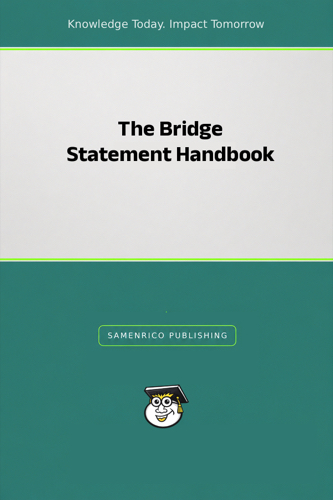
The Bridge Statement Handbook eBook
Transition smoothly from one topic to another with
by Cota Lisette
Transition smoothly from one topic to another without awkward gaps or jarring shifts.
Formats
Free sample
Chapter 1: The Broken Handshake...--–- Every day, without realizing it, you lose people. Not in a dramatic, door-slamming way. Not with arguments or disagreements. You lose them in the tiny, almost invisible spaces between your sentences. You lose them in the pause after a paragraph, in the jarring shift from one idea to the next, in the moment when your audience thinks, Wait… how did we get here?
And by the time you notice they’re gone—checking their phone, glazing over, clicking to another tab—it is too late. The connection is broken. The bridge has collapsed.This chapter is about those collapses. It is about the hidden architecture of human attention and why your otherwise brilliant ideas fail to land. But more than that, it is about the one tool you have been missing: the bridge statement.
Before we can build bridges, however, we must understand the gaps they cross. And before we understand gaps, we must face an uncomfortable truth: most of the transitions you write or speak are probably terrible. You just never noticed because no one stopped to tell you.The Moment of Confusion Imagine you are in a meeting. A colleague is presenting. They have just finished a detailed analysis of customer retention data, complete with charts and quarterly trends.
You are following along. Then they say: “So that’s where we are with retention. Now, parking structures.” Silence. You blink. Parking structures?
What do parking structures have to do with customer retention? You spend the next thirty seconds reverse-engineering the connection, mentally scanning for the missing link. By the time you figure out that they meant “partner structures” (a new organizational framework), you have missed the next three slides. The presenter has lost you.Or consider a more common scenario: you are reading an article. The first paragraph describes a heartbreaking childhood memory.
The second paragraph begins with “On a lighter note…” and launches into a joke about office printers. You feel a jolt, a small but real emotional whiplash. The author has not earned the shift. You close the tab.These are not failures of content. The retention data was solid.
The childhood memory was moving. The problem was not what was said, but what was not said in the space between. The problem was a gap.The Gap Defined (And Why Most Writers Get It Wrong)Let us define our terms with surgical precision. A gap, in the context of communication, is any moment where the audience must work to infer a connection that the writer or speaker failed to provide. That is the definition we will use throughout this book.
Notice what it does not say. It does not say that gaps are always bad. (We will save that nuance for Chapter 10.) It says that gaps require work. And here is the brutal reality: most audiences will not do that work. They will simply leave.In the history of best-selling books on writing—from William Zinsser’s On Writing Well to Chip and Dan Heath’s Made to Stick—one finding appears again and again: readers crave orientation.
They want to know where they are, how they got there, and where they are going next. When you deny them that orientation, even for a second, you break what cognitive scientists call “fluency.” Fluency is the ease with which a brain processes information. When a transition is smooth, the audience does not notice it. The meaning flows like water. When a transition is jarring, the brain stutters.
It allocates resources to problem-solving instead of comprehension. And that stutter, repeated enough times, becomes a full stop.Let me give you a concrete example. Read these two sentences aloud:Example A: “The company missed its quarterly targets. They decided to rebrand.”Example B: “Because the company missed its quarterly targets, they decided to rebrand.”Example A contains a gap. The reader must supply the causal relationship (“missing targets caused the rebrand”).
Example B contains a bridge (the word “because”). Both sentences contain the same information. But Example A creates a micro-second of friction. Example B does not. Over a thousand-word document, those micro-seconds add up to a measurable difference in comprehension, retention, and trust.The Four Gap Types (Standardized for This Book)Throughout The Bridge Statement Handbook, we will refer to four—and only four—types of gaps.
These categories appear in the diagnostic chart in Appendix B and form the backbone of every chapter that follows. Memorize them. They are your map.1. The Logical Gap. This occurs when the cause-and-effect relationship between two ideas is missing or unclear.
The reader thinks: “Why are we talking about this? How does B follow from A?” Logical gaps are the most common in business writing, technical documentation, and academic papers. They often appear between paragraphs where the author has made an intuitive leap that the audience cannot follow. Example: “The new software update includes enhanced security protocols. Our customer satisfaction scores rose by 12%.” The missing bridge: “Because customers value data protection, the enhanced security protocols directly contributed to a 12% rise in satisfaction.”2.
The Tonal Gap. This occurs when the emotional register shifts too abruptly, without warning or justification. The reader thinks: “Why are we laughing? We were just crying.” Tonal gaps are the most common in personal essays, memoirs, and social media content, where writers oscillate between vulnerability and humor without the necessary pivot. Example: “My grandmother’s funeral was the saddest day of my life.
Anyway, here’s a funny story about my cat.” The missing bridge: “In the midst of that sadness, I found myself remembering small, ridiculous moments—like the time my grandmother tried to teach my cat to sit.”3. The Structural Gap. This occurs when the audience loses track of time, space, or point of view. The reader thinks: “Wait… where are we? When is this?
Who is talking?” Structural gaps are the most common in fiction, narrative nonfiction, and long-form journalism, where authors jump between locations or timelines without orientation. Example: “She closed the door and walked into the rain. Three years later, he opened his eyes in a hospital bed.” The missing bridge: “Three years later, on the other side of the country, he opened his eyes in a hospital bed.”4. The Thematic Gap. This occurs when the audience loses sight of the central argument or story.
The reader thinks: “What does this have to do with anything?” Thematic gaps are the most common in long-form writing—books, dissertations, keynote speeches—where the author has wandered into a digression and forgotten to reconnect to the main thread. Example: A chapter about productivity suddenly spends three pages on the history of desk design. The missing bridge: “The history of desk design might seem like a detour, but it reveals a crucial insight about productivity: our environment shapes our focus more than any app ever could.”These four gap types will appear again in Chapter 2 (where we diagnose them), Chapter 4 through 7 (where we close them with specific bridges), and Appendix B (where you can quickly identify which gap you are dealing with). For now, simply practice spotting them. Read the newspaper this morning with a highlighter.
Mark every moment you feel a jolt. Chances are, it falls into one of these four categories.The Hidden Cost of…
This is the end of the free sample. Get the eBook to keep going. Buy now
About this book
Details
- Author
- Cota Lisette
- Publisher
- SamEnrico
- Language
- English
- Genre
- Non-Fiction, Self-Help, Conversation Flow
- Released
- 2026-06-07
- Pages (approx.)
- 136
- Available as
- eBook, Audiobook

Read better in the ZLOADR app
Your eBooks on your phone or tablet. Sign in with your SamEnrico account and start reading.
More by Cota Lisette
 Franchising Your Local Brand Across Borders Performance DashboardsCota Lisette$11.99
 Stimulant Medications GuideCota Lisette$11.99
 Workplace NVC TrainingCota Lisette$11.99
 Senior Relocation Cost ModelCota Lisette$11.99
 Missing FishermenCota Lisette$11.99
 Number Memory SystemCota Lisette$11.99
 Cannabis And FertilityCota Lisette$11.99
 The Silent Revolution: The 18th-Century Women Who Defied the GamesCota Lisette$11.99
 The Phoenix Code: Benjamin Banneker's Celestial CalculationsCota Lisette$11.99
 Mastering The Art of Bujinkan (武神館)Cota Lisette$11.99
 How to Produce SpursCota Lisette$11.99
 How to Produce Soybean Grass and Weed Control ProductsCota Lisette$11.99