
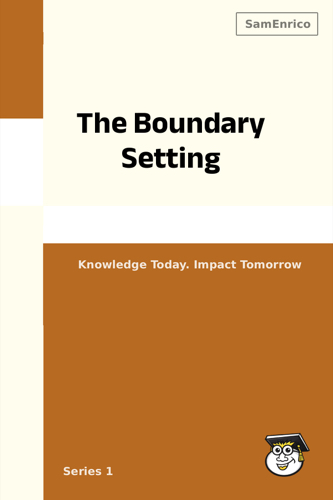
Non-FictionSelf-HelpBoundaries
The Boundary Setting eBook
Teaches stating limits without guilt or fear.
Teaches stating limits without guilt or fear.
Formats
Free sample
Chapter 1: The Boundary Trifecta--–- Resentment. Exhaustion. Avoidance. These three sensations are not character flaws or signs that you are "too sensitive." They are diagnostic tools. They are the smoke detectors of a soul that has been saying yes for too long.
Most people who struggle with boundaries do not actually know what a boundary is. They have a feeling—a vague, heavy feeling that life is happening to them, that other people are pulling levers they cannot see, that their energy is leaking out of a thousand small cracks they cannot find. This chapter will give you a working definition of boundaries, a map of the four types you need to protect, and most importantly, the three warning signs that will tell you exactly where your boundaries have already been breached—often without your conscious permission.What a Boundary Actually Is Let us begin with a definition so clear that you will never again confuse boundaries with selfishness, rudeness, or control. A boundary is a limit you set on what you will and will not accept in order to protect your physical, emotional, mental, and digital well-being. Notice what this definition does not say.
It does not say a boundary is something you impose on others. It does not say a boundary is a rule other people must follow. It does not say a boundary is a way to change someone else's behavior. The locus of control in this definition is entirely internal. You are not setting a boundary to make your mother stop calling every night.
You are setting a boundary to protect your need for quiet evenings. Your mother may continue calling every night. That is her choice. Your boundary is what you do in response: you let the call go to voicemail, you reply by text the next morning, you answer only on Tuesdays and Thursdays. A boundary controls you.
An ultimatum tries to control someone else.This distinction is the single most misunderstood concept in all of boundary literature. Thousands of people believe they have set boundaries when they have actually issued ultimatums, and they wonder why nothing changes. "I told my partner he has to stop leaving dishes in the sink," a client once said to me. "That was my boundary. And he still does it." No.
That was a rule you imposed on another human being. Human beings do not always follow rules. A boundary would be: "I am not willing to clean dishes that are not mine. If dishes are left in the sink, I will put them in a designated bin and they will wait there until the person who used them cleans them." That is a boundary because it controls your behavior—not his. He may still leave dishes.
You have simply stopped being the person who cleans them.Let me say this again because it is the foundation of everything that follows: Boundaries are not about making other people behave. Boundaries are about making choices for yourself about what you will and will not tolerate, and then acting on those choices. When you truly internalize this, your entire approach to limits changes. You stop waiting for other people to change. You stop being angry that they have not changed.
You simply adjust your own actions and move forward.The Four Types of Boundaries Boundaries are not one thing. They are four distinct domains, each requiring different skills and each vulnerable to different kinds of violation. Most boundary books lump everything together, leaving readers confused about why a boundary that works at work fails at home. The answer is simple: different types of limits operate under different rules.Physical boundaries govern your body, your space, and your privacy. This is the oldest and most primal category.
Physical boundaries include who can touch you and how, who can enter your home and when, who can see your body and under what circumstances, and who can access your personal space. When someone stands too close, hugs you without asking, enters your room without knocking, or touches you in a way that feels wrong, they are violating a physical boundary. Many people who struggle with other types of boundaries are actually quite good at physical boundaries—most of us know not to let strangers touch us. The problem is that we often suspend our physical boundaries with people we love, as if love means unlimited access to our bodies and spaces. It does not.Emotional boundaries govern the transfer of feelings between people.
This is the most frequently violated category and the least understood. An emotional boundary protects you from taking on other people's emotions as your own, from being used as a dumping ground for someone else's unprocessed distress, and from feeling responsible for how other people feel. When your friend calls to vent for forty-five minutes without asking if you have the capacity to listen, that is an emotional boundary violation. When your parent cries and you feel compelled to fix it, that is an emotional boundary breach. When your partner is angry and you immediately feel guilty even though you did nothing wrong, that is a sign that your emotional boundaries are porous.
Emotional boundaries do not mean you stop caring about people. They mean you stop drowning with them.Time boundaries govern your most irreplaceable resource: the hours of your life. Unlike money, you cannot earn more time. Unlike energy, you cannot restore time with sleep. Time is non-renewable, and every yes you give to something or someone is a no to something or someone else—including yourself.
Time boundaries include when you are available to work, when you are available to socialize, how long you will stay on the phone, how many commitments you will make in a week, and how much time you will spend on activities that drain you. The most common time boundary violation is the assumption that your time is less valuable than someone else's. This is not humility. This is self-abandonment.Digital boundaries govern access to you through technology. This category did not exist twenty years ago, and most people over forty have never been taught that they are allowed to have them.
Digital boundaries include when you reply to messages, whether you have read receipts turned on, what hours you check email, whether you answer texts during meals or after 9 PM, and who can reach you on which platforms. The expectation of 24/7 availability is not natural or healthy. It is a recent invention of the technology industry, designed to maximize engagement at the cost of your sanity. Digital boundaries are not optional. They are as essential to your well-being as locking your front door at night.The Boundary Trifecta: Three Warning Signs You Are Already Violated Now we arrive at the most practical section of this chapter.
You do not need to guess whether your boundaries are intact. Your body and your emotions will tell you, if you learn to read the signals. I have identified three warning signs that appear across every boundary type and every relationship context. I call these three signals the Boundary Trifecta. When you notice any of them, you can be certain that a boundary has been…
This is the end of the free sample. Get the eBook to keep going. Buy now
About this book
Details
- Author
- Mcfarland Corine
- Publisher
- SamEnrico
- Language
- English
- Genre
- Non-Fiction, Self-Help, Boundaries
- Released
- 2026-06-09
- Pages (approx.)
- 139
- Available as
- eBook, Audiobook

Read better in the ZLOADR app
Your eBooks on your phone or tablet. Sign in with your SamEnrico account and start reading.
More by Mcfarland Corine
 Letting Go Breath PracticeMcfarland Corine$11.99
 Dream Location JournalMcfarland Corine$11.99
 Joyful Retirement Planning GuideMcfarland Corine$11.99
 Stress and Betrayal RecoveryMcfarland Corine$11.99
 Listening In Crisis ManagementMcfarland Corine$11.99
 Trauma Focused Therapy GuideMcfarland Corine$11.99
 The Geocache TreasureMcfarland Corine$11.99
 Magic Johnson HIVMcfarland Corine$11.99
 The Ice Palace Massacre: The Red Terror in YekaterinburgMcfarland Corine$11.99
 The Crown’s Last Stand: How a Queen’s Resignation Shook a NationMcfarland Corine$11.99
 The Clockwork Alchemist: How a 19th-Century Outcast Invented Time ItselfMcfarland Corine$11.99
 The Mineral Guide to LiroconiteMcfarland Corine$11.99
You may also like
 Hong Kong Handover 1997Dunn Johnnie$11.99
 Zumba For Postnatal Recovery CourseNeal Christian$11.99
 Zumba for BeginnersLadner Nikia$11.99
 YouTube Comment Mining GuideHumes Pandora$12.99
 Worry Box MeditationCarlin Rudy$11.99
 Workplace Stress MeditationNguyen Lynn$11.99
 Workplace Stress and Sleep RepairHawley Ivory$11.99
 Workplace Perfectionism CureDelaney Jeffry$11.99
 Workplace Injustice Anger GuideWallen Isabelle$11.99
 Work Addiction and Burnout LinkGreenwood Ester$11.99
 Women in Yoga and WellnessBeattie Galina$11.99
 Women in Stand Up ComedyChun Evangeline$11.99