
Non-FictionBusiness BriefMarketing
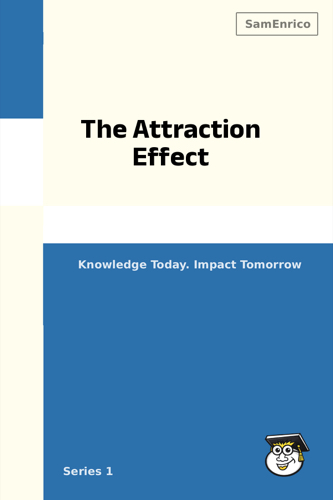
The Attraction Effect eBook
Add dominated options to increase preference for t
Add dominated options to increase preference for target choices.
Formats
Free sample
Chapter 1: The Three Chairs...--–- In a small, unremarkable furniture store outside Cincinnati, a curious experiment unfolded in the early 1980s that would eventually force economists to rewrite their theories about how human beings make choices. The owner of the store, a pragmatic man named Harold who had never taken a psychology course in his life, noticed something strange happening with his mid-range armchair. Priced at $900, it was neither his cheapest option nor his most luxurious. It simply sat there, week after week, gathering dust while customers either bought the $600 economy model or stretched to the $1,200 premium leather version. Harold tried everything.
He moved the $900 chair to the front of the store. He put a spotlight on it. He trained his salespeople to mention it first. Nothing worked. The middle chair was trapped in what marketers now call the "dead zone" of indecision—too expensive to be an impulse buy, too cheap to signal status, too ambiguous to justify.Then Harold met a young consultant who proposed something that seemed, on its face, utterly insane.
"Add another chair," the consultant said. "Price it at $1,200, but make it objectively worse than your $900 chair. Same price, cheaper fabric, less comfortable padding. Put them side by side." Harold laughed. Why would anyone add a product designed to fail?
Why would a worse product priced the same as a better product do anything except confuse customers? But the consultant had a quiet confidence, and Harold was desperate. He ordered a single ugly chair—same frame as the $900 model, but upholstered in a scratchy, cheap-looking fabric that felt like sandpaper. He placed it directly next to the $900 chair. The $1,200 premium leather chair stayed in the back, untouched for now.Within two weeks, sales of the $900 chair tripled.Customers who had previously walked past the $900 chair without a second glance now stopped, pointed, and said, "This one is clearly better than that ugly one over there, and it's the same price.
And look, the leather one is $1,200. This seems like the smart choice." They didn't see the ugly chair as a trap. They saw it as a gift—a comparison point that made their decision easy, defensible, and obvious. The ugly chair sold almost nothing, exactly as planned. But it transformed the $900 chair from an ignored middle option into a clear winner.What Harold discovered by accident, and what the consultant understood from emerging research, was a principle so counterintuitive that it took economists nearly two decades to fully accept: adding an option that nobody wants can increase the preference for an option that you do want.
This is the Asymmetric Dominance Effect. And this chapter will teach you not only how it works, but how to build one yourself.The Grammar of Choice: Target, Competitor, Decoy Every effective decoy requires exactly three characters in a carefully choreographed drama. Before you can build anything, you must learn to name these roles with precision. The Target is the option you actually want people to choose. In Harold's furniture store, the Target was the $900 mid-range armchair.
The **Competitor** is the genuine alternative that customers might reasonably choose instead. In Harold's store, the Competitor was the $1,200 premium leather chair—more expensive, higher quality, a legitimate trade-off. The Decoy is the asymmetrically dominated option. In Harold's store, the Decoy was the $1,200 ugly chair with cheap fabric. Notice the asymmetry: the Decoy was clearly worse than the Target (same price, worse materials) but not clearly worse than the Competitor (same price, different trade-offs between quality and comfort).
That asymmetry is the secret sauce.Let me be explicit about what makes dominance "asymmetric." A fully dominated option is worse than every other option on every attribute. Nobody would ever choose it, and it typically doesn't influence choice because it's simply irrelevant. An asymmetrically dominated option is worse than the Target in a clear, easy-to-see way, but it is not clearly worse than the Competitor. In Harold's store, the Decoy was worse than the Target (same price, worse fabric) but compared to the Competitor, the Decoy offered a different trade-off: same price as the Competitor, but much lower quality. That's not a clear win for either.
The asymmetry forces the brain to compare the Decoy to the Target, notice the Target's superiority, and then transfer that positive feeling to the Target- Competitor comparison.Think of it as a love triangle where one person is obviously unsuitable. When you see your friend dating someone who is clearly wrong for them—same paycheck, same schedule, but meaner and less attractive—your friend suddenly looks like a catch. The unsuitable partner makes your friend shine by comparison. That's asymmetric dominance in social form.The furniture store example reveals a second crucial insight: the Decoy doesn't need to be cheap. In fact, pricing the Decoy lower than the Target is usually a catastrophic mistake because it transforms the Decoy into a competitor.
Customers will think, "Why pay $900 when I can get this slightly worse option for $600?" The Decoy must be priced at or above the Target to avoid becoming an alternative destination. Harold's Decoy was priced at the Target's price ($1,200 for the ugly chair versus $1,200 for the premium leather Competitor), which created a direct comparison. The most powerful decoys are often priced identically to the Target but with clearly inferior attributes. The second most powerful are priced slightly above the Target with dramatically inferior attributes. The forbidden zone is pricing the Decoy below the Target.This grammar of Target, Competitor, and Decoy is the alphabet of attraction.
Every successful decoy in every industry—from popcorn to premium cars, from subscription plans to hotel rooms—follows this same grammatical structure. Once you learn to see it, you will notice decoys everywhere. And once you notice them, you will never be able to ignore them.The 1982 Revolution: How Three Psychologists Broke Economics Before 1982, economists and psychologists believed in a simple, elegant rule called the Regularity Principle. The principle stated that adding a new option to a choice set should never increase the market share of an existing option. At best, the new option would take some share away from existing options.
At worst, it would take share and give nothing back. But it could never, ever make an existing option more popular. This seemed not just reasonable but mathematically necessary. If you add a third flavor of ice cream, why would more people suddenly choose vanilla? If anything, vanilla should lose some share to the new flavor.Then three researchers—Joel Huber, John Payne, and Christopher Puto—published a study that shattered the Regularity Principle into pieces.
They presented consumers with two options: a high-quality, expensive beer and a lower-quality, cheaper beer. When only these two options existed, about 50% of consumers chose each. Then they added a third option: a "decoy" beer that was similar to the high-quality beer but slightly worse in quality and priced slightly higher. According to the Regularity Principle, the high-quality beer should have lost some share to the new decoy. Instead, the high-quality beer's share jumped from 50% to over 70%.
The decoy took almost no share itself. It simply made the high-quality beer look better by comparison.The study was replicated with microwave ovens, with…
This is the end of the free sample. Get the eBook to keep going. Buy now
About this book
Details
- Author
- Juarez Emerald
- Publisher
- SamEnrico
- Language
- English
- Genre
- Non-Fiction, Business Brief, Marketing
- Released
- 2026-06-12
- Pages (approx.)
- 145
- Available as
- eBook, Audiobook

Read better in the ZLOADR app
Your eBooks on your phone or tablet. Sign in with your SamEnrico account and start reading.
More by Juarez Emerald
 Catherine Great Military ReformJuarez Emerald$11.99
 Financial Stress for Small Business OwnersJuarez Emerald$11.99
 Meditation for Beginners WorkbookJuarez Emerald$11.99
 The Silent Witness of Baghdad: The 1941 Murder That Changed Iraqi JusticeJuarez Emerald$11.99
 How to Produce Audio Cards and AdaptersJuarez Emerald$11.99
 IS LM Model Excel SimulatorJuarez Emerald$12.99
 How to Start a Blank Tapes and Discs (retail) Business (Beginners Guide)Juarez Emerald$11.99
 Crocoite MiningJuarez Emerald$11.99
You may also like
 Hong Kong Handover 1997Dunn Johnnie$11.99
 Zumba For Postnatal Recovery CourseNeal Christian$11.99
 Zumba for BeginnersLadner Nikia$11.99
 YouTube Comment Mining GuideHumes Pandora$12.99
 Worry Box MeditationCarlin Rudy$11.99
 Workplace Stress MeditationNguyen Lynn$11.99
 Workplace Stress and Sleep RepairHawley Ivory$11.99
 Workplace Perfectionism CureDelaney Jeffry$11.99
 Workplace Injustice Anger GuideWallen Isabelle$11.99
 Work Addiction and Burnout LinkGreenwood Ester$11.99
 Women in Yoga and WellnessBeattie Galina$11.99
 Women in Stand Up ComedyChun Evangeline$11.99