
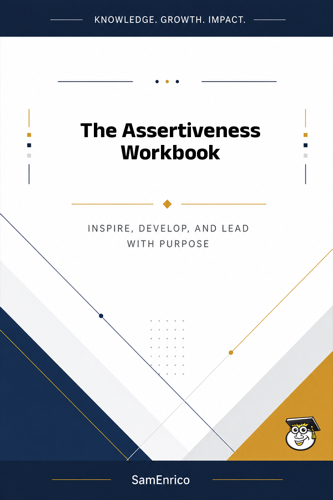
The Assertiveness Workbook eBook
Practice saying no making requests and handling cr
Practice saying no making requests and handling criticism through structured exercises.
Formats
Free sample
Chapter 1: The Ledger of Silence--–- The alarm on your phone reads 11:15 PM, and you’ve been staring at the same email for forty-seven minutes. It’s a request—a favor, really—from a colleague who has asked you for something similar four times this month. Your jaw is clenched. Your shoulders have crept up toward your ears. A voice in your head says, I don’t want to do this.
Another voice, older and louder, says, But I should.You type a reply: Sure, no problem.You hit send. Then you sit in the dark, feeling something you can’t quite name. Not anger, exactly. Not sadness. It feels more like the slow, heavy ache of having just paid a bill with money you don’t have—except the currency was your own time, and the interest will come due as exhaustion tomorrow morning.If this scene feels familiar, you have come to the right chapter.The Question That Changes Everything Let us begin with a question that sounds simple but will, if you take it seriously, rearrange the furniture of your life: What did you not say today that you wish you had?Not yesterday.
Not last year. Today.Take a breath. Let the question settle. Now, think back hour by hour. The barista who got your order wrong, and you said “It’s fine” while planning to throw the drink away.
The meeting where someone interrupted you, and you stopped talking mid-sentence. The friend who texted a last-minute request for a favor, and you typed “Of course!” while your stomach tightened. The family member who made a comment about your job, your weight, your relationship status—and you laughed along, then felt small afterward.Each of these moments is a transaction. You traded your truth for a fleeting sense of safety. And the receipt for that transaction is a quiet, cumulative cost that most people never calculate.This chapter is the calculator.
By the time you finish it, you will understand not only the price of your silence but also the precise shape of your default communication style. More importantly, you will have the first hard data you need to change it.The Three Faces of Unassertiveness Before you can build assertiveness, you must recognize its opposites. Most people assume there are only two ways to handle conflict: fight or flight. But in the landscape of human communication, there are three distinct patterns of unassertive behavior, and each comes with its own signature costs.The first is Passive Communication. This is the pattern of the pleaser, the peacekeeper, the person who has learned that silence is safer than speaking.
Passive communicators say “yes” when they mean “no,” apologize when they haven’t done anything wrong, and shrink their own needs to make room for everyone else’s. Their body language telegraphs submission: slumped shoulders, averted eyes, a voice that rises at the end of statements as if asking permission to exist. The passive communicator’s unspoken creed is: You matter. I do not.The second is Aggressive Communication. This is the pattern of the fighter, the bulldozer, the person who has learned that volume and intimidation get results.
Aggressive communicators interrupt, blame, and use “you” statements as weapons (“You always,” “You never”). Their body language is rigid and invading: pointed fingers, crossed arms, a voice that is loud and flat. The aggressive communicator’s unspoken creed is: I matter. You do not.The third is Passive-Aggressive Communication. This pattern is more cunning because it wears the mask of passivity while wielding the dagger of aggression.
The passive-aggressive communicator says “I’m fine” while radiating resentment. They agree to requests they have no intention of fulfilling. They make sarcastic comments disguised as jokes. They give the silent treatment. Their body language often contradicts their words: a smile that doesn’t reach the eyes, a sigh that says more than any sentence.
The passive-aggressive communicator’s unspoken creed is: You hurt me, so I will hurt you—but you won’t see it coming.Now, here is the uncomfortable truth that every assertiveness book eventually forces you to confront: You have used all three patterns. Maybe not today. Maybe not this week. But the passive pleaser lives in you, the aggressive fighter lives in you, and the passive-aggressive saboteur lives in you. The question is not which one you are.
The question is which one you have practiced so often that it has become your default.The Passive-Aggressive Trap Let us pause here and clarify a term that is frequently misunderstood. In this book, passive-aggressive behavior refers consistently to indirect resistance or silent resentment—for example, agreeing to a request but then “forgetting” to do it, or fuming silently instead of naming a problem. This is something you may do yourself, especially when you feel trapped or powerless. Later in this book (specifically Chapter 5), we will teach you how to respond when others use passive-aggressive tactics with you. For now, the focus is on recognizing your own patterns.
You cannot change what you cannot see.The Hidden Costs of Silence If you have been living in the passive zone—the most common default for readers who pick up this book—you have likely told yourself a comforting story: It’s fine. I’m just easygoing. I don’t like conflict anyway.But the research tells a different story. Chronic unassertiveness is not a personality trait. It is a stress response.
And like any sustained stress response, it exacts a toll on every system of your body and life.Consider the physical costs. When you suppress what you want to say, your nervous system does not simply stop reacting. Instead, it shifts into a low-grade, persistent activation. Cortisol levels remain elevated. Muscles stay partially clenched.
Sleep becomes lighter. Over months and years, this pattern contributes to tension headaches, digestive issues, chronic fatigue, and even cardiovascular strain. Your body keeps the score, even when your voice does not.Consider the emotional costs. Resentment is the interest you pay on borrowed silence. Every time you say “yes” when you mean “no,” you make a withdrawal from your emotional bank account.
The transaction feels small in the moment—It’s just a half-hour favor—but accumulated over weeks and years, it becomes a crushing debt. Resentment does not fade on its own. It fossilizes. By the time you feel it fully, you are not angry about the email you answered at 11:15 PM. You are angry about the five hundred emails before it.Consider the relational costs.
Here is the paradox that shocks most readers: Unassertiveness destroys relationships just as surely as aggression does. When you never say what you need, you rob others of the chance to meet those needs. You become a hidden minefield—pleasant on the surface, explosive underneath. Friends, partners, and colleagues cannot trust what you say because they learn that your “yes” might mean “no,” and your “I’m fine” might mean “I am furious.” The passive person often believes they are being kind by not burdening others. In truth, they are being dishonest.
And dishonesty, even well-intentioned dishonesty, erodes intimacy.Consider the professional costs. One study of workplace dynamics found that employees who consistently…
This is the end of the free sample. Get the eBook to keep going. Buy now
About this book
Details
- Author
- Mireles Cyrus
- Publisher
- SamEnrico
- Language
- English
- Genre
- Non-Fiction, Self-Help, Cognitive
- Released
- 2026-06-08
- Pages (approx.)
- 135
- Available as
- eBook, Audiobook

Read better in the ZLOADR app
Your eBooks on your phone or tablet. Sign in with your SamEnrico account and start reading.
More by Mireles Cyrus
 HR Tech Spending ForecastMireles Cyrus$11.99
 Post Hypnotic WorkbookMireles Cyrus$11.99
 HRT For Gallbladder Health HandbookMireles Cyrus$11.99
 The Empathy for Discrimination GuideMireles Cyrus$11.99
 The Phoenix That Burned Twice: The Great Chicago Fire’s Hidden ArsonistMireles Cyrus$11.99
 Understanding Pericardium Congenital AnomalyMireles Cyrus$17.99
 NYC Pop Up Lease Negotiation GuideMireles Cyrus$12.99
 Flutterwave Split Payments GuideMireles Cyrus$12.99
 Segment ProducerMireles Cyrus$11.99
 How to Start a Testing Laboratories BusinessMireles Cyrus$11.99
You may also like
 Silencing The Inner FraudTrudeau Glennis$11.99
 Check The Facts DBT WorkbookMangum Zenaida$11.99
 Working Memory Aging GuideSpain Andree$11.99
 The Prevention Mindset ShiftLawler Hanh$11.99
 The Context Switching CostWilks Maryalice$11.99
 Mindfulness Of Thoughts And EmotionsWithers Lavona$11.99
 Myths About Emotions GuideBaugh Jung$11.99
 Burnout and Brain FogKearney Maira$11.99
 Benzo Memory Loss RecoveryGoad Tracie$11.99
 Pain Catastrophizing Meditation CourseBronson Summer$11.99
 The Initial Memory Hook GuideRichter Modesta$11.99
 Sleep Deprivation Brain FogVera Salome$11.99