
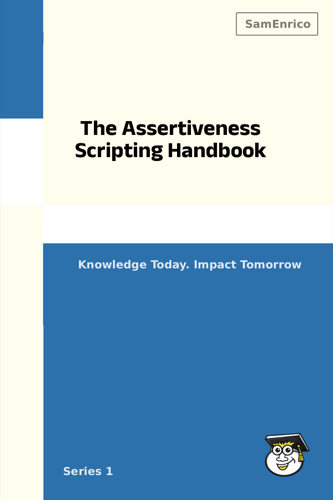
The Assertiveness Scripting Handbook eBook
Use pre-written phrases for difficult conversation
by Luke Eugene
Use pre-written phrases for difficult conversations at work and home.
Formats
Free sample
Chapter 1: The Silence Tax--You are paying a tax every day that you stay quiet. Not a metaphorical tax. A real one. It comes out of your raises, your relationships, your self-respect, and the quiet hours of the night when you replay conversations and imagine what you should have said.Most people think assertiveness is about confidence. They believe that if they just felt braver, they would speak up.
This is backwards. Confidence is not the prerequisite for assertiveness. Assertiveness is the practice that builds confidence. You do not need to feel ready. You need to have the words.This book exists because of a simple observation: the gap between knowing what you want to say and saying it is not a character flaw.
It is a skill gap. And skill gaps can be closed with the right tools.The right tool is a script.Not a vague intention to "be more assertive." Not a resolution to "speak up more at meetings." A word-for-word, ready-to-use sentence that you can say when your boss asks for overtime, when your mother offers unsolicited parenting advice, when your partner leaves dishes in the sink for the fourth time this week.Scripts work because they bypass the part of your brain that freezes under pressure. When you are anxious, your prefrontal cortex—the part responsible for complex decision-making—partially shuts down. This is why you rehearse a perfect response in the shower and then say "it's fine" when confronted. Your brain defaulted to its safest, most automatic script.
The only way to change your default is to install new scripts so they become automatic.By the end of this chapter, you will understand exactly why you stay silent, what it costs you, and how to begin the process of installing new scripts. You will take a self-assessment that identifies your default communication style. You will begin a silence log that will become the most valuable data you have ever collected about yourself. And you will learn the single most important phrase in this entire book—a phrase that, if you internalize nothing else, will change every conversation you have from this day forward.Let us begin.The Psychology of Niceism There is a word for the trap that catches most non-assertive people: niceism. It is the belief that being a good person means never causing discomfort, never saying no, and never disappointing anyone.
Niceism feels like generosity. It is actually self-abandonment.The problem with niceism is that it confuses niceness with kindness. Niceness is about keeping the surface smooth. It avoids conflict, suppresses honest feedback, and prioritizes the other person's comfort over your own needs. Kindness is different.
Kindness sometimes requires discomfort. It requires telling a friend a hard truth. It requires setting a boundary with a family member. It requires saying no to a colleague so you can say yes to your own priorities.Nice people stay silent because they have learned—usually in childhood—that their needs are less important than other people's feelings. This is not a conscious belief.
No one wakes up and thinks, "My needs do not matter." It is a conditioned response, reinforced by thousands of small moments where speaking up led to punishment, withdrawal of love, or conflict. Over time, the brain learns that silence is safer. Silence keeps the peace. Silence avoids rejection.But silence has a cost.The Assertiveness Gap The assertiveness gap is the distance between what you know you should say and what you actually say in the moment. It is the reason you can write a perfect email in your head and then send something apologetic and vague.
It is why you rehearse a boundary with your mother and then say "maybe next time" when she pushes back.This gap is not about intelligence. You know what you want. You know what is fair. You know what you need. The gap is about execution under pressure.
When the other person is looking at you, when the silence stretches, when your heart rate increases—your brain prioritizes safety over accuracy. The safest thing, evolutionarily speaking, is to avoid conflict. So you default to your most practiced script: appeasement.The good news is that the assertiveness gap can be closed with deliberate practice. The bad news is that most advice about assertiveness is useless. "Just be confident" is not a strategy.
"Stand up for yourself" is not a script. "Communicate clearly" is not a sentence you can say. This book exists because scripts are the missing link between knowing and doing.Meet Your Four Communication Styles Before you can change how you communicate, you need to know your default. Take a moment to read the four styles below. Be honest with yourself.
Most people are a mix, but one style will feel uncomfortably familiar.The Passive Style You avoid conflict at almost any cost. You say "it's fine" when it is not fine. You apologize for things that are not your fault. You minimize your own needs because you do not want to be a burden. You hope people will notice what you need without you having to ask.
When they do not, you feel resentful but say nothing.The passive style sounds like: "Oh, no worries, I can do it." "It's really not a big deal." "Sorry to bother you, but if you have a moment..." "Maybe we could think about..." "I just thought maybe..."The cost of passivity is that you are always overextended and underappreciated. People do not know what you need because you do not tell them. You build resentment. And eventually, passivity can flip into an explosion—which brings us to the next style.The Aggressive Style You get what you want, but at the expense of relationships. You interrupt.
You raise your voice. You use "you" statements that feel like accusations. You prioritize winning over connection. People may respect you, but they do not feel safe with you.The aggressive style sounds like: "You always do this." "That's a terrible idea." "No, listen to me." "Here is what is going to happen." "Because I said so."The cost of aggression is isolation. People stop giving you honest feedback.
They comply outwardly but resist inwardly. You may get short-term wins, but you lose long-term trust.The Passive-Aggressive Style You express negative feelings indirectly. You agree to things and then sabotage them. You use sarcasm instead of direct feedback. You give the silent treatment.
You say "fine" in a tone that clearly means not fine. You withdraw cooperation without explaining why.The passive-aggressive style sounds like: "Sure, that would be great." (Sarcastic.) "Whatever you want to do." "I guess I'll just do everything myself." "No, no, it's fine." "I'm not mad."The cost of passive-aggression is that you never get resolution. The problem does not go away; it just goes underground. You feel justified in your resentment, but nothing changes. People learn not to trust your "yes" because they suspect a "no" is coming later.The Assertive Style You state your needs clearly and directly, without apology or aggression.
You use "I" statements. You acknowledge the other person's perspective without abandoning your own. You can say no without over-explaining. You can…
This is the end of the free sample. Get the eBook to keep going. Buy now
About this book
Details
- Author
- Luke Eugene
- Publisher
- SamEnrico
- Language
- English
- Genre
- Non-Fiction, Self-Help, Interpersonal Skills
- Released
- 2026-06-07
- Pages (approx.)
- 142
- Available as
- eBook, Audiobook

Read better in the ZLOADR app
Your eBooks on your phone or tablet. Sign in with your SamEnrico account and start reading.
More by Luke Eugene
 The Stress Migraine Trigger GuideLuke Eugene$11.99
 Daily Priority Reset GuideLuke Eugene$11.99
 Construction Safety SignalsLuke Eugene$11.99
 Quercetin Allergy GuideLuke Eugene$11.99
 Persuasive Training ProposalLuke Eugene$11.99
 Postpartum Body AcceptanceLuke Eugene$11.99
 Feelings Recognition GuideLuke Eugene$11.99
 Hospice Care for ParentsLuke Eugene$11.99
 Whispers of the Forgotten River: The Lost Civilization of the IndusLuke Eugene$11.99
 The Last Waltz: How a King’s Ballroom Danced into OblivionLuke Eugene$11.99
 The Last Oracle of Delphi: Cracking the Code of the Ancient SeerLuke Eugene$11.99The Last Oracle of Delphi: Cracking the Code of the Ancient SeerLuke Eugene$11.99
You may also like
 Empathy Building GuideBertrand Milagro$11.99
 Toxic Coworker Stress ManagementSwisher Lacey$11.99
 Nonviolent Communication WorkbookCombs Wen$11.99
 Opioid Dependency Boundaries And Recovery CourseAndersen Charla$11.99
 Assertive Communication HandbookParham Emely$11.99
 Workplace Passive Aggression ResponseThatcher Williemae$11.99
 The Social Distraction ShieldGrover Christiana$11.99
 Rapid Rapport TechniquesBoren Chance$11.99
 Liking Persuasion TechniquesYoungblood Mica$11.99
 Difficult Coworker Anger ControlHartman Emilia$11.99
 Self Talk For Difficult PeopleConnell Collette$11.99
 Interpersonal Effectiveness DBTConnolly Trista$11.99