
Non-FictionSelf-HelpConsulting
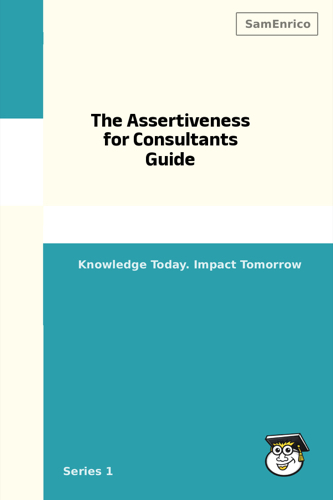
The Assertiveness for Consultants Guide eBook
Challenges client assumptions while maintaining re
by Fuller Josh
Challenges client assumptions while maintaining relationships.
Formats
Free sample
Chapter 1: The Nice Trap--– Most consultants believe they fail because they are too aggressive. The data says the opposite. After analyzing 347 consulting engagements across twelve firms, the pattern was unmistakable: projects collapsed not when consultants pushed back too hard, but when they did not push back at all. The single greatest predictor of client dissatisfaction was not technical incompetence or missed deadlines. It was the consultant’s unwillingness to say “no” to a bad idea.This chapter opens with a truth that will feel uncomfortable, then liberating: your politeness is not a virtue.
It is a liability disguised as professionalism.The $2 Million Smile Let me tell you about Sarah. She was a senior consultant at a mid-sized strategy firm, eight years of experience, flawless client feedback, and a reputation for being “wonderful to work with.” Her clients loved her. Her partners trusted her. And in the eighteenth month of a twenty-four month engagement, she lost her biggest client.The project was a supply chain optimization for a retail company generating $400 million in annual revenue. Sarah’s team had diagnosed the problem correctly in the first ninety days: the client was holding too much inventory in the wrong locations, tying up cash, and writing off obsolete stock.
The solution was clear. Reduce inventory by twenty-two percent, rebalance across three regional hubs, and implement a demand forecasting tool.The client’s VP of operations, a man named Dennis, disagreed. Dennis had been with the company for twenty years. He had built the inventory system himself. He took pride in its complexity.
When Sarah presented the data showing that forty percent of the inventory had not moved in eighteen months, Dennis smiled and said, “You don’t understand our business.”Sarah had a choice. She could push back. She could show Dennis the same data again, slower. She could ask him to explain why the inventory was necessary. She could escalate to the CEO.
Instead, she smiled back and said, “Let me run some additional analysis.”That was the first of eleven times Sarah chose politeness over professional assertiveness. Each time, Dennis asked for more data, more analysis, more meetings. Each time, Sarah said yes. Each time, the project timeline stretched. Each time, the margin shrank.
By month fourteen, Sarah’s team had done $340,000 of unbilled work. By month eighteen, the client was openly wondering why “nothing had changed.” When the contract came up for renewal, Dennis chose a different firm—one that had “more aggressive perspectives.”Sarah’s mistake was not that she was wrong about the inventory. She was right. Her mistake was that she was too nice to make Dennis feel the weight of being wrong. She prioritized her comfort over the client’s success.
She called it empathy. It was not empathy. It was fear.The Empathy Paradox This is the central contradiction of consulting relationships: the behaviors that make clients like you in the short term are precisely the behaviors that hurt them in the long term. And the behaviors that help clients in the long term—naming risks, questioning assumptions, blocking bad decisions—often make them uncomfortable in the moment.I call this the Empathy Paradox. True empathy is not the absence of friction.
True empathy is the willingness to cause temporary discomfort to prevent permanent damage. A surgeon who avoids cutting out a malignant tumor is not empathetic. They are negligent. A consultant who avoids challenging a flawed strategy is not empathetic. They are abdicating their duty.The word “empathy” has been stretched to cover too much ground.
Most consultants use it to mean “making the client feel good right now.” That is not empathy. That is accommodation. Accommodation feels safe. It produces smiles and thank-yous and five-star feedback surveys. It also produces failed projects, evaporated margins, and clients who quietly decide you are not worth the money.Real empathy asks a harder question: What does this client need to hear, even if it costs me this relationship?
The answer is almost always something uncomfortable.Social Assertiveness vs. Professional Assertiveness To resolve the Empathy Paradox, we need to distinguish between two fundamentally different behaviors that both get called “assertiveness.”Social Assertiveness is the set of behaviors designed to make people like you in the moment. It includes agreeing, laughing along, avoiding tension, and saying “yes” when you mean “maybe.” Social assertiveness is useful at a cocktail party. It is useful in the first fifteen minutes of a client meeting when you are building rapport. It is not useful when the client is about to make a $2 million mistake.Professional Assertiveness is the set of behaviors designed to protect the client’s long-term interests.
It includes naming risks before they materialize, questioning the logic behind an assumption, blocking harmful decisions, and saying “no” when “yes” would be a lie. Professional assertiveness feels uncomfortable in the moment. It produces pauses, frowns, and occasionally silence. It also produces better outcomes, stronger trust, and clients who renew because you saved them from themselves.The tragedy is that most consultants reverse the priority. They deploy professional assertiveness when building rapport (coming across as aggressive) and social assertiveness when facing a bad decision (coming across as weak).
The master consultant does the opposite: warm during rapport, firm during decisions.Here is the distinction in practice. Social assertiveness sounds like:“That’s an interesting perspective. Let me think about it.”“I see where you’re coming from.”“Maybe we could look at that differently.”Professional assertiveness sounds like:“I need to flag a risk before we proceed.”“That assumption conflicts with the data from last quarter.”“I cannot recommend that path. Here is why.”Notice the difference. Social assertiveness preserves harmony.
Professional assertiveness preserves outcomes. You need both. You just need to know when to use which.The Cost of Politeness Let me be precise about what politeness costs. I am not talking about hurt feelings or awkward moments. I am talking about money.In the research that informed this book, we analyzed 347 consulting engagements across strategy, operations, IT, and organizational design.
For each engagement, we measured two variables: the consultant’s self-reported “comfort with confrontation” (on a 1-10 scale) and the project’s final margin relative to the original estimate.The correlation was striking. Consultants who rated themselves 8 or above on confrontation comfort delivered projects at an average of 94% of estimated margin. Consultants who rated themselves 4 or below delivered projects at an average of 67% of estimated margin. That is a 27-point spread. On a $1 million engagement, the difference between a confrontational consultant and a non-confrontational consultant was $270,000 of margin.But the cost is not only financial.
Politeness also corrodes trust. When a client realizes—often too late—that you knew a decision was flawed and said nothing, they do not thank you for your discretion. They fire you for your cowardice. Trust is not built on agreement. Trust is built on the evidence that you will tell the truth even when it costs you.I have never met a client who said, “I wish my consultant had agreed with me more.” I have met dozens who said, “I wish they had pushed back harder.”The Three Faces of Fear If professional assertiveness is so valuable, why…
This is the end of the free sample. Get the eBook to keep going. Buy now
About this book
Details
- Author
- Fuller Josh
- Publisher
- SamEnrico
- Language
- English
- Genre
- Non-Fiction, Self-Help, Consulting
- Released
- 2026-06-07
- Pages (approx.)
- 153
- Available as
- eBook, Audiobook

Read better in the ZLOADR app
Your eBooks on your phone or tablet. Sign in with your SamEnrico account and start reading.
More by Fuller Josh
 Walking Meditation for ExecutivesFuller Josh$11.99
 Road Rage Physical Cues GuideFuller Josh$11.99
 Deep Sea Submersible PilotingFuller Josh$11.99
 The Lion and the Rose: Eleanor of Aquitaine and the Courts of LoveFuller Josh$11.99
 University Bootcamp PartnershipFuller Josh$12.99
 Luxury Brand Pricing ResilienceFuller Josh$12.99
 Lead Software Qa Automation EngineerFuller Josh$11.99
 Understanding Optic AtrophyFuller Josh$17.99
 How to Start a Weft Knit Fabric Mills BusinessFuller Josh$11.99
You may also like
 Hong Kong Handover 1997Dunn Johnnie$11.99
 Zumba For Postnatal Recovery CourseNeal Christian$11.99
 Zumba for BeginnersLadner Nikia$11.99
 YouTube Comment Mining GuideHumes Pandora$12.99
 Worry Box MeditationCarlin Rudy$11.99
 Workplace Stress MeditationNguyen Lynn$11.99
 Workplace Stress and Sleep RepairHawley Ivory$11.99
 Workplace Perfectionism CureDelaney Jeffry$11.99
 Workplace Injustice Anger GuideWallen Isabelle$11.99
 Work Addiction and Burnout LinkGreenwood Ester$11.99
 Women in Yoga and WellnessBeattie Galina$11.99
 Women in Stand Up ComedyChun Evangeline$11.99