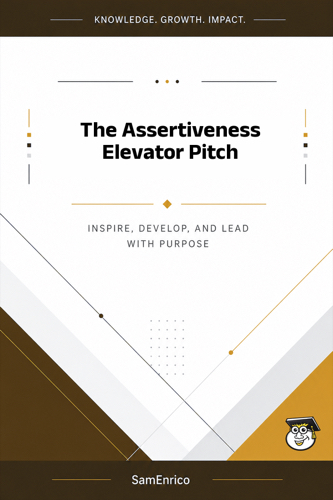
The Assertiveness Elevator Pitch Audiobook
State your needs or boundaries in 30 seconds or le
State your needs or boundaries in 30 seconds or less.
Formats
Free sample
Chapter 1: The Three Traps--–- You are not bad at assertiveness. You were never taught it.The first time you failed to speak up, you probably told yourself a story. Maybe you said, I'm just not a confrontational person. Or I'll pick my battles. Or It's not worth the drama.
Those stories feel true because you have repeated them for years. But they are not true. They are explanations you invented to make sense of a pattern you did not understand.Here is what actually happened: your brain detected a social threat. It scanned the situation—someone asking too much, stepping over a line, ignoring your time—and it calculated that speaking up might lead to rejection, anger, or loss of approval. So it chose a survival strategy.
That strategy worked to keep you safe in the moment. But it failed to protect your time, energy, or self-respect.This chapter is about naming those survival strategies. Not to shame you. To liberate you. Because once you see the pattern, you cannot unsee it.
And once you cannot unsee it, you can finally choose something different.The Myth of the Natural Assertor Most people believe that assertiveness is a personality trait. You either have it or you do not. Some people are born confident, and the rest of us spend our lives apologizing for existing. This is completely wrong.Assertiveness is a set of behaviors. Behaviors can be learned.
No one is born knowing how to say no without guilt, how to state a need without apology, or how to hold a boundary when someone pushes back. These are skills, like driving a stick shift or cooking a meal from scratch. The first few attempts feel awkward. You stall. You burn things.
But over time, the movements become automatic.The reason you believe you are "just not assertive" is not because you lack the gene for it. It is because you have practiced the opposite behaviors thousands of times. Every time you said yes when you meant no, you strengthened a neural pathway. Every time you stayed silent when you should have spoken, you made silence more automatic. Every time you apologized for having a need, you told your brain that your needs are shameful.The good news is that neural pathways can be rewritten.
But first, you have to see the three traps you keep falling into.The First Trap: The Flinch The Flinch is…
This is the end of the free sample. Get the Audiobook to keep going. Buy now
About this book
Details
- Author
- Putnam Sterling
- Publisher
- SamEnrico
- Language
- English
- Genre
- Non-Fiction, Self-Help, Brevity
- Released
- 2026-06-08
- Pages (approx.)
- 114
- Available as
- eBook, Audiobook

Listen in the VoxFlicks app
Audiobooks and audio dramas wherever you go. Sign in with your SamEnrico account and press play.
More by Putnam Sterling
 IKEA Effect In BusinessPutnam Sterling$11.99
 Organization of African UnityPutnam Sterling$11.99
 Central India CampaignPutnam Sterling$11.99
 Emotion Apps GuidePutnam Sterling$11.99
 Anger And Bullying ChildrenPutnam Sterling$11.99
 Trauma Impact Relationship GuidePutnam Sterling$11.99
 Persuasive Crisis Response PlanPutnam Sterling$11.99
 Marc Andreessen BrowserPutnam Sterling$11.99
 The Velvet Coup: How a Secret Society Almost Toppled the White HousePutnam Sterling$11.99
 Dancing on the Edge of Scandal: The Radical Moves of Modern Dance's Forgotten RebelPutnam Sterling$11.99
 The 1971 Dollar Bill Heist: When Counterfeiters Almost Broke the U.S.Putnam Sterling$11.99
 The Mineral Guide to PericlasePutnam Sterling$11.99