
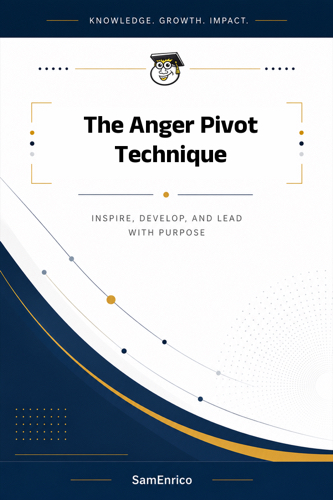
The Anger Pivot Technique eBook
Shifts from rage to curiosity by asking specific q
by Fleck Hyman
Shifts from rage to curiosity by asking specific questions that interrupt the anger script.
Formats
Free sample
Chapter 1: The Seven-Second Prison--You have approximately seven seconds from the moment you are triggered until the moment you say something you cannot take back. That is not a metaphor. That is not a motivational slogan. That is the measured speed of the amygdala hijack, and it is the most important number you will learn in this entire book.Seven seconds.In that brief window, your brain—specifically your amygdala, two almond-shaped clusters of neurons deep in your temporal lobes—will decide whether you are under attack. If it decides yes, it will bypass your prefrontal cortex entirely.
It will not consult your better judgment. It will not check your values or your long-term goals or your memory of the last time you exploded and regretted it. It will simply flood your body with cortisol and adrenaline, and it will do so faster than you can think the words "I should calm down."You are not choosing to get angry in those seven seconds. You are being acted upon. And that distinction—between choice and hijack—is the first and most important pivot this book will teach you.The Shame Trap Let us begin with something most anger books avoid: the shame.If you are reading this, you have almost certainly lost your temper in a way that still haunts you.
Maybe it was a text message you sent at 11 PM that you woke up regretting. Maybe it was a scream at your child that you have apologized for a dozen times but cannot forget. Maybe it was a confrontation at work that got you labeled as "difficult" or "volatile" or worse. And after each explosion, someone—a partner, a friend, a therapist, or your own inner voice—told you that anger is a choice. That you should have walked away.
That you knew better.That advice is not wrong in its intention, but it is wrong in its timing. Because in the moment of the hijack, you do not have access to "knowing better." Your prefrontal cortex—the part of your brain responsible for reasoning, impulse control, and long-term thinking—has been temporarily disconnected. It is like telling someone who is drowning to remember proper swimming technique. They already know how to swim. The problem is that they are currently underwater and cannot breathe.The shame comes from the gap between what you know you should have done and what you actually did.
And that gap feels like a moral failure. It feels like proof that you are a bad person, or weak, or broken.You are none of those things. You are experiencing a predictable, well-documented neurological event. And the only way to close that gap between knowledge and action is not to try harder. It is to understand the architecture of the hijack and install an interrupt exactly where the architecture allows one.The Anatomy of a Hijack Let us walk through what happens inside your brain during those seven seconds.Step One: The Trigger.
Something happens. Your child spills juice on your laptop. Your partner makes a sarcastic comment. A driver cuts you off. A coworker takes credit for your idea.
The trigger itself is neutral—it is an event, a sound, a sequence of words. But your brain does not process it neutrally. Your brain processes it through the lens of survival.Step Two: The Appraisal. Within milliseconds, your amygdala asks a single question: Is this a threat? It does not ask "Is this a threat to my physical safety?" It asks "Is this a threat?" full stop.
And because the amygdala is an ancient structure designed for a world of predators and ambushes, it casts a very wide net. A sarcastic comment can be appraised as a threat to your social standing. A spilled drink can be appraised as a threat to your resources. A slight at work can be appraised as a threat to your reputation. All of these are, in the amygdala's primitive calculus, threats to survival.
Not because they will kill you, but because in the environment where the amygdala evolved, social exclusion often did lead to death.Step Three: The Bypass. Once the amygdala appraises a threat, it activates the HPA axis (hypothalamic-pituitary-adrenal axis), which releases cortisol and adrenaline. Your heart rate increases. Your breathing becomes shallow. Blood flows away from your digestive system and toward your large muscle groups.
Your pupils dilate. Your hearing sharpens. You are now in fight-or-flight mode. And crucially, this entire cascade happens without input from your prefrontal cortex. The amygdala has a direct neural pathway that bypasses the thinking brain entirely.
That is why you cannot reason your way out of an anger hijack in real time. The reasoning part of your brain is literally offline.Step Four: The Script. This is where individual differences matter. Your amygdala does not just trigger a generic fight response. It triggers a specific anger script—a learned sequence of physiological reactions, thoughts, and behaviors that you have rehearsed over years.
If you grew up in a household where anger was expressed as yelling, your script probably involves yelling. If you grew up where anger was expressed as stonewalling, your script probably involves withdrawal. If you grew up where anger was suppressed until it exploded, your script probably involves sudden, catastrophic outbursts. These scripts are stored in your brain like any other habit. And each time you run the script, you groove the neural pathway deeper.This is why people say "I have a short fuse" as if it were a fixed trait.
It is not fixed. But it is practiced. And what has been practiced can be interrupted.The 7-Second Window (And What Comes After)Now we need to be precise about timing, because imprecise timing has ruined more anger management efforts than anything else.Here is the standardized timeline that will structure every technique in this book:Seconds 0 to 7: The Hijack. This is the automatic, unconscious, non-volitional phase. Your amygdala appraises a threat, activates your sympathetic nervous system, and bypasses your prefrontal cortex.
You are not choosing anything during these seven seconds. You are reacting. This is not a moral failure. This is biology.Seconds 7 to 10: The Pivot Window. This is the only three-second period in which you can successfully interrupt the anger script.
Why? Because by second seven, the initial cortisol surge has crested but not yet fully saturated your system. Your prefrontal cortex is beginning to come back online. You are not calm—far from it—but you have a brief window of partial access to your executive function. If you miss this window—if you let the anger script run past second ten—you will likely explode, and your prefrontal cortex will not fully return until the adrenaline clears, which can take twenty minutes or longer.The Pivot Itself: 2.5 Seconds.
The actual interrupt—the physical or cognitive move that stops the script—takes only 2.5 seconds. You are not trying to calm down in 2.5 seconds. You are not trying to solve the problem. You are not trying to forgive anyone. You are simply interrupting.
Think of it like slamming the pause button on a video that is playing. The video is still there. The emotion…
This is the end of the free sample. Get the eBook to keep going. Buy now
About this book
Details
- Author
- Fleck Hyman
- Publisher
- SamEnrico
- Language
- English
- Genre
- Non-Fiction, Self-Help, Reframing
- Released
- 2026-06-09
- Pages (approx.)
- 142
- Available as
- eBook, Audiobook

Read better in the ZLOADR app
Your eBooks on your phone or tablet. Sign in with your SamEnrico account and start reading.
More by Fleck Hyman
 Self Hypnosis For Habit Change CourseFleck Hyman$11.99
 Chunking for Team LeadershipFleck Hyman$11.99
 Hybrid Meeting Facilitation GuideFleck Hyman$11.99
 Family Time Distraction GuideFleck Hyman$11.99
 The Redemption Code: How a Hacker Saved the InternetFleck Hyman$11.99
 The Celestial Cartographer: When the Stars SpokeFleck Hyman$11.99
 Functional AnalystFleck Hyman$11.99
 How to Start a Dehydrating Fruit for Human Consumption Business (Beginners Guide)Fleck Hyman$11.99
 Scrum for Netflix StartupsFleck Hyman$12.99
 Redbubble Design RequirementsFleck Hyman$12.99
 Understanding EnetophobiaFleck Hyman$17.99
You may also like
 Hong Kong Handover 1997Dunn Johnnie$11.99
 Zumba For Postnatal Recovery CourseNeal Christian$11.99
 Zumba for BeginnersLadner Nikia$11.99
 YouTube Comment Mining GuideHumes Pandora$12.99
 Worry Box MeditationCarlin Rudy$11.99
 Workplace Stress MeditationNguyen Lynn$11.99
 Workplace Stress and Sleep RepairHawley Ivory$11.99
 Workplace Perfectionism CureDelaney Jeffry$11.99
 Workplace Injustice Anger GuideWallen Isabelle$11.99
 Work Addiction and Burnout LinkGreenwood Ester$11.99
 Women in Yoga and WellnessBeattie Galina$11.99
 Women in Stand Up ComedyChun Evangeline$11.99