
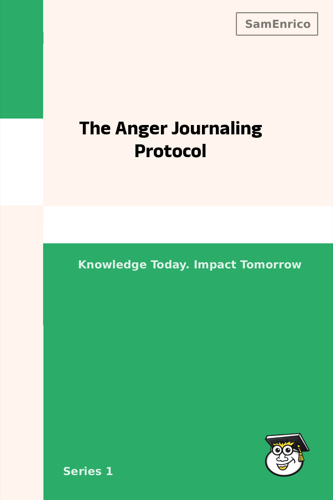
Non-FictionSelf-HelpTherapeutic Writing
The Anger Journaling Protocol eBook
Provides structured prompts to vent, analyze, and
Provides structured prompts to vent, analyze, and transform rage on paper before speaking.
Formats
Free sample
Chapter 1: The 6-Second Hijack--The most dangerous moment in any argument is not the first shout or the slammed door. It is the six seconds that come before—the interval in which your brain decides that the person standing in front of you is no longer a person but a threat. In those six seconds, your prefrontal cortex, the seat of logic, reason, and empathy, is effectively offline. You are not thinking. You are reacting.
And no amount of willpower, self-help mantras, or good intentions can override biology.If you have ever said something in anger that you would never say in a calm moment—a cruelty that shocked even you—you have experienced the 6-Second Hijack. This chapter is about understanding that hijack so completely that you can see it coming, name it, and most importantly, delay your response long enough to choose a different path. The path this book offers is not silence or suppression. It is the page. Before you can journal your way through anger, you must understand what anger actually is: a neurochemical event, not a moral failure.The Myth of Rational Anger Let us begin with a lie you have probably told yourself: "If I could just explain myself clearly, they would understand." Or worse: "I am right to be angry, so my anger is justified, so my behavior is acceptable."Here is the truth.
Anger is not a problem because it is immoral. Anger is a problem because it is biologically incapable of producing the outcomes you want during its peak intensity. You cannot negotiate with a hijacked brain. You cannot persuade someone of your righteousness while your pupils are dilated, your heart rate is 140 beats per minute, and your body is pumping cortisol and adrenaline through every vessel. You are not in a conversation.
You are in a survival response.The myth of rational anger is seductive because it feels true. When you are angry, you feel clear. You feel certain. The world simplifies into two categories: threats and allies. This clarity is an illusion.
It is produced by the same neurological mechanisms that make people in cults feel certain, that make gamblers feel lucky, that make drivers in road rage feel justified ramming another car. Certainty is not truth. Certainty is a chemical state.The Neuroscience of the Blow-Up Let us walk through exactly what happens inside your skull when a trigger occurs.At time zero, something happens. A comment. A gesture.
A memory. A text left on read. Your brain's threat-detection system—the amygdala, two almond-shaped clusters deep in the temporal lobes—processes this event in 30 milliseconds. That is faster than conscious thought. Your amygdala does not ask, "Is this actually dangerous?" It asks, "Does this resemble a past danger?" If the answer is yes, it sounds the alarm.Within one second, your hypothalamus activates your sympathetic nervous system.
This is the "fight or flight" response. Your adrenal glands release epinephrine (adrenaline) and norepinephrine. Your heart rate jumps from 70 to 120 beats per minute. Your blood pressure rises. Your breathing becomes shallow and rapid.
Blood flows away from your digestive system and toward your large muscle groups—you are being prepared to fight or flee.Within three seconds, your body releases cortisol, the primary stress hormone. Cortisol increases glucose in your bloodstream, enhances your brain's use of glucose, and increases the availability of substances that repair tissues. In a genuine survival situation—a predator, a falling object—this is life-saving. In a conversation with your partner about who forgot to take out the trash, this is catastrophic.Within six seconds, your prefrontal cortex—the part of your brain responsible for impulse control, long-term planning, empathy, and abstract reasoning—begins to downregulate. Your brain is diverting energy from "thinking slow" to "reacting fast." You are not stupid when you are angry.
You are temporarily operating with a different brain.This is the 6-Second Hijack. From trigger to takeover: six seconds.Why "Counting to Ten" Is Almost Useless You have heard the old advice: count to ten before you speak. This advice is not wrong, but it is incomplete. Counting to ten gives your neurochemical spike approximately ten seconds to crest and begin subsiding. That is useful.
The problem is that counting alone does not do anything with the energy of the hijack. It simply delays the explosion. The pressure builds behind a dam, and when you finally speak after ten seconds, you often speak just as harshly—only now you have had ten seconds to rehearse your cruelty.The science of emotion regulation tells us that the amygdala cannot sustain its peak activation indefinitely. The adrenaline surge lasts between 6 and 10 seconds. The cortisol response takes longer to clear—up to 20 minutes for a single spike, and hours if the trigger is repeated or the rumination continues.
But the peak intensity, the moment when you are most likely to say something you will regret, lasts only about 10 seconds.Here is what counting to ten misses: the need for embodied discharge. The energy of the hijack has to go somewhere. If you simply count, the energy remains. It pools in your chest, your jaw, your fists. It waits.
The moment you stop counting, it explodes. This is why so many people report "trying to stay calm" and then "snapping anyway." They delayed but did not discharge.The solution is not counting. The solution is redirected discharge—taking that six seconds of hijack energy and putting it onto a page before it comes out of your mouth. This is the entire premise of The Anger Journaling Protocol. You are not preventing the biological response.
You are intercepting its expression.Hot Anger vs. Cold Anger: A Critical Distinction Before we go further, you need a vocabulary for what you will experience over the next twelve weeks. Not all anger is the same. The difference between destructive rage and useful information is often the difference between Hot Anger and Cold Anger.Hot Anger is the 6-Second Hijack. It is physical, high-adrenaline, short-duration, and low-clarity.
Hot Anger feels like electricity in your veins, heat in your face, pressure in your chest. You cannot think clearly during Hot Anger—not because you are weak or undisciplined, but because your prefrontal cortex is literally under-resourced. Hot Anger is for discharge. Its purpose is to give you the energy to survive a threat. In modern life, that threat is almost never physical.
But your body does not know that. Your body thinks you are being chased by a lion. It is preparing you to fight.Cold Anger is what remains after the hijack passes. It is calm, analytical, and sustainable. Cold Anger can last for days or weeks.
It does not make your hands shake. It does not make you want to throw things. Cold Anger is the recognition that something is wrong, that a boundary has been crossed, that a value has been violated. Cold Anger is for problem-solving. It is the emotion that fuels activism, justice, and necessary confrontation.Here is the most important thing you will learn in this chapter: You cannot skip Hot Anger to get to Cold Anger.
You must pass through the fire. The question is not whether you will experience Hot Anger—you will. The question is…
This is the end of the free sample. Get the eBook to keep going. Buy now
About this book
Details
- Author
- Cobb Lorraine
- Publisher
- SamEnrico
- Language
- English
- Genre
- Non-Fiction, Self-Help, Therapeutic Writing
- Released
- 2026-06-08
- Pages (approx.)
- 141
- Available as
- eBook, Audiobook

Read better in the ZLOADR app
Your eBooks on your phone or tablet. Sign in with your SamEnrico account and start reading.
More by Cobb Lorraine
 Chunking for InnovationCobb Lorraine$11.99
 Remote Onboarding PlaybookCobb Lorraine$11.99
 Student Support Network BuildingCobb Lorraine$11.99
 Money Scarcity Mindset CourseCobb Lorraine$11.99
 The Sapphire Serpent Heist: A Thief, a Legend, and a Vanishing CrownCobb Lorraine$11.99
 Icebound Secrets: The Scientists Who Solved Franklin's Arctic MysteryCobb Lorraine$11.99
 How to Start a Automobile Racing Team BusinessCobb Lorraine$11.99
 GlidingCobb Lorraine$11.99
 Redbubble AI Art Group BoardsCobb Lorraine$12.99
 Scrum for Slack StartupsCobb Lorraine$12.99
 Understanding EnterobiasisCobb Lorraine$17.99
You may also like
 Hong Kong Handover 1997Dunn Johnnie$11.99
 Zumba For Postnatal Recovery CourseNeal Christian$11.99
 Zumba for BeginnersLadner Nikia$11.99
 YouTube Comment Mining GuideHumes Pandora$12.99
 Worry Box MeditationCarlin Rudy$11.99
 Workplace Stress MeditationNguyen Lynn$11.99
 Workplace Stress and Sleep RepairHawley Ivory$11.99
 Workplace Perfectionism CureDelaney Jeffry$11.99
 Workplace Injustice Anger GuideWallen Isabelle$11.99
 Work Addiction and Burnout LinkGreenwood Ester$11.99
 Women in Yoga and WellnessBeattie Galina$11.99
 Women in Stand Up ComedyChun Evangeline$11.99