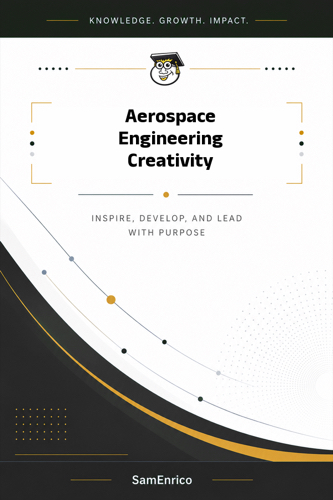
The Aerospace Engineer Creativity eBook
Lightweighting and aerodynamic innovation.
Lightweighting and aerodynamic innovation.
Formats
Free sample
Chapter 1: The Weight-Drag Spiral--The most dangerous moment in an aerospace engineer’s career is not the explosion, the crash, or the failed test flight. It is the quiet moment when she decides, against all evidence, that a tiny addition of weight or a small increase in drag “doesn’t matter.”That decision happens in design reviews, in CAD models, in the margins of hand calculations. A bracket is thickened “just to be safe.” A wire bundle is routed without optimization “because we’ll fix it later.” A panel is left untapered “because manufacturing prefers straight lines.” Each decision adds a few grams, a few counts of drag. None of them, in isolation, kills the program.But they never stay in isolation.This chapter reveals the hidden mathematics of failure in aerospace engineering: the weight-drag spiral. It is the single most important concept in this book because it explains why great designs become mediocre, why mediocre designs become failures, and why the most creative engineers are obsessed with things that, to outsiders, look like penny-ante nitpicking.We will begin with a story—a true story—about an aircraft that should have changed the world.
Then we will derive the equations that explain why it failed. And finally, we will learn the creativity skill that separates the engineers who break records from those who break airplanes.The Story of the Aircraft That Ate Itself In the early 1960s, a major American airframer began development of a medium-range commercial jet intended to compete with the Boeing 727. The design was elegant: three rear-mounted engines, a T-tail, and a wing designed with the latest supercritical airfoil technology. The marketing team called it “the perfect regional jet.”The engineering team knew better. They had a problem.
The aircraft was getting heavier.It started innocently. The wing needed additional spar thickness to accommodate a last-minute landing gear repositioning. That added seventy kilograms. The landing gear itself needed strengthening to handle the new wing loads. That added thirty kilograms.
The heavier gear required a larger hydraulic actuator. That added twelve kilograms. The larger actuator required a bigger pump. That added eight kilograms. The pump required more electrical power.
That required a larger generator. That added fourteen kilograms.Seventy kilograms became one hundred thirty-four kilograms in six cascading decisions. And that was just the landing gear chain.The fuselage needed additional stringers when the payload requirement increased by two passengers. The tail needed resizing when the center of gravity shifted aft. The engines needed uprating when the takeoff weight exceeded the original thrust assumption.
The uprated engines weighed more, which moved the center of gravity further aft, which required more tail, which weighed more, which required more thrust…By the time the aircraft entered flight test, it was twenty-three percent heavier than the original concept. Its range was thirty-one percent less than promised. Airlines canceled orders. The program was discontinued after only forty-eight aircraft. The airframer lost nearly half a billion dollars.The post-mortem identified no single cause of death.
The aircraft had not suffered a catastrophic structural failure. It had not experienced an engine explosion or a control system malfunction. It had simply been eaten alive—from the inside—by the weight-drag spiral.The Breguet Range Equation: A Creativity Tool in Disguise Most engineers encounter the Breguet Range Equation in their first aircraft design course. It looks like this:R = (V / C) * (L/D) * ln(W_initial / W_final)Where R is range, V is velocity, C is specific fuel consumption, L/D is lift-to-drag ratio, W_initial is takeoff weight, and W_final is landing weight.In textbooks, this equation is presented as a performance prediction tool. You plug in numbers.
You get a range. You compare it to requirements. That is the boring way to use it.The creative way to use the Breguet equation is as a sensitivity analysis tool—a way of understanding which design changes produce the biggest leverage. Let us rewrite the equation in a more intuitive form. For a given aircraft with fixed velocity, fuel consumption, and aerodynamic efficiency, the range is proportional to the logarithm of the weight ratio.Logarithms have a beautiful property for the creative engineer: they reward reductions in empty weight much more than they reward reductions in fuel weight.
Here is why.If you reduce fuel weight by one kilogram, you are reducing both W_initial and W_final by the same amount. The ratio inside the logarithm changes very little. But if you reduce empty weight by one kilogram, you reduce W_initial without changing W_final. The ratio improves directly.The mathematics works out like this: for a typical commercial jet, reducing empty weight by one percent increases range by roughly three percent. Reducing empty weight by ten percent—which is achievable through the techniques in this book—doubles the range increase from the same fuel load.This is the leverage point that non-creative engineers miss.
They focus on fuel weight because fuel is heavy and visible. Creative engineers focus on empty weight because the leverage is higher and the opportunities are everywhere.Every gram of empty weight that you eliminate is worth three grams of fuel that you never have to burn. That is the hidden math of lightweighting. That is why the engineers who obsess over brackets, fasteners, and wire gauges are not being pedantic. They are chasing leverage.The Vicious Cycle of Supporting Weight The weight-drag spiral has two engines, not one.
The first engine is structural: weight begets weight. The second engine is aerodynamic: drag begets drag. And the two engines feed each other in a feedback loop that can destroy a design in months.Structural Cascades Consider a simple structural component: a wing spar. The spar must support the wing’s bending moment, which is proportional to the wing’s weight multiplied by the distance from the root. If the wing gets heavier, the bending moment increases.
If the bending moment increases, the spar must be thicker or wider. A thicker or wider spar is itself heavier. That additional weight increases the bending moment further.The mathematics of this cascade is known as the weight growth factor. For a typical transport aircraft, each kilogram of added equipment at the wing tip requires approximately three kilograms of additional structure to support it. Why three?
Because the tip weight increases the bending moment, which requires more spar material, which adds weight along the entire span, which increases the moment further, which requires even more material…This cascade does not stop at the wing. The heavier wing requires a stronger wing box. The stronger wing box is heavier, which increases the fuselage bending moment. The fuselage must be stiffened. The stiffened fuselage is heavier, which increases the landing gear loads.
The landing gear must be strengthened. The strengthened landing gear is heavier, which increases the braking requirement. The brakes must be enlarged. The enlarged brakes are heavier…A single kilogram added in the wrong place can become ten kilograms of total aircraft weight growth. The engineer who adds a bracket “just to be safe” without recalculating the cascade is not being safe.
They are planting a time bomb.Aerodynamic Cascades The same logic applies to drag. Consider the wing-body junction—the place where the…
This is the end of the free sample. Get the eBook to keep going. Buy now
About this book
Details
- Author
- Sumpter Chantal
- Publisher
- SamEnrico
- Language
- English
- Genre
- Non-Fiction, Self-Help, Aerospace Engineering
- Released
- 2026-06-06
- Pages (approx.)
- 138
- Available as
- eBook, Audiobook

Read better in the ZLOADR app
Your eBooks on your phone or tablet. Sign in with your SamEnrico account and start reading.
More by Sumpter Chantal
 The Assertive Communication GuideSumpter Chantal$11.99
 Seasonal Hiring StrategiesSumpter Chantal$11.99
 Rise Of Napoleon Bonaparte HandbookSumpter Chantal$11.99
 Oswald Chambers Evangelist TeacherSumpter Chantal$11.99
 The Minie Ball Revolution: How a Bullet Changed Warfare Forever (1850s)Sumpter Chantal$11.99
 Understanding Sulfatidosis Juvenile, Austin TypeSumpter Chantal$17.99
 SA8000 Certification ExportSumpter Chantal$12.99
 ESG Intangible Value GuideSumpter Chantal$12.99
 How to Become a StackerSumpter Chantal$11.99
 Ecommerce Project ManagerSumpter Chantal$11.99