
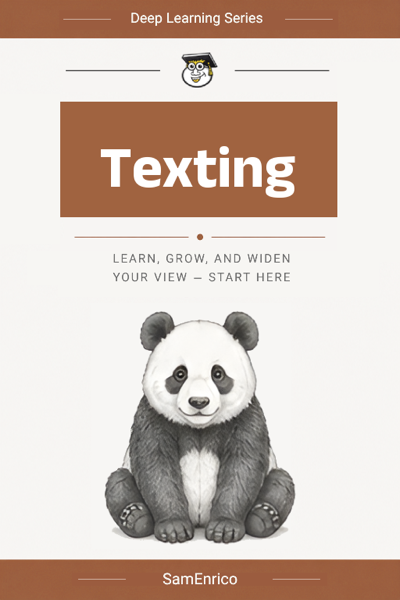
Non-FictionInformativeEducational
Texting
A Coursebook on Texting
by Simpkins Jae
A Coursebook on Texting
Formats
About this book
Free sample
Chapter 1: The Silent Boom--– In 1992, a 22-year-old British engineer named Neil Papworth sat at a computer in Berkshire, typed the letters "M-E-R-R-Y C-H-R-I-S-T-M-A-S," and sent the first text message in human history. He didn't know it, but he had just ignited a communication revolution that would, within three decades, become the most frequently used data service on the planet. That first SMS—sent from a computer to an Orbitel 901 mobile phone—was not a conversation. It was a test. But it cracked open a door that no one has been able to close since.Today, over 23 billion text messages are sent every single day worldwide.
That's more than 2.6 million messages per second. If you took all the text messages sent in a single year and lined them up as individual characters, they would stretch across the observable universe and back—multiple times. Texting has become the default human interface, the primary channel through which we flirt, fight, parent, negotiate, grieve, and love. Yet most of us learned to do it without a single lesson, a single manual, or a single moment of intentional training. We learned by doing—and by failing.This chapter traces the improbable journey of texting from a technical afterthought to the dominant form of human connection on the planet.
We will explore why 160 characters shaped not just a technology but a psychology, how different cultures adapted the same medium to opposite ends, and the hidden architecture of unwritten rules that now governs billions of daily interactions. By the end of this chapter, you will never look at your message thread the same way again.The Accidental Invention The story of texting begins not with a grand vision but with a constraint. In the mid-1980s, a French engineer named Friedhelm Hillebrand was working on the Global System for Mobile Communications (GSM) standards. He had a problem: how many characters should a single text message contain? The answer was not based on user research, behavioral science, or even market testing.
It was based on Hillebrand sitting at a typewriter in his home, tapping out random sentences and questions, and counting…
This is the end of the free sample. Get the eBook to keep going. Buy now
Contents
- Chapter 1
- Chapter 2
- Chapter 3
- Chapter 4
- Chapter 5
- Chapter 6
- Chapter 7
- Chapter 8
- Chapter 9
- Chapter 10
- Chapter 11
- Chapter 12
Details
- Author
- Simpkins Jae
- Publisher
- SamEnrico
- Language
- English
- Genre
- Non-Fiction, Informative, Educational
- Released
- 2026-05-06
- Pages (approx.)
- 134
- Available as
- eBook, Audiobook

Read better in the ZLOADR app
Your eBooks on your phone or tablet. Sign in with your SamEnrico account and start reading.
More by Simpkins Jae
 Cross Cultural Email Cheat SheetSimpkins Jae$11.99
 Letting Go Of Perfectionism GuideSimpkins Jae$11.99
 Esports and Gaming BurnoutSimpkins Jae$11.99
 The Listening Without Interrupting GuideSimpkins Jae$11.99
 Metta For Pregnancy LossSimpkins Jae$11.99
 The Tsar’s Plague Fighters: Russia’s Medical Miracle in the Age of CholeraSimpkins Jae$11.99
 How to Start a Acoustical Engineering Design Business (Beginners Guide)Simpkins Jae$11.99
 Published Article Sharing GuideSimpkins Jae$12.99
 Cost Tracking Inflation GuideSimpkins Jae$12.99
 Understanding Sosby SyndromeSimpkins Jae$17.99
You may also like
 Hong Kong Handover 1997Dunn Johnnie$11.99
 Zumba For Postnatal Recovery CourseNeal Christian$11.99
 Zumba for BeginnersLadner Nikia$11.99
 YouTube Comment Mining GuideHumes Pandora$12.99
 Worry Box MeditationCarlin Rudy$11.99
 Workplace Stress MeditationNguyen Lynn$11.99
 Workplace Stress and Sleep RepairHawley Ivory$11.99
 Workplace Perfectionism CureDelaney Jeffry$11.99
 Workplace Injustice Anger GuideWallen Isabelle$11.99
 Work Addiction and Burnout LinkGreenwood Ester$11.99
 Women in Yoga and WellnessBeattie Galina$11.99
 Women in Stand Up ComedyChun Evangeline$11.99