
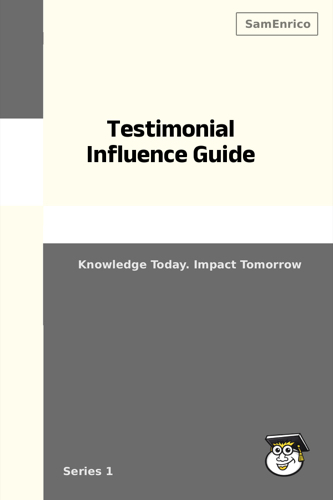
Non-FictionSelf-HelpTestimonialEndorsement
Testimonial Influence Guide eBook
Use third party endorsements to build credibility
Use third party endorsements to build credibility and trust.
Formats
Free sample
Chapter 1: The Permission Paradox--Every morning, before your first cup of coffee, you make a dozen decisions that will determine the trajectory of your day. You decide whether to hit snooze or rise. You decide what to wear, what to eat, which route to drive, which email to open first, which task to prioritize, which notification to ignore. By the time you arrive at your desk—or your kitchen table, or your favorite coffee shop—your brain has already processed more information than a supercomputer from the 1980s could handle in a month. And here is the cruel irony: you are not done.
The hardest decisions are still waiting for you. Which vendor should you trust? Which product will actually solve your problem? Which course, which tool, which service, which expert, which promise is real?This is the permission paradox. You desperately want someone to tell you what to do.
You want a shortcut, a signal, a seal of approval that says, “This one is safe.” But you also distrust anyone who tries too hard to give you that permission. You smell manipulation. You sense the sales pitch. You pull back. So you remain stuck, paralyzed between the need for guidance and the fear of being guided.This chapter is about why that paradox exists and how third-party endorsements—when deployed correctly—resolve it better than any other mechanism in marketing.
We will explore the neuroscience of trust, the evolutionary roots of social proof, and the counterintuitive truth that people will believe a complete stranger before they will believe your carefully crafted advertising. By the end of this chapter, you will understand why testimonials are not merely “nice to have” but are, in fact, the most efficient trust-building tool available to you. You will also understand why most testimonials fail and how to ensure yours do not.The Evolution of Suspicion To understand why testimonials work, we must first understand why your customers do not trust you. It is not personal. It is evolutionary.Imagine, if you will, a prehistoric landscape.
You are a hunter-gatherer. Another member of your tribe approaches you and says, “These berries are delicious. Eat them.” You have two choices. You can trust them and eat the berries, or you can distrust them and go hungry. If they are telling the truth, you eat well.
If they are lying—perhaps because they want the berries for themselves, or because they have mistaken toxic berries for edible ones—you die. The cost of being wrong is extinction. So your brain evolved a simple rule: trust the person who has nothing to gain from your trust.This is the foundation of what psychologists call source credibility. A message is persuasive not only because of its content but because of who delivers it. And the most credible source, evolutionarily speaking, is someone who gains no advantage from your compliance.
That is why a stranger’s honest review on Amazon feels more trustworthy than the manufacturer’s glowing product description. The stranger has nothing to gain. The manufacturer has everything to gain.Fast-forward to the present day. Your customer’s brain is still running on prehistoric software. They may not be evaluating berries, but they are evaluating your website, your sales page, your pitch, your promise.
And their ancient suspicion module is firing on all cylinders. They are asking the same question their ancestors asked: “What does this person gain if I believe them?”If the answer is “money,” “commission,” “a promotion,” or “a bonus,” the suspicion module activates. The customer does not consciously think, “This marketer is biased.” They simply feel uneasy. They click away. They “think about it.” They never return.
This is the first law of testimonial influence: your own voice is the least trusted voice in the room. You can say you are great until you are blue in the face. It will not matter. The only voice that matters is the voice of someone who has nothing to gain.The Three Layers of Social Proof The concept of social proof is usually credited to Robert Cialdini, and rightly so. His 1984 book, Influence, introduced the term to a generation of marketers.
But social proof is not a single phenomenon. It is a family of related psychological mechanisms, and understanding the differences between them is essential to using testimonials effectively.Layer one is informational social proof. This occurs when we look to others because we believe they have knowledge we lack. If you are lost in an unfamiliar city and you see a crowd of people walking in the same direction, you assume they know where they are going. You follow.
This is rational. The crowd may indeed have information you do not. Informational social proof is most powerful when the situation is ambiguous and the crowd is large.Layer two is normative social proof. This occurs when we look to others not because we think they know more, but because we want to fit in. We conform to avoid rejection.
This is the mechanism behind “everyone is doing it” marketing. It is less rational and more emotional. Normative social proof is most powerful when the situation involves social identity—when the product signals belonging to a desirable group.Layer three is experiential social proof. This is the deepest and most durable form. It occurs when we hear a story from someone who has already walked the path we are about to walk.
We do not follow them because we think they know more (although they might) or because we want to fit in (although that may be a side effect). We follow them because their experience reduces our perceived risk. They have already made the mistake we are trying to avoid. They have already found the solution we are seeking. Experiential social proof is most powerful when the storyteller is similar to us in relevant ways.Most testimonials fail because they target the wrong layer.
A generic “five stars” targets informational social proof but provides no information. A celebrity endorsement targets normative social proof but may fail the similarity test. A detailed case study from a customer who looks like your prospect targets experiential social proof. That is the gold standard. That is what we will build throughout this book.The Curious Case of the $420,000 Blurb In 1991, a major American author published a book that would become a cautionary tale for anyone who thinks they can fake social proof.
The author, whom we will not name because the lesson is more important than the scandal, had written a novel that publishers initially rejected. After finding a small press willing to take a chance, the author did something desperate. They invented fake endorsements. They created imaginary critics, fabricated quotes, and placed them on the book’s cover and inside pages.The book sold. It sold well.
In fact, it sold so well that it earned an estimated $420,000 in its first year. The fake blurbs worked. Readers saw names they recognized—or thought they recognized—and assumed the book was legitimate. They bought. They told their friends.
The book became a word-of-mouth hit, not because of its quality alone, but because the fake endorsements triggered an information cascade.Then the…
This is the end of the free sample. Get the eBook to keep going. Buy now
About this book
Details
- Author
- Hardesty Zelda
- Publisher
- SamEnrico
- Language
- English
- Genre
- Non-Fiction, Self-Help, Testimonial, Endorsement
- Released
- 2026-06-09
- Pages (approx.)
- 136
- Available as
- eBook, Audiobook

Read better in the ZLOADR app
Your eBooks on your phone or tablet. Sign in with your SamEnrico account and start reading.
More by Hardesty Zelda
 Three Minute Breathing Space PracticeHardesty Zelda$11.99
 Earle's Galapagos QuestHardesty Zelda$11.99
 Workplace Conflict Stress GuideHardesty Zelda$11.99
 The RLS Yoga and Stretching GuideHardesty Zelda$11.99
 The Maid of Orléans: Joan’s Fire Against the EnglishHardesty Zelda$11.99
 Understanding KeratoacanthomaHardesty Zelda$17.99
 Diaspora Talent Networks GuideHardesty Zelda$12.99
 Failure Data Reframing WorkbookHardesty Zelda$12.99
 Shot on Goal TrackingHardesty Zelda$11.99
 How to Start a Business (Beginners Guide) Brokerage and Appraisal Business (Beginners Guide)Hardesty Zelda$11.99
You may also like
 Hong Kong Handover 1997Dunn Johnnie$11.99
 Zumba For Postnatal Recovery CourseNeal Christian$11.99
 Zumba for BeginnersLadner Nikia$11.99
 YouTube Comment Mining GuideHumes Pandora$12.99
 Worry Box MeditationCarlin Rudy$11.99
 Workplace Stress MeditationNguyen Lynn$11.99
 Workplace Stress and Sleep RepairHawley Ivory$11.99
 Workplace Perfectionism CureDelaney Jeffry$11.99
 Workplace Injustice Anger GuideWallen Isabelle$11.99
 Work Addiction and Burnout LinkGreenwood Ester$11.99
 Women in Yoga and WellnessBeattie Galina$11.99
 Women in Stand Up ComedyChun Evangeline$11.99