
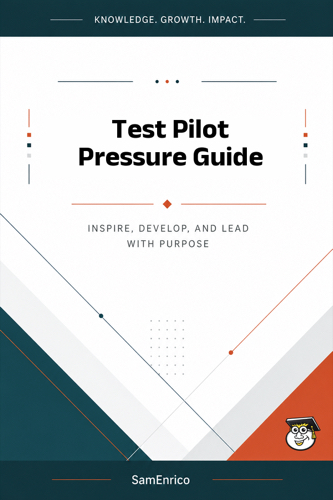
Test Pilot Pressure Guide Audiobook
Fly experimental aircraft knowing one failure coul
Fly experimental aircraft knowing one failure could be fatal.
Formats
Free sample
Chapter 1: The Quick and the Dead...--The morning of August 23, 1954, dawned clear over the Mojave Desert. George Welch, a decorated combat pilot who had famously scrambled to intercept Japanese Zeroes at Pearl Harbor, strapped into the prototype F-100A Super Sabre. The aircraft was the world's first supersonic fighter, a sleek, hungry-looking machine that engineers had pushed through development at breakneck speed. Welch had already survived one harrowing flight in this same airframe—a high-speed dive that caused the controls to lock, forcing him to wrestle the jet back to earth using only differential throttle and sheer will. That near-miss had been logged, discussed, and then, like so many warnings in the golden age of jet testing, quietly filed away.On this August morning, Welch took off, climbed to altitude, and began a routine handling test.
At Mach 1.4, the F-100A's vertical fin began to flutter—a vibration so violent that it tore the tail section clean off the aircraft. The Super Sabre pitched nose-down from 35,000 feet. Welch never had a chance. He was the first test pilot fatality of the Century Series fighters, but he would not be the last.The question that echoes through test pilot history is not whether Welch was brave. He was.
The question is whether his death—and the deaths that followed—were inevitable. The answer, as this chapter will show, is no.The Cowboy Era: Grit, Intuition, and the Cult of the Invincible In the years immediately following World War II, test flying underwent a transformation that had little to do with technology and everything to do with culture. The war had produced a generation of pilots who had survived flak, engine failures, and combat damage through sheer improvisation. Men like Chuck Yeager, who broke the sound barrier in 1947, embodied a particular American archetype: the taciturn, instinctively gifted aviator who trusted his gut over any manual. Yeager's famous description of the X-1 flights—"You don't concentrate on the instruments.
You feel the airplane through your seat, through your hands, through your feet"—became gospel.This "cowboy" culture, celebrated in books and films, carried a hidden cost. When test flying is framed as an art rather than a science, the logical corollary is that accidents are the result of pilot failure—a lack of feel, a moment of hesitation, a failure of nerve. This framing served two purposes. First, it protected aircraft manufacturers and the military from…
This is the end of the free sample. Get the Audiobook to keep going. Buy now
About this book
Details
- Author
- Dodson Darline
- Publisher
- SamEnrico
- Language
- English
- Genre
- Non-Fiction, Self-Help, Aviation
- Released
- 2026-06-08
- Pages (approx.)
- 124
- Available as
- eBook, Audiobook

Listen in the VoxFlicks app
Audiobooks and audio dramas wherever you go. Sign in with your SamEnrico account and press play.
More by Dodson Darline
 OA Vs RA Differences GuideDodson Darline$11.99
 The Teen Praise HandlingDodson Darline$11.99
 Breath for CreativityDodson Darline$11.99
 Social Media Comparison and TraumaDodson Darline$11.99
 FODMAP Stacking Prevention GuideDodson Darline$11.99
 Glycation Skin Aging Prevention GuideDodson Darline$11.99
 Industrial Revolution LeadersDodson Darline$11.99
 Non Toxic Pest Control GuideDodson Darline$11.99
 The Last Signal: The Vanished Campers of the Black ForestDodson Darline$11.99
 The Hidden Codebreakers: Asia's Unsung Pioneers of the Digital AgeDodson Darline$11.99
 The Bone Orchard's Whispering GuardianDodson Darline$11.99
 World Bank Environmental SpecialistDodson Darline$12.99
You may also like
 Hong Kong Handover 1997Dunn Johnnie$11.99
 Zumba For Postnatal Recovery CourseNeal Christian$11.99
 Zumba for BeginnersLadner Nikia$11.99
 YouTube Comment Mining GuideHumes Pandora$12.99
 Worry Box MeditationCarlin Rudy$11.99
 Workplace Stress MeditationNguyen Lynn$11.99
 Workplace Stress and Sleep RepairHawley Ivory$11.99
 Workplace Perfectionism CureDelaney Jeffry$11.99
 Workplace Injustice Anger GuideWallen Isabelle$11.99
 Work Addiction and Burnout LinkGreenwood Ester$11.99
 Women in Yoga and WellnessBeattie Galina$11.99
 Women in Stand Up ComedyChun Evangeline$11.99