
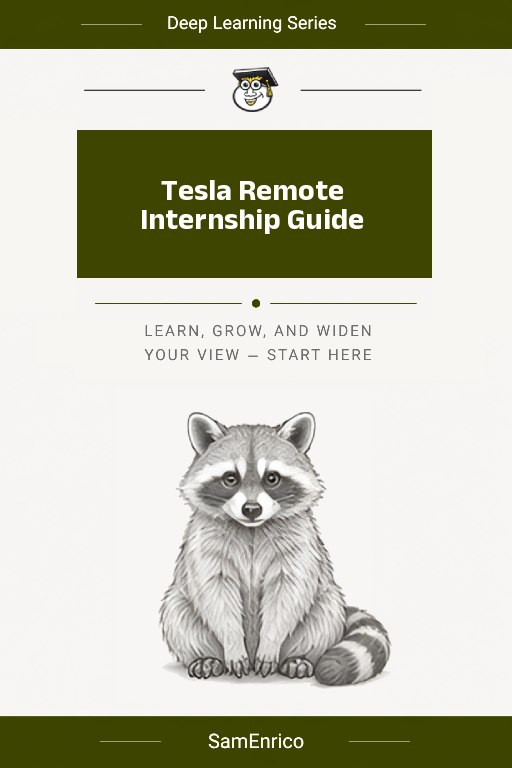
Tesla Remote Internship Guide eBook
Join Tesla's virtual internship program from anywh
by Branson Yuki
Join Tesla's virtual internship program from anywhere. Engineering challenges, remote simulations, and Elon's expectations.
Formats
Free sample
Chapter 1: The Virtual Waiting Room--–- The email arrived at 11:47 PM on a Tuesday. Subject line: “Tesla Remote Internship – Decision.” Your heart stopped for three full seconds before you opened it. Then came the words you had been chasing for months: “We are pleased to offer you a position…” But buried in the second paragraph, between the standard legal disclaimers and the NDAs, was a sentence that made your stomach tighten: “This role is fully remote. You will not receive a badge. You will not visit a factory.
Your workspace is wherever you can run a simulation.”The celebration lasted exactly one hour. Then the doubt crept in. How do you prove yourself when you cannot shake Elon’s hand? How do you debug a robot arm you will never touch? How do you escape the invisible prison that remote workers call the Virtual Waiting Room—that limbo where you exist as a name on Slack, a ghost in the code review queue, a person who types but never materializes?This chapter dismantles the single greatest fear of every aspiring Tesla remote intern: the fear of invisibility.
It replaces that fear with a systematic framework for becoming indispensable without ever stepping foot in Fremont, Berlin, or Shanghai. You will learn why Tesla measures interns by output velocity rather than hours logged, how First Principles thinking transforms remote work from a disadvantage into a superpower, and the exact three-step method for escaping the Virtual Waiting Room within your first fourteen days.If you came here looking for Zoom etiquette tips or work-life balance advice, close the book now. This is not that guide. This is a field manual for engineers who want to ship code that bends metal, from a bedroom desk, before breakfast.The Myth of Physical Presence Tesla is not a normal company. This is not a controversial statement—it is the entire premise of this book.
But the specific abnormality you need to understand for remote work is this: Tesla does not fetishize presence. It fetishizes physics.At most hardware companies, being on the factory floor is a kind of religious requirement. You cannot design the stamping press unless you can hear it cycle. You cannot debug the battery pack unless you can smell the coolant. This is not stupidity; it is an understandable bias.
Physical intuition is real, and it is valuable. But it is not the only path to understanding.Consider the following thought experiment, which is actually just a description of how Tesla’s most effective remote engineers already work. A robot arm in Fremont fails to stack battery cells with the required precision. The on-site engineer notices that the arm makes a grinding sound on the third cell. They suspect a worn bearing.
They replace the bearing. The problem persists. They spend three days chasing ghosts.A remote engineer, sitting in an apartment in São Paulo, pulls the telemetry logs from the same robot. They notice that the torque spike occurs not on the third physical cell but exactly 4.7 seconds after the start of every cycle—regardless of which cell. They overlay the controller command stream and see that the spike coincides with a mode switch in the motion planner.
Within two hours, they identify a software bug: the planner switches from position control to force control 500 milliseconds too early. They push a patch. The robot runs silently. The on-site engineer never hears the grinding again because it never happens again.Who was more present? The person who heard the sound or the person who read the data?This is the first principle of remote engineering at Tesla: Fidelity of information matters more than proximity to the asset.
A high-fidelity digital twin, streamed to your laptop with sub-millisecond latency, contains more actionable truth than standing next to a machine that is hiding its own failure modes behind audible noise.The myth of physical presence is just that—a myth. It persists because most companies have invested nothing in their digital infrastructure. Their “remote work” means VPN into a desktop that is screen-sharing a spreadsheet. Tesla has invested billions in simulation, telemetry, and digital twins because Tesla needs to build things that have never been built before. You cannot iterate a Mars lander by walking around a factory floor.
There is no factory floor. There is only the simulation.Output Velocity: The Only Metric That Matters If presence is not the currency of recognition, what is? The answer is deceptively simple: output velocity—the rate at which you produce validated, bottleneck-unblocking deliverables.Output velocity has three components, each measurable, each comparable across remote and on-site interns alike:1. Commits. Not lines of code.
Not hours spent typing. Every commit that passes CI and is merged into a production branch is a unit of progress. A single commit that fixes a subtle race condition in the simulation scheduler is worth more than fifty commits that adjust whitespace. But the commit is the atomic unit of visibility. No commit, no evidence.2.
Simulations validated. A simulation that runs but produces garbage is worse than no simulation. A validated simulation—one whose outputs have been checked against real sensor logs or analytical solutions—is a brick in the cathedral. The number of validated simulations you produce per week is a direct measure of your contribution to the team’s understanding of the physical system.3. Bottlenecks resolved.
This is the highest-leverage metric. A bottleneck is any point in the engineering workflow where progress stops because of a missing answer, a broken tool, or an unresolved question. When you unblock a bottleneck—by answering the question, fixing the tool, or making a decision that lets five other engineers proceed—you have created value far out of proportion to the time you spent.The remote intern who masters these three metrics becomes visible not because they are liked or remembered from a team lunch, but because their name appears on the commits that make the simulation run, the validation reports that make the design credible, and the Slack threads that end with “thanks, that was blocking me.”You do not escape the Virtual Waiting Room by being louder. You escape by being undeniable.The Three Symptoms of the Virtual Waiting Room Before you can escape, you must recognize that you are inside. The Virtual Waiting Room has three distinct symptoms.
If you experience any of them for more than five consecutive workdays, you are trapped.Symptom 1: Your pull requests sit unmerged for more than 48 hours. This is not always your fault. Senior engineers are busy. But if your PRs consistently gather dust while others are merged within hours, the signal is clear: you have not yet demonstrated that your work is worth the cognitive load of review. You are invisible.Symptom 2: You are never mentioned in the daily stand-up summary.
The stand-up summary—whether written in Slack or spoken on a call—is the public record of who matters today. If your name appears only in the passive voice (“the simulation was run”), never in the active voice (“Alex reran the simulation with corrected friction and found a 12% improvement”), you are a feature of the environment, not an agent within it.Symptom 3: You…
This is the end of the free sample. Get the eBook to keep going. Buy now
About this book
Details
- Author
- Branson Yuki
- Publisher
- SamEnrico
- Language
- English
- Genre
- Non-Fiction, Virtual Work Experience, Engineering Guide
- Released
- 2026-06-01
- Pages (approx.)
- 133
- Available as
- eBook, Audiobook

Read better in the ZLOADR app
Your eBooks on your phone or tablet. Sign in with your SamEnrico account and start reading.
More by Branson Yuki
 Caregiver Burnout In PreemiesBranson Yuki$11.99
 Fertility and Sperm DonorsBranson Yuki$11.99
 Anger at In Laws CognitiveBranson Yuki$11.99
 The Paralysis Nightmare SolutionBranson Yuki$11.99
 The Admiral Who Defied the Rising Sun: Yamamoto's Gambit at MidwayBranson Yuki$11.99
 Understanding Ohaha SyndromeBranson Yuki$17.99
 Intuitive Surgical SWOTBranson Yuki$12.99
 How to Become a Laundry Pricing ClerkBranson Yuki$11.99
 Contracts AdministratorBranson Yuki$11.99