
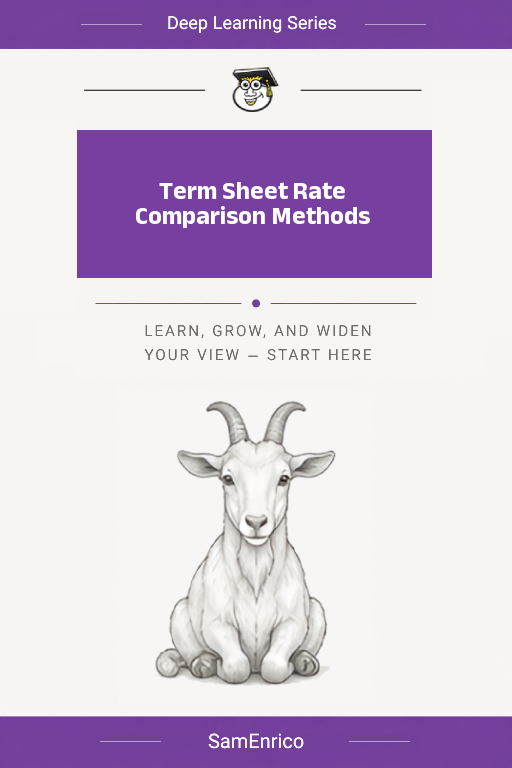
Term Sheet Rate Comparison Methods eBook
Compare APRs across small business loan offers inc
by Dooley Rana
Compare APRs across small business loan offers including fees and origination costs, identifying which terms become cheaper or expensive as base rates shift.
Formats
Free sample
Chapter 1: The $34,000 Mistake--–- Maria Vaccaro thought she had won the lottery. Not the actual lottery—she was too busy running three coffee shops for that—but the small business lending lottery. Her bank had just approved a $200,000 loan at 7.5% APR. The offer landed in her inbox on a Tuesday morning, and by Tuesday afternoon, she had already told her brother, her bookkeeper, and two baristas that she had scored the cheapest money on the market.The loan was for a new espresso roastery. Her dream.
The 7.5% rate looked like a gift compared to the 12% and 14% quotes she had seen from online lenders. She signed the documents without calling a single competitor. Eighteen months later, Maria sat across from a bankruptcy attorney, her coffee shops still running but her cash flow gutted by a monthly payment she had never truly understood.Across town, a baker named James received a very different offer the same week. He needed 50,000foracommercialoven.Hiscreditwasworsethan Maria′s.Theonlylenderwillingtotouchhimofferedan1850,000 for a commercial oven. His credit was worse than Maria's.
The only lender willing to touch him offered an 18% APR on a six-month term. James nearly hung up. But he asked one question the loan officer didn't expect: "What is the total dollar cost?" Eighteen percent sounded terrifying. But on 50,000foracommercialoven.Hiscreditwasworsethan Maria′s.Theonlylenderwillingtotouchhimofferedan1850,000 over six months, the total interest came to roughly 4,500.Jamespaidtheloanoffinfivemonths,saved4,500. James paid the loan off in five months, saved 4,500.Jamespaidtheloanoffinfivemonths,saved750 in interest, and kept his bakery open.Maria paid $34,000 more in total interest than James did, despite her rate being less than half of his.
The lower APR lost. The higher APR won.This chapter exists because Maria's story happens every day. Small business owners are drowning in a sea of percentages—APR, factor rates, simple interest, prime plus margins—and they have been trained to believe that the smallest number next to the percent sign is always the best deal. That belief is wrong. Sometimes it is catastrophically wrong.The 60% Problem Let us start with a number that should disturb you.
According to a 2023 survey by the Federal Reserve Banks of New York and Atlanta, approximately 60 percent of small business owners cannot accurately calculate the total cost of a loan when presented with two different term sheets. Sixty percent. That means more than half of the people reading this chapter have probably overpaid on at least one loan without knowing it.The problem is not stupidity. The problem is what behavioral economists call "sticker rate bias." When humans compare two products—a loan, a mortgage, a credit card—they instinctively fixate on the most prominent number. Lenders know this.
That is why advertisements shout "AS LOW AS 6.9% APR" in fifty-point font and bury the term length, fees, and repayment structure in eight-point gray type at the bottom of the page.Here is what the lenders do not want you to know: the interest rate is only one variable in a multi-variable equation. The term length, the fee structure, the repayment frequency, and the prepayment terms can each matter more than the rate itself. A loan with a 9% APR over five years can cost you more in absolute dollars than a loan with 18% APR over six months. That is not a math trick. That is arithmetic.The Cost Per $10,000 Benchmark Before we go any further, we need a common language.
Throughout this book, we will use a single, simple benchmark that cuts through every pricing gimmick: Cost Per $10,000 Borrowed.Here is how it works. Instead of comparing APRs, factor rates, or any other abstract percentage, you convert every loan offer into a single number: the total dollars you will pay in interest and fees for every $10,000 you receive. That is it. That is the whole method.Let us test it on Maria's loan and James's loan.Maria borrowed 200,000at7.5200,000 at 7.5% APR for 10 years. Using a standard amortization calculator, her total interest over the life of the loan came to approximately 200,000at7.585,000.
That is 4,250ininterestper4,250 in interest per 4,250ininterestper10,000 borrowed. (Calculation: 85,000totalinterest÷20unitsof85,000 total interest ÷ 20 units of 85,000totalinterest÷20unitsof10,000 = 4,250per4,250 per 4,250per10,000.)James borrowed 50,000at1850,000 at 18% APR for six months. His total interest came to approximately 50,000at184,500. That is 900ininterestper900 in interest per 900ininterestper10,000 borrowed. (Calculation: 4,500totalinterest÷5unitsof4,500 total interest ÷ 5 units of 4,500totalinterest÷5unitsof10,000 = 900per900 per 900per10,000.)The lower APR loan cost 4,250per4,250 per 4,250per10,000.
The higher APR loan cost 900per900 per 900per10,000. The higher rate was cheaper by a factor of nearly five to one.Now, you might object: "But Maria's loan was for ten years, and James's loan was for six months. They are different products." Exactly. That is the point. Lenders present all loans as if they are interchangeable, but they are not.
The Cost Per $10,000 benchmark forces you to compare apples to apples by stripping away term length and revealing the true dollar cost.The Matching Rule: Your New Compass The Cost Per $10,000 benchmark solves one problem—it tells you which loan is cheaper in absolute dollars. But it does not tell you which loan is right for your business. For that, you need a second principle: The Matching Rule.The Matching Rule is simple: the term of your loan should match the useful life of the asset you are financing.Let us unpack that. If you are buying a piece of equipment that will last ten years—a commercial oven, a CNC machine, a delivery truck—you should finance it with a loan that lasts roughly ten years. Why?
Because the asset generates revenue over ten years, and the loan payments should align with that revenue stream. If you take a two-year loan for a ten-year asset, your payments will be crushingly high. If you take a twenty-year loan for a ten-year asset, you will be paying interest long after the asset has stopped producing value.Maria violated the Matching Rule. She financed a roastery—a long-term asset—with a ten-year loan. That was appropriate.
The problem was not the term; the problem was that she never compared the Cost Per $10,000 across different term lengths. James, on the other hand, financed a commercial oven—also a long-term asset—with a six-month loan. That violated the Matching Rule in the opposite direction. He got lucky because his cash flow was strong enough to absorb the high monthly payments. But if his bakery had a slow season during those six months, he would have defaulted.The Matching Rule is not a suggestion.
It is a guardrail. When you match term to asset life, you minimize two risks: overpaying interest (if the term is too long) and defaulting on payments (if the term is too short). We will return to the Matching Rule in Chapter 4 when we discuss lender selection and again in Chapter 12 when we build the final decision matrix.Why the Lowest APR Almost Never Wins Let us get specific. Below are four real loan offers that a small business owner might receive on the same day for the same $100,000 need. Which one is cheapest?Offer A: Bank term loan, 8% APR, 5 years, 2% origination fee.Offer B: Online lender, 20% APR, 18 months, no origination fee.Offer C: Equipment financing, 12% APR, 3 years, 1% origination fee.Offer…
This is the end of the free sample. Get the eBook to keep going. Buy now
About this book
Details
- Author
- Dooley Rana
- Publisher
- SamEnrico
- Language
- English
- Genre
- Non-Fiction, Annual Checkup
- Released
- 2026-06-01
- Pages (approx.)
- 136
- Available as
- eBook, Audiobook

Read better in the ZLOADR app
Your eBooks on your phone or tablet. Sign in with your SamEnrico account and start reading.
More by Dooley Rana
 Sasquatch Theory ExploredDooley Rana$11.99
 Franchising Your Local Brand Across Borders Logistics GuideDooley Rana$11.99
 The Five Minute Friend MakerDooley Rana$11.99
 Meth Craving StrategiesDooley Rana$11.99
 Immigrant Language Barrier ShameDooley Rana$11.99
 Assertiveness in FriendshipDooley Rana$11.99
 Spaced Repetition Study GuideDooley Rana$11.99
 Seasonal Affective Disorder GamblingDooley Rana$11.99
 The Storming of Xiangyang: The Siege That Broke the YuanDooley Rana$11.99
 Peparella: The Untold Love Story of Two Roman Gladiators and Their Revolutionary Training PhilosophyDooley Rana$11.99
 Mastering The Art of Bājíquán (八極拳) Eight Extreme FistsDooley Rana$11.99
 How to Produce Spotting Scope AccessoriesDooley Rana$11.99
You may also like
 Ransomware Evolution ReportWatkins Kara$11.99
 DFIR Response MetricsBolt Eufemia$11.99
 Breach Disclosure TimelinesRudolph Benito$11.99Breach Disclosure TimelinesRudolph Benito$11.99
 SEC Cyber Rules ImpactWorthy Jay$11.99
 Cyber Talent ShortageVanhoose Delta$11.99
 Mobile Malware SurgeCurry Annette$11.99
 Data Breach Cost AnalysisStepp Filiberto$11.99
 Financial Sector BreachesWyman Nicolasa$11.99
 Ransomware EconomicsJacques Keely$11.99
 Cybersecurity Budget BenchmarksBradbury Setsuko$11.99
 Vulnerability Disclosure TrendsMccune Kevin$11.99