
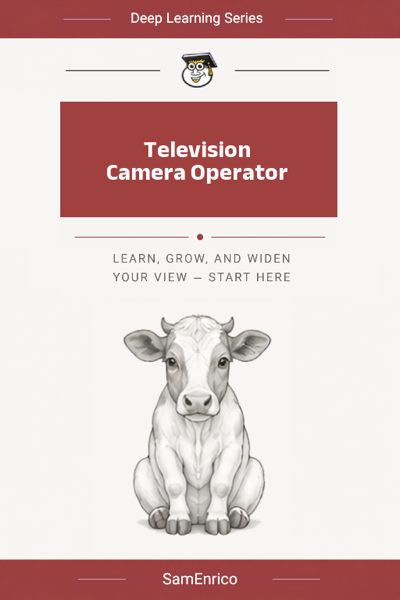
Non-FictionInformativeEducational
Television Camera Operator eBook
A Coursebook on Television Camera Operator
by Conn Charity
A Coursebook on Television Camera Operator
Formats
Free sample
Chapter 1: The Thousand-Yard Stare...--The first time a producer said “You’re live in thirty,” I was holding a thirty-pound camera on my shoulder, sweating through a brand-new polo shirt, and absolutely certain I was about to vomit into my own viewfinder. It was a local morning show in a midsized market—the kind of affiliate that no one dreams about during film school. The story was a dog adoptions segment. Three puppies. One bleating anchor.
And me, a twenty-two-year-old who had just realized that every single button on the broadcast camera looked nothing like the DSLR I’d practiced on in college.I didn’t vomit. I didn’t drop the camera. I did, however, forget to white balance, which meant the anchor’s face turned the color of a bruised plum for four excruciating seconds before the director cut away. The control room laughed. The engineer called me “Plum Boy” for a month.
And somewhere in the back of that news truck, a grizzled sixty-year-old camera operator named Raymond—a man who had shot floods, fires, and four presidential motorcades—watched the replay, shook his head, and said the only true thing I would hear in my first year: “Kid, you don’t learn this job. You survive it long enough to realize you never stop learning.”This book is for the person standing where I stood: camera on shoulder, heart in throat, desperate for someone to explain not just the buttons, but the unwritten rules. The ones that turn a person who knows how to operate a camera into a person who can operate on a live television set. Because those are two very different things.Before we touch a single f-stop or zebra stripe, you need to understand what this career actually is. Television camera operation is not cinematography.
It is not You Tube content creation. It is not wedding videography with a bigger budget. It is a distinct craft with its own language, its own physiology, its own politics, and its own peculiar kind of glory. And if you want to succeed—not just survive, but actually build a career that pays your rent and doesn’t destroy your back by forty—you need to start with a clear-eyed look at what you’re signing up for.The Unspoken Hierarchy: Where the Camera Operator Stands In the film world, the director of photography is an artist. They light scenes, choose lenses, and confer with the director about emotional arcs.
In the television world—specifically in news, sports, and live events—the camera operator is a technician with artistic instincts, but those instincts operate within very narrow rails. Understanding this distinction is the first step to not resenting it.The hierarchy on a television production is brutally simple. At the top sits the director, who calls the shots—literally and figuratively. Below them is the technical director, who punches the switcher. Below that, in the control room, are the audio mixer, the graphics operator, and the CCU (Camera Control Unit) engineer who paints your camera remotely.
And then, out on the floor or in the field, there is you: the camera operator.You are the last link in the chain before the signal goes to air. That means you are also the first person the director blames when something goes wrong. The anchor’s face is soft? That’s on you. The camera wobbled during a live hit?
That’s on you. The shot was framed too tight, and the chyron covered the subject’s chin? That is also, somehow, on you.Here is what the textbooks don’t tell you: you will be blamed for things that are not your fault approximately forty percent of the time. The CCU engineer might have cranked the gain. The director might have called the wrong camera.
The anchor might have leaned forward at the exact wrong moment. None of that matters. In the live environment, the camera operator is the visible point of failure, and the visible point of failure gets yelled at.But here is the trade-off. When everything goes right—when you pull focus on a breaking news runner, when you hold the perfect frame on a game-winning touchdown, when your handheld shot breathes exactly the way the director wanted—you are invisible. That is the goal.
The best camera operators in television never get mentioned in reviews. Their work is not analyzed on You Tube breakdowns. They simply deliver the shot, cut to cut, hour after hour, and the audience never thinks about them for a single second.That invisibility is the craft.The Five Career Paths (And Which One Wants You)Before you learn how to operate a camera, you need to know where you will operate it. Television splits into five distinct operating environments, and each one requires a different mindset, different gear, and a different relationship with your own spine.Studio Pedestal Operator – You work indoors, on a controlled set, usually with a prompter and a three-camera setup. Your back stays relatively happy because the camera sits on a pedestal with pneumatic lift.
Your challenge is boredom mixed with sudden terror: you will frame the same anchor shot for forty-five minutes, and then the director will scream for a tight two-shot that you have to find in two seconds. Studio operators need a near-photographic memory of their framing presets and the ability to listen to intercom chatter while absolutely ignoring ninety percent of it.Electronic News Gathering (ENG) Operator – You are a solo operator or part of a two-person team (you plus a reporter or an audio person). You work in the field, often in terrible conditions. Rain. Snow.
Crowds pushing against your shoulder. The families of shooting victims screaming at you. You carry your own gear, set up your own lights (if you have time), and drive your own news vehicle. ENG operators need the physical endurance of a marathon runner and the emotional detachment of a trauma nurse. You will see things you cannot unsee.
You will be asked to keep rolling when every instinct tells you to stop.Electronic Field Production (EFP) Operator – You work on a crew, usually for pre-produced segments, documentaries, or lifestyle shows. You might have a gaffer, a grip, and a sound person. The pace is slower than news but faster than film. EFP operators need the social skills to spend twelve-hour days in close quarters with the same three people, plus the technical range to switch between tripod, handheld, and Steadicam as the shot demands.Sports Operator – You work on the edge of chaos. Stadiums, arenas, racetracks.
You will carry a 40-pound box lens on a tripod head that costs more than a used car. You will stand in the sun or freezing rain for four hours without a bathroom break. You will learn to anticipate where the ball is going because if you follow it instead of leading it, you will miss the shot. Sports operators need eyes that can track small objects moving at sixty miles an hour, hands that never cramp on the zoom rocker, and a bladder of cast iron.Robotic (PTZ) Operator – You sit in the control room or…
This is the end of the free sample. Get the eBook to keep going. Buy now
About this book
Details
- Author
- Conn Charity
- Publisher
- SamEnrico
- Language
- English
- Genre
- Non-Fiction, Informative, Educational
- Released
- 2026-05-09
- Pages (approx.)
- 150
- Available as
- eBook, Audiobook

Read better in the ZLOADR app
Your eBooks on your phone or tablet. Sign in with your SamEnrico account and start reading.
More by Conn Charity
 Staying Relevant At Any AgeConn Charity$11.99
 NVC For Coaches And Consultants GuideConn Charity$11.99
 LBO Environmental Due DiligenceConn Charity$11.99
 The Alternate Nostril BreathingConn Charity$11.99
 Metta For Incarcerated PersonsConn Charity$11.99
 The Al Ahly Ultras: A Love Letter to Cairo's Football FaithfulConn Charity$11.99
 Understanding Somatization DisorderConn Charity$17.99
 How to Start a Bank Note Counting Machine Business (Beginners Guide)Conn Charity$11.99
 Week Three Follow Up StrategyConn Charity$12.99
 Customer Retention PricingConn Charity$12.99
You may also like
 Hong Kong Handover 1997Dunn Johnnie$11.99
 Zumba For Postnatal Recovery CourseNeal Christian$11.99
 Zumba for BeginnersLadner Nikia$11.99
 YouTube Comment Mining GuideHumes Pandora$12.99
 Worry Box MeditationCarlin Rudy$11.99
 Workplace Stress MeditationNguyen Lynn$11.99
 Workplace Stress and Sleep RepairHawley Ivory$11.99
 Workplace Perfectionism CureDelaney Jeffry$11.99
 Workplace Injustice Anger GuideWallen Isabelle$11.99
 Work Addiction and Burnout LinkGreenwood Ester$11.99
 Women in Yoga and WellnessBeattie Galina$11.99
 Women in Stand Up ComedyChun Evangeline$11.99