
Non-FictionCapital & Valuation RegisterTelecommunications
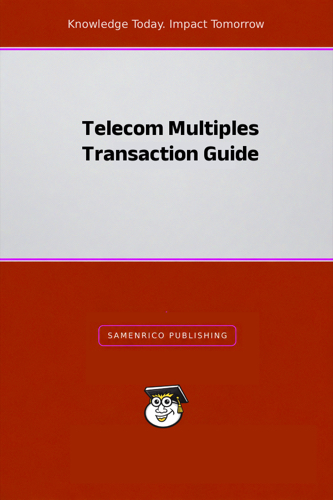
Telecom Multiples Transaction Guide eBook
Reviews precedent deals in wireless, broadband, an
Reviews precedent deals in wireless, broadband, and tower infrastructure sectors.
Formats
Free sample
Chapter 1: The R.E.P. Revelation–- When a $3.3 billion deal turns on a single clause about renewal options, you learn quickly that not all telecom assets are created equal. I learned this lesson in a windowless conference room in Denver, watching a partner from a major infrastructure fund tear apart a hundred-page lease agreement with the focus of a diamond cutter. He wasn't looking at the price. He wasn't looking at the rent escalator.
He was staring at three words: "right to renew." Those three words, he explained to the junior associates hovering behind him, would determine whether the fund just made a 15 percent annual return or whether they had just bought a decaying asset with a ten-year expiration date. The deal, he said, would live or die on the R.E.P. framework – Rights, Exclusivity, Physicality. That was my first exposure to the taxonomy that separates smart telecom investors from the ones who quietly go bankrupt.The Three Letters That Separate Winners from Losers The R.E.P. framework is not theoretical.
It is not academic. It is the practical lens through which every serious investor evaluates a telecom infrastructure asset before signing a single document. Rights, Exclusivity, Physicality. These three dimensions determine valuation, risk, and exit options. Ignore any one of them, and you are not investing – you are gambling.Rights refer to the legal entitlements embedded in the lease or ownership structure.
How long does the lease last? What are the renewal options? Can the tenant assign the lease to a third party without your consent? These questions sound like lawyerly abstractions until a carrier like DISH walks away from $9 billion in obligations, leaving tower owners with empty sites and no recourse. Then, suddenly, rights become the only thing that matters.Exclusivity asks whether the tenant has exclusive use of the site or whether the landlord can colocate additional tenants.
A site with exclusivity is worth less to the landlord because you cannot add revenue from a second or third carrier. A site without exclusivity is worth more because you can stack tenants – the classic tower business model. But exclusivity is not binary. It exists on a spectrum from full exclusivity (one tenant, no colocation ever) to neutral host (any carrier can colocate at market rates). Where your asset falls on that spectrum determines its upside potential.Physicality distinguishes between land ownership, leasehold interests, and easements.
Do you own the dirt beneath the tower? If not, who does? What are the terms of the ground lease? When does it expire? What happens at renewal?
The physicality dimension is the one most often overlooked by first-time investors, and it is the one that has destroyed more deals than any other. A tower with a ground lease that resets to market rent in five years is not an infrastructure asset – it is a ticking time bomb.The Three Transaction Structures You Must Know Before we dive deeper into the R.E.P. framework, we need to understand the transaction structures that define telecom infrastructure M&A. Every deal falls into one of three categories, and each category has its own risk profile, tax treatment, and valuation methodology.The sale-leaseback is the most common structure in tower transactions. A carrier – Verizon, AT&T, T-Mobile – sells its towers to an infrastructure fund.
The carrier gets upfront cash, typically 18 to 20 times annual EBITDA. The infrastructure fund then leases the towers back to the carrier under a long-term Master Lease Agreement. The carrier continues to use the towers as before, but now it pays rent instead of owning the asset. This structure was pioneered in the early 2000s and exploded in popularity after 2010 as carriers needed capital for 4G and then 5G buildouts. The sale-leaseback is attractive to carriers because it converts a capital-intensive asset into operating expense.
It is attractive to funds because it generates predictable, long-term, inflation-linked cash flows.The Master Lease Agreement, or MLA, is not a transaction structure by itself but rather the contractual vehicle that governs sale-leasebacks and direct colocation arrangements. An MLA is a single lease covering hundreds or thousands of sites, often with volume discounts and standardized terms. The MLA is the single most important document in tower transactions – more important than the purchase agreement, more important than the financing documents, more important than anything else. We will spend all of Chapter 8 dissecting the MLA clause by clause. For now, understand that the MLA is where the R.E.P.
framework gets translated into binding legal obligations.The fee simple sale is the third and rarest structure. In a fee simple sale, the carrier sells the land and the tower outright. No leaseback. No ongoing relationship. The buyer owns the asset free and clear, and the carrier walks away entirely.
Fee simple sales are rare because carriers rarely want to lose access to prime tower sites. When they do occur, it is typically for non-core assets – towers in rural areas that the carrier does not plan to use for future deployments, or excess land that was acquired for a buildout that never happened. Fee simple sales trade at a discount to sale-leasebacks because the buyer loses the anchor tenant's rent guarantee.Deep Dive: Valuing Leasehold vs. Owned Real Estate The most common valuation mistake in telecom infrastructure is treating a leasehold interest as if it were owned real estate. They are not the same.
They are not even close.Owned land – fee simple ownership – trades at a premium because there is no ground lease risk. You own the dirt. No landlord can raise your rent. No one can refuse to renew your lease. The only ongoing costs are property taxes and maintenance, both of which are predictable and controllable.
Tower portfolios with fee simple ownership of the underlying land trade at cap rates 50 to 100 basis points lower than comparable portfolios with leasehold interests. That difference, on a billion-dollar portfolio, is worth tens of millions of dollars.Leasehold interests are different. When you buy a tower but not the land beneath it, you become a tenant of the landowner. You pay ground rent. You are subject to the ground lease's terms, including renewal options, rent resets, and termination rights.
The ground lease is a liability that sits between you and the asset's cash flows. If the ground lease expires or resets to an unfavorable market rent, your tower's profitability can be wiped out overnight.The valuation formula for a leasehold interest is straightforward but unforgiving:Asset Value = (Net Operating Income – Ground Rent) / Cap Rate Net Operating Income is the tower's rental income from carriers minus operating expenses (property taxes, insurance, maintenance, management fees). Ground Rent is the annual payment to the underlying landowner. The Cap Rate reflects the risk of the asset class, typically 6 to 8 percent for tower portfolios post-DISH.To see how this works, consider a tower that generates $100,000 in annual rental income from carriers. Operating expenses are $20,000, so Net Operating Income is $80,000.
If the tower sits on owned land, with no ground rent, and we apply a 7 percent cap rate, the value is $80,000 divided by 0.07, or approximately $1,142,857.Now assume the same tower sits on leased land with annual ground rent of…
This is the end of the free sample. Get the eBook to keep going. Buy now
About this book
Details
- Author
- Hitchcock Miquel
- Publisher
- SamEnrico
- Language
- English
- Genre
- Non-Fiction, Capital & Valuation Register, Telecommunications
- Released
- 2026-06-09
- Pages (approx.)
- 127
- Available as
- eBook, Audiobook

Read better in the ZLOADR app
Your eBooks on your phone or tablet. Sign in with your SamEnrico account and start reading.
More by Hitchcock Miquel
 Trench Poetry AnalysisHitchcock Miquel$11.99
 Physical Warmth PersuasionHitchcock Miquel$11.99
 Food Addiction Recovery for SeniorsHitchcock Miquel$11.99
 Cost Per Use CalculationHitchcock Miquel$11.99
 The Church Trafficking SurvivorHitchcock Miquel$11.99
 Dune Crossing EnduranceHitchcock Miquel$11.99
 Bipolar Master GuideHitchcock Miquel$11.99
 The Shot Heard 'Round the World: The Iconic Photo That Captured Rugby's Greatest MomentHitchcock Miquel$11.99
 The Camelot of Cairo: How a Bookstore United a Nation’s VoicesHitchcock Miquel$11.99
 A Collector's Handbook to the Ford SquireHitchcock Miquel$11.99
 How to Produce Test TubesHitchcock Miquel$11.99
 LinkedIn Virtual Internship GuideHitchcock Miquel$12.99
You may also like
 Hong Kong Handover 1997Dunn Johnnie$11.99
 Zumba For Postnatal Recovery CourseNeal Christian$11.99
 Zumba for BeginnersLadner Nikia$11.99
 YouTube Comment Mining GuideHumes Pandora$12.99
 Worry Box MeditationCarlin Rudy$11.99
 Workplace Stress MeditationNguyen Lynn$11.99
 Workplace Stress and Sleep RepairHawley Ivory$11.99
 Workplace Perfectionism CureDelaney Jeffry$11.99
 Workplace Injustice Anger GuideWallen Isabelle$11.99
 Work Addiction and Burnout LinkGreenwood Ester$11.99
 Women in Yoga and WellnessBeattie Galina$11.99
 Women in Stand Up ComedyChun Evangeline$11.99