
Non-FictionSelf-HelpTech Stress
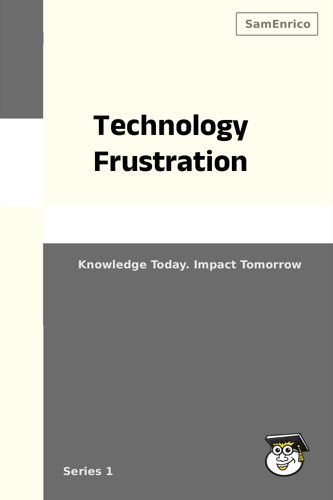
Technology Frustration eBook
Teaches identifying slow wifi, crashed programs, a
by Whited David
Teaches identifying slow wifi, crashed programs, and broken devices as modern triggers.
Formats
Free sample
Chapter 1: The 47 Clicks--–- It begins, as it always does, with a simple task. You need to print a document. Not a complex document—a single page. Maybe it is a boarding pass, a contract that requires a wet signature, or a recipe you refuse to read from a glowing screen while your hands are covered in flour. You have done this a thousand times.
You click the print icon. And then nothing happens.You wait. Three seconds. Five seconds. Ten seconds.
The loading spinner appears—that little circle of implied progress that has become the universal symbol of your time being held hostage. You click again. Nothing. You check if the printer is on. It is.
You check if it has paper. It does. You check if it is connected to the same Wi-Fi network as your computer. This requires navigating to Settings, then Network, then Properties—a journey of seven clicks just to confirm what you already suspect: the printer and the computer are both online, but they have stopped speaking to one another.You restart the print queue. You delete the document and reopen it.
You run the printer troubleshooter, which informs you helpfully that it has “detected a problem” but cannot identify what the problem is. You search online for a solution and find a forum thread from 2017 where someone with the exact same issue was told to “update the drivers.” You do not know what a driver is. You update them anyway, following a You Tube tutorial that involves downloading a file from a website that looks like it was designed in 1999. The file installs. You restart your computer.
You restart the printer. You try again.The document prints. Twenty-two minutes have passed. Your heart rate is elevated. Your jaw is clenched.
You are not relieved—you are furious. And somewhere beneath the fury, you feel something worse: shame. Because you know, or at least you believe, that this should not have been hard. That someone smarter, someone more competent, would have fixed it in thirty seconds. That the problem, ultimately, is you.This book exists because that belief is a lie.The Hidden Epidemic No One Is Talking About Technology frustration is not a minor inconvenience.
It is not the price we pay for progress. It is a modern psychological epidemic, and it is making millions of people miserable every single day—not because they are bad with technology, but because the technology itself is designed in ways that systematically produce frustration.Let us define our terms. Technology frustration is a distinct emotional state characterized by three simultaneous experiences: helplessness (the feeling that nothing you do will fix the problem), time anxiety (the awareness that every second of delay is stolen from something that matters), and physiological stress (elevated heart rate, muscle tension, shallow breathing). It is not the same as simple annoyance. Annoyance passes in seconds.
Frustration lingers, poisons the hours that follow, and accumulates like sediment in a pipe until one minor incident triggers an explosion entirely disproportionate to the trigger.Consider what happened when you tried to print that document. You did not just lose twenty-two minutes. You lost the twenty-two minutes, plus the ten minutes it took for your heart rate to return to baseline, plus the cognitive residue that made you less patient with your next task, plus the quiet erosion of confidence that whispers: you cannot handle something this simple. The true cost of a single frustrating incident is rarely less than an hour of effective productivity—and often much more.The research on this is surprisingly sparse, given how universal the experience is. A 2021 study by the cybersecurity firm Beyond Identity found that the average worker loses nearly one full day per week to technology friction—logins, crashes, slow connections, and the recovery time that follows.
Other studies have put the number lower, around four to six hours per week, but even the most conservative estimates suggest that technology frustration costs the global economy hundreds of billions of dollars annually in lost productivity.But the economic cost, staggering as it is, misses the point entirely. The real damage is emotional. Technology frustration is one of the few stressors that combines unpredictability, powerlessness, and social shame all at once. You cannot predict when a program will crash. You cannot force it to cooperate.
And you cannot admit, especially at work, that you spent fifteen minutes crying over a frozen screen without feeling like a failure.The Five Core Triggers Through analysis of thousands of self-reports, support tickets, and forum discussions, five specific technological events emerge as the primary sources of modern frustration. These are not rare edge cases. They are daily experiences for the majority of computer users.Trigger One: Slow Wi-Fi. The single most common frustration trigger. Slow internet does not just delay tasks—it fractures attention.
You click a link and wait. You type a search and wait. You join a video call and watch your colleague’s face freeze into a pixelated mask of existential despair. Each wait is short enough to feel trivial but long enough to break your concentration. Over the course of a day, slow Wi-Fi can turn an hour of actual work into three hours of fragmented, rage-filled effort.Trigger Two: Login and Password Problems.
The 38 percent problem. That is the proportion of all IT support tickets that involve login failures—lost passwords, expired credentials, multi-factor authentication codes that arrive thirty seconds too late. The average person has between seventy and one hundred passwords to remember across work and personal accounts. No human being is capable of remembering one hundred unique, complex passwords. And yet the systems that require them continue to act as though forgetting a password is a moral failing rather than a biological certainty.Trigger Three: Dying Batteries.
The low battery warning is a unique form of frustration because it combines a predictable problem (batteries discharge) with an unpredictable timeline (some days your laptop lasts six hours; some days it lasts forty-five minutes). The psychological effect is akin to being in a car that is running out of gas but refuses to tell you how much is left in the tank. Every task becomes a gamble. You start working faster, skipping breaks, trying to finish before the screen goes black—and in doing so, you make more mistakes, which create more frustration.Trigger Four: Program Crashes. The sudden, unexplained disappearance of your work.
A program crashes and takes with it everything you have done since your last save. The auto-save feature, which was supposed to prevent this exact scenario, somehow saved a version from forty minutes ago. The crash itself is infuriating, but what follows is worse: the five minutes of stunned silence, the slow realization that you have to do it all again, and the paranoid habit of hitting Ctrl+S every thirty seconds for the rest of your career.Trigger Five: Broken Devices. The cracked screen. The keyboard key that no longer registers.
The phone that refuses to charge unless the cable is held at a precise 37-degree angle. Broken devices are frustrating not because they are unusable—many are still technically functional—but because they are reminders.…
This is the end of the free sample. Get the eBook to keep going. Buy now
About this book
Details
- Author
- Whited David
- Publisher
- SamEnrico
- Language
- English
- Genre
- Non-Fiction, Self-Help, Tech Stress
- Released
- 2026-06-05
- Pages (approx.)
- 133
- Available as
- eBook, Audiobook

Read better in the ZLOADR app
Your eBooks on your phone or tablet. Sign in with your SamEnrico account and start reading.
More by Whited David
 Alcohol Recovery Exercise PlanWhited David$11.99
 Post Hypnotic Suggestion for GratitudeWhited David$11.99
 Washing Machine ResiduesWhited David$11.99
 The Bloodhound and the Billionaire: How a K9 Detective Uncovered Europe's Largest Tax FraudWhited David$11.99
 How to Produce a CleanerWhited David$11.99
 Poland Software Development TeamsWhited David$12.99
 Space Superiority InstructorWhited David$11.99
You may also like
 Hong Kong Handover 1997Dunn Johnnie$11.99
 Zumba For Postnatal Recovery CourseNeal Christian$11.99
 Zumba for BeginnersLadner Nikia$11.99
 YouTube Comment Mining GuideHumes Pandora$12.99
 Worry Box MeditationCarlin Rudy$11.99
 Workplace Stress MeditationNguyen Lynn$11.99
 Workplace Stress and Sleep RepairHawley Ivory$11.99
 Workplace Perfectionism CureDelaney Jeffry$11.99
 Workplace Injustice Anger GuideWallen Isabelle$11.99
 Work Addiction and Burnout LinkGreenwood Ester$11.99
 Women in Yoga and WellnessBeattie Galina$11.99
 Women in Stand Up ComedyChun Evangeline$11.99