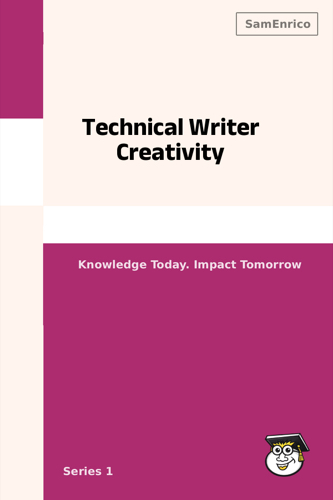
Technical Writer Creativity eBook
Explain complex topics clearly and engagingly usin
by Braden Royce
Explain complex topics clearly and engagingly using this practical guide.
Formats
Free sample
Chapter 1: The Jargon Mask--–- It was 3:47 on a Tuesday afternoon when Maria, a senior Dev Ops engineer with fifteen years of experience, stared at her own documentation and realized she had no idea what it said. She had written the API guide six months ago, carefully using every correct technical term, every proper specification, every precise architectural description. And now, sitting at her desk with a junior developer asking for help, Maria read her own words aloud: "The endpoint authenticates via OAuth 2.0 bearer token with scoped permission delegation across microservice boundaries utilizing circuit breaker pattern implementation for fault isolation."The junior developer blinked. "What does that mean?"Maria wanted to say, I don't know. Instead, she said, "Let me show you."This moment—the moment an expert cannot understand their own explanation—is the most humbling and most important moment in a technical writer's career.
Because in that moment, Maria discovered the central lie of technical communication: that complexity is a sign of expertise. It is not. It is a sign of the Jargon Mask.The Fallacy of Expert Language The Jargon Mask fallacy is the false belief that using specialized terminology, complex sentence structures, and technical precision makes you look smarter, more authoritative, and more credible. In reality, it does the opposite. It signals that you either do not fully understand the concept yourself or that you care more about appearing expert than about being understood.Consider two versions of the same instruction:Version A (Jargon Mask): "Prior to initiating the software installation protocol, the end user must verify the integrity of the downloaded binary by cross-referencing its cryptographic hash against the published checksum value located on the distribution manifest."Version B (Clear): "Before installing, check that your download matches our official file.
Compare the file's checksum to the one listed on our website."Both versions say the same thing. Version A takes forty-two words. Version B takes twenty-three. Version A uses eight technical terms. Version B uses two.
Version A will be read by approximately zero users. Version B will be read by everyone.The Jargon Mask is not malice. It is fear. Experts fear that if they explain something simply, they will be seen as simplistic. They fear that non-technical language signals non-technical thinking.
They fear that a five-year-old could understand their work—and somehow, that is an insult.It is not an insult. It is the highest compliment.Richard Feynman, the Nobel Prize-winning physicist, was famous for saying that if you cannot explain something to a first-year student, you have not truly understood it. He did not mean "dumb it down." He meant strip it down. Remove the jargon until only the idea remains. Then rebuild with clarity, not complexity.The Curse You Cannot See The Jargon Mask is a specific symptom of a broader cognitive bias called the Curse of Knowledge.
This is the single most important concept in this entire book, and it will appear in nearly every chapter that follows. Understand this, and you will understand why technical writing is so difficult. Miss this, and nothing else will matter.The Curse of Knowledge is simple: once you know something, you cannot remember what it was like not to know it.That is not a character flaw. It is a neurological fact. Your brain literally rewires itself when you learn a concept.
The neural pathways that were once tortuous and uncertain become smooth and automatic. You forget the confusion. You forget the wrong turns. You remember only the destination, not the journey.This is why experts make terrible teachers. Not because they are mean or impatient, but because they literally cannot see what beginners cannot see.
The expert looks at a complex system and sees elegance. The beginner looks at the same system and sees a brick wall.Consider an example that has nothing to do with technology. Ask yourself: how does a zipper work? You have used a zipper thousands of times. You know what it does.
But can you explain, in precise mechanical terms, how the slider forces the teeth together, how the wedge shape creates compression, how the lock prevents separation? Most people cannot. And yet, the moment someone explains it, you think, Of course. That is obvious.That is the Curse of Knowledge in reverse. You did not know.
Now you know. And now you cannot remember not knowing.Every technical document you have ever written was affected by the Curse of Knowledge. Every confusing instruction, every skipped step, every assumption that "they will figure it out"—all of it traces back to this single bias.The Broken Window Theory of Documentation In the 1980s, criminologists James Wilson and George Kelling introduced the Broken Window Theory. The idea was simple: a building with one broken window, if left unrepaired, will soon have all its windows broken. Why?
Because the first broken window signals that no one cares. It lowers the threshold for vandalism. Disorder invites more disorder.Documentation works exactly the same way.A single confusing sentence—a single typo, a single missing step, a single piece of jargon—signals to the reader that this document is not trustworthy. If the writer did not care enough to fix that one error, why should the reader trust the rest? And once that trust is broken, the reader stops reading carefully.
They skim. They guess. They call support.Worse, the broken window spreads to the writer. One bad sentence in a document invites more bad sentences. The writer thinks, This section is already confusing, so why spend extra time on the next section?
The standard drops. The jargon creeps in. The document decays.The opposite is also true. One exceptionally clear sentence raises the standard for everything around it. When a reader encounters a perfectly crafted explanation, they suddenly expect the same quality from the rest of the document.
They read more carefully. They trust more deeply. And the writer, seeing that high standard, works harder to maintain it.Here is the most practical takeaway from this theory: fix the broken windows immediately. Every time you find a confusing sentence, a typo, or a piece of unexplained jargon, stop and fix it. Do not say "I will fix it later." Later never comes.
The broken window will break more windows. Fix it now.The Feynman Four-Step Method Richard Feynman developed a technique for learning and explaining that is so effective it has become legendary among physicists, teachers, and now technical writers. The Feynman Four-Step Method is the core practice of this book. You will see references to it in later chapters, but the full method lives here, in Chapter 1, and will not be repeated elsewhere.Here is how it works.Step One: Choose a concept. Write the name of the concept at the top of a blank sheet of paper.
For our purposes, let us use "OAuth 2.0 authentication."Step Two: Explain it to a five-year-old. Write an explanation of the concept using only the simplest words you know. No jargon. No technical terms. No assumptions about prior knowledge.
Imagine you are explaining it to a child, or to your grandmother, or to someone who has never used a computer. This is…
This is the end of the free sample. Get the eBook to keep going. Buy now
About this book
Details
- Author
- Braden Royce
- Publisher
- SamEnrico
- Language
- English
- Genre
- Non-Fiction, Self-Help, Technical Communication
- Released
- 2026-06-11
- Pages (approx.)
- 136
- Available as
- eBook, Audiobook

Read better in the ZLOADR app
Your eBooks on your phone or tablet. Sign in with your SamEnrico account and start reading.
More by Braden Royce
 Employer Branding EdgeBraden Royce$11.99
 Mindful Retirement TransitionBraden Royce$11.99
 The Complicated Grief Yoga GuideBraden Royce$11.99
 The Remote Meeting Etiquette GuideBraden Royce$11.99
 Hannibal's Gambit: The Alpine Crossing That Shook Rome (218 BC)Braden Royce$11.99
 B Corp Certification ExportBraden Royce$12.99
 Brand Loyalty Across AgesBraden Royce$12.99
 Understanding StrongyloidiasisBraden Royce$17.99
 Correspondant Technique ElectroniqueBraden Royce$11.99
 How to Start a Cider Perry Business (Beginners Guide)Braden Royce$11.99