
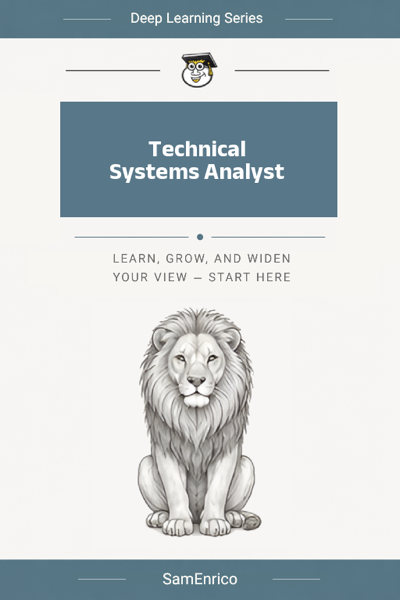
Non-FictionInformativeEducational
Technical Systems Analyst eBook
A Coursebook on Technical Systems Analyst
A Coursebook on Technical Systems Analyst
Formats
Free sample
Chapter 1: The Translator’s Code--–- The first time Maria watched a room full of truck drivers and software engineers argue for forty-five minutes about the word “refresh,” she realized her university degree had not prepared her for this. The drivers wanted a button that said “Refresh” to update their route displays. The engineers explained that the system already auto-refreshed every thirty seconds, so a manual button would create “unnecessary database contention.” Maria, three weeks into her first role as a Technical Systems Analyst at Logi Trans Solutions, understood both sides perfectly. She also understood that neither side was listening to the other.That moment—the moment she stood up and said, “What if we call it ‘Force Update’ and make it only appear when the driver has been stationary for more than two minutes?”—changed everything. The drivers nodded.
The engineers blinked, then nodded. The meeting ended seven minutes later. Maria had not written a single line of code. She had not approved a budget or assigned a task. She had done something far more valuable: she had translated.This chapter is about that translation.
It is about the peculiar, powerful, and often misunderstood role of the Technical Systems Analyst (TSA). If you are reading this book, you have likely sensed that there is a gap between what business stakeholders want and what technology teams build. You may have been that frustrated manager who received exactly what you asked for but not what you needed. You may have been that developer who built a technically flawless system that nobody used. Or you may be entirely new to the field, wondering how a single role can span databases, diagrams, requirements, and human psychology.The answer is that it cannot—not alone.
And that is the first and most important truth of this chapter.The Great Misunderstanding: What a Technical Systems Analyst Is Not Before we can define what a Technical Systems Analyst is, we must clear away the myths that surround the role. These misconceptions are not harmless; they actively prevent organizations from using TSAs effectively and discourage talented professionals from entering the field.Myth 1: The TSA is just a junior developer who cannot code.This is perhaps the most damaging misconception. In many organizations, the title “Systems Analyst” is treated as a penalty box for developers who are not “technical enough” or a stepping stone for business graduates who learned a little SQL. Both perspectives are wrong. A skilled TSA may never write production code, but they must read code well enough to understand its implications.
They must review database schemas, API documentation, and infrastructure diagrams. They are not failed developers; they are a distinct specialization that requires a different cognitive toolkit. Think of the difference between a novelist and a literary translator. Both work with language. One creates.
The other bridges worlds. Neither is a lesser version of the other.Myth 2: The TSA is a business analyst who knows a bit of Excel.Business analysis is a noble and necessary discipline. Business Analysts (BAs) focus on processes, value streams, and organizational outcomes. They often produce requirement documents, process maps, and business cases. But there is a critical distinction: a BA typically stops at the logical level (“the system shall calculate fuel efficiency”).
A TSA takes that logical requirement and translates it into technical specifications that a developer can implement (“the system shall query the vehicle telematics API every 60 seconds, calculate fuel consumed per kilometer using the formula (fuel_used / distance_traveled), and write the result to the fuel_efficiency table with a precision of two decimal places”). The BA answers “what” and “why.” The TSA answers “how” in enough technical detail to build.Myth 3: The TSA is a project manager with a technical hobby.Project managers (PMs) own the triple constraint: scope, time, and cost. They manage risk, resources, and stakeholder communication at the macro level. A TSA does none of these things as a primary responsibility. The TSA owns the technical truth: what is feasible, what is expensive, what is fragile, and what is elegant.
A PM asks, “Can we deliver this by December?” A TSA asks, “If we deliver this by December, what technical debt will we incur, and which non-functional requirements will we violate?” The PM manages the plan; the TSA ensures the plan is grounded in reality.Myth 4: The TSA writes documentation all day.This myth persists because documentation is a visible output. But documentation is a means, not an end. The TSA’s true work happens in conversation, in whiteboard sessions, in code reviews, in testing sessions, and in the painful moments of discovery when a stakeholder says “that’s not what I meant” and the TSA must figure out why. Documentation captures agreements; it does not create them. A TSA who only writes documents is a clerk, not an analyst.With these myths dismantled, we can build a positive definition.The Core Identity: Translator, Negotiator, and Truth-Seeker A Technical Systems Analyst is a problem solver who translates business value into technical specifications and technical constraints into business language.Notice what this definition does not say.
It does not say “coder,” “architect,” “DBA,” “UX designer,” or “project manager.” It identifies a unique position at the intersection of three domains: business value (what the organization needs to achieve), technical possibility (what technology can realistically do), and human reality (what users will actually tolerate and adopt).This definition rests on three foundational competencies.Competency 1: Translation Translation is the most visible TSA skill. It requires fluency in two languages: the imprecise, contextual, emotionally charged language of business stakeholders, and the precise, logical, unforgiving language of machines and engineers.Consider a stakeholder who says, “The system should be fast.” A bad translator writes “fast” in a requirement document. A mediocre translator asks, “What do you mean by fast?” A great TSA asks: “For which user type? At which point in the workflow? At what data volume?
On what network connection? What is the consequence if it is not fast enough?” From these answers, the TSA produces a non-functional requirement: “The driver mobile application shall display an updated route within 300 milliseconds of receiving new GPS data, measured at the 99th percentile under normal network conditions (LTE or better), or else the driver may miss a turn and incur a 12-minute delay cost.”Translation is not simplification. Translation is precision under uncertainty.Competency 2: Negotiation The TSA lives in a world of trade-offs. Faster systems cost more money. More features increase complexity.
Higher security reduces convenience. Perfect data accuracy requires human validation, which slows throughput. Every technical decision is a compromise, and every stakeholder wants to avoid compromise.The TSA does not simply document these trade-offs. They negotiate them. They facilitate conversations where engineers say “we cannot guarantee sub-300ms latency if we also add real-time weather overlays” and business stakeholders say “weather overlays will reduce accident rates by 8%” and together they find the third option: weather overlays that update every five minutes instead of every thirty seconds, achieving both safety gains and acceptable latency.Negotiation is not capitulation or coercion.
It is collaborative problem-solving within constraints.Competency 3: Truth-Seeking Of all the competencies, this is the most overlooked and the most…
This is the end of the free sample. Get the eBook to keep going. Buy now
About this book
Details
- Author
- Gainey Earlean
- Publisher
- SamEnrico
- Language
- English
- Genre
- Non-Fiction, Informative, Educational
- Released
- 2026-06-02
- Pages (approx.)
- 159
- Available as
- eBook, Audiobook

Read better in the ZLOADR app
Your eBooks on your phone or tablet. Sign in with your SamEnrico account and start reading.
More by Gainey Earlean
 Delegation for TherapistsGainey Earlean$11.99
 Downsizing Family Mediation CourseGainey Earlean$11.99
 Informant Testimony False ConvictionsGainey Earlean$11.99
 Men's Cardiac Rehab Exercise GuideGainey Earlean$11.99
 Business Plan Complete GuideGainey Earlean$11.99
 Brewing the Revolution: How a Belgian Monk Toppled the Beer WorldGainey Earlean$11.99
 Fangs of the Forbidden: The Great London Zoo Panic of 1857Gainey Earlean$11.99
 How to Become a Calendering-machine OperatorGainey Earlean$11.99
 Vendor Innovation Sourcing GuideGainey Earlean$12.99
 Parenting App RetentionGainey Earlean$12.99
 Understanding Chromosome 13q DeletionGainey Earlean$17.99
You may also like
 Hong Kong Handover 1997Dunn Johnnie$11.99
 Zumba For Postnatal Recovery CourseNeal Christian$11.99
 Zumba for BeginnersLadner Nikia$11.99
 YouTube Comment Mining GuideHumes Pandora$12.99
 Worry Box MeditationCarlin Rudy$11.99
 Workplace Stress MeditationNguyen Lynn$11.99
 Workplace Stress and Sleep RepairHawley Ivory$11.99
 Workplace Perfectionism CureDelaney Jeffry$11.99
 Workplace Injustice Anger GuideWallen Isabelle$11.99
 Work Addiction and Burnout LinkGreenwood Ester$11.99
 Women in Yoga and WellnessBeattie Galina$11.99
 Women in Stand Up ComedyChun Evangeline$11.99