
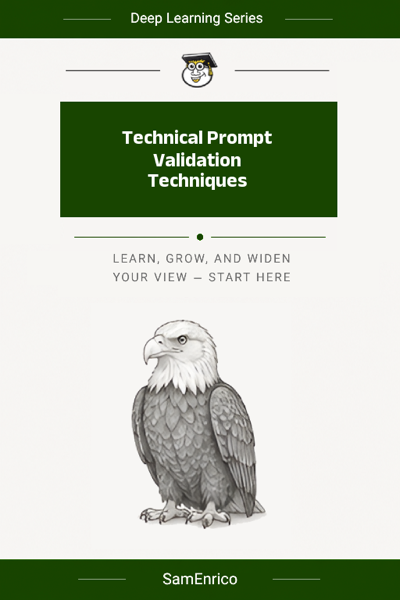
Technical Prompt Validation Techniques eBook
A Coursebook on Technical Prompt Validation Techni
A Coursebook on Technical Prompt Validation Techniques
Formats
Free sample
Chapter 1: The 11:59 PM Alert...--–- The call came in at 11:47 PM on a Tuesday. Maria Vasquez, senior prompt engineer at Med Logs Health, was halfway through a bowl of cold pasta when her pager buzzed against the kitchen counter. She ignored it at first—on-call weeks were brutal, and the night before had been a false alarm about a summarization timeout. But the pager buzzed again. Then her phone lit up with a Slack message from the clinical support lead: “CODE RED.
Patient safety incident. Call me now.”The patient was a 67-year-old man with diabetes and hypertension, admitted for observation after a fall. At 6:00 PM, the Med Logs AI system had automatically generated a discharge summary from his morning notes. The summary omitted one critical detail: a newly discovered allergy to sulfa drugs, clearly documented in the attending physician’s 10:15 AM progress note. At 7:30 PM, a covering pharmacist prescribed sulfamethoxazole for a suspected urinary tract infection.
By 9:00 PM, the patient was in anaphylactic shock.The prompt that generated the discharge summary had been “working fine” for three months. It had passed every demo. The product manager had signed off. The team had celebrated the launch with pizza and high-fives. No one had ever tested what would happen if a progress note contained an allergy buried in the third paragraph and the model decided it wasn’t “relevant” to the discharge summary.Maria stared at the patient safety report.
At the bottom, in red letters: “Root cause: LLM omitted critical clinical information. No validation detected omission.” Her team had automated everything except checking whether the prompt actually worked. They had confused “it runs without errors” with “it produces correct outputs.” They had measured what was easy to measure—latency, token usage, API uptime—but not what mattered: correctness, completeness, safety.This chapter is for everyone who has ever shipped a prompt based on a gut feeling, watched it work on three examples, and assumed it would work forever. It is for the engineer who has never had a 11:47 PM call—yet. And it is for the leader who wants to ensure that call never comes.We begin with a deceptively simple question: What does it mean for a prompt to “work”?
The answer, as Maria discovered, is anything but simple.The 82% Problem: Why Most Teams Are Flying Blind In early 2025, a comprehensive survey of 450 AI engineering teams revealed a stunning statistic: 82% of teams have no automated detection for prompt quality. They deploy prompts based on manual review of a handful of examples, monitor only infrastructure metrics (latency, error rates), and have no systematic way to know if their prompts are getting worse over time.This is not because teams are lazy or incompetent. It is because the discipline of prompt validation is new, poorly understood, and rarely taught. Most prompt engineering guides focus on crafting—how to write instructions, how to structure examples, how to chain thoughts. They treat validation as an afterthought, a final “does it look right?” check before hitting deploy.But consider the difference between two activities that sound similar:Prompt Engineering Prompt Validation Crafting the input text Measuring the output quality Designing instructions Testing against known correct answers Iterating based on intuition Iterating based on metrics Artisanal Engineering“Does this feel right?”“Can I prove this is right?”The distinction is not academic.
When Maria’s team engineered their discharge summary prompt, they spent weeks refining the system message, tuning the few-shot examples, and adjusting the temperature parameter. They did almost no validation—because they didn’t know how. They assumed that if the prompt looked good and worked on a few test cases, it was ready.That assumption nearly killed a patient.The Three Pillars of Validation: A Framework for Reliability Throughout this book, we will organize every validation technique around three foundational pillars. These pillars answer the question “What does it mean for a prompt to work?” in a measurable, actionable way.Pillar One: Functional Correctness Does the output match the expected result?Functional correctness is the most obvious pillar—and the most frequently violated. It means that given an input, the prompt produces the output that a reasonable human expert would produce (or that a rubric defines as correct).
For Maria’s discharge summary prompt, functional correctness required that the output include all critical clinical information from the source notes, especially allergies, adverse reactions, and contraindications.But functional correctness is not always binary. In many tasks—summarization, creative writing, code generation—there is no single “correct” answer. This chapter introduces the concept of a correctness spectrum:Deterministic tasks (e.g., SQL generation, data extraction): One correct answer exists. Validation is exact matching or schema validation.Constrained tasks (e.g., customer support replies, medical coding): A range of acceptable answers exists, bounded by rules and rubrics.Open-ended tasks (e.g., creative writing, brainstorming): Many valid answers exist. Validation requires comparative judgment.The validation techniques in this book work across all three categories, though the specific methods differ.
Chapter 2 (Ground Truth & Test Oracles) teaches how to define correctness for each category.Pillar Two: Structural Integrity Is the output safe, unbiased, and leak-free?A prompt can be functionally correct—producing the right information—while still failing catastrophically. Structural integrity covers everything outside the narrow question of factual correctness:Safety: Does the output contain harmful content (violence, self-harm instructions, dangerous medical advice)?Bias: Does the output systematically disadvantage certain groups or perspectives?Privacy: Does the output leak personally identifiable information (PII) or proprietary data?Security: Is the prompt vulnerable to injection attacks or prompt leaking?Maria’s prompt never produced an unsafe output in the sense of generating toxic language. But it did produce a dangerous omission—a failure of completeness that is a form of safety failure. Structural integrity includes both commission (outputting bad things) and omission (failing to output necessary things).Chapter 3 (Static Analysis & Prompt Linting) and Chapter 8 (Security Validation & Red-Teaming) focus on structural integrity. But the concept appears throughout the book because every validation technique must consider whether the prompt is violating unstated safety boundaries.Pillar Three: Performance Consistency Is the response fast and reliable under load?A prompt that is correct and safe but takes ten seconds to return is unusable in production.
Performance consistency has three dimensions:Latency: How long does the prompt take to return? Is the p95 (95th percentile) latency within acceptable bounds?Reliability: Does the prompt fail (timeout, error, malformed output) under production load?Stability: Does the prompt’s behavior change over time as the underlying model is updated or the input distribution shifts?Maria’s team monitored latency religiously. They had dashboards showing p50, p95, and p99 response times. They had alerts for API errors. They had no alerts for correctness degradation.
They optimized what they could measure and ignored what they couldn’t.This book teaches you to measure what matters. Performance consistency is important—a slow prompt is a broken prompt—but it is not more important than functional correctness. A fast wrong answer is still wrong.The Taxonomy of Hallucinations: Four Ways Prompts Fail Before we dive into validation techniques, we need a shared language for the most common failure mode in LLM systems: hallucination. The word “hallucination” is…
This is the end of the free sample. Get the eBook to keep going. Buy now
About this book
Details
- Author
- Grogan Jarrod
- Publisher
- SamEnrico
- Language
- English
- Genre
- Non-Fiction, Informative, Educational
- Released
- 2026-06-02
- Pages (approx.)
- 141
- Available as
- eBook, Audiobook

Read better in the ZLOADR app
Your eBooks on your phone or tablet. Sign in with your SamEnrico account and start reading.
More by Grogan Jarrod
 Contract Abstraction Prompt LibraryGrogan Jarrod$11.99
 Nubian ConquestsGrogan Jarrod$11.99
 Jealousy Regulation SkillsGrogan Jarrod$11.99
 Trauma Surgeon Coping GuideGrogan Jarrod$11.99
 The Waco Flash PaperGrogan Jarrod$11.99
 The Post Meditation BreathGrogan Jarrod$11.99
 Deep Diver's Gas Mix PrimerGrogan Jarrod$11.99
 Self Talk For Emotional RegulationGrogan Jarrod$11.99
 Marketing Framework PalaceGrogan Jarrod$11.99
 The Siege of Belgrade: The Cannons That Roared Against the CrescentGrogan Jarrod$11.99
 The Secret Life of the Queen: Inside the Royal Family's Most Exclusive ClubGrogan Jarrod$11.99
 The Great Bitcoin Heist: How a Billion Dollars Vanished into Thin AirGrogan Jarrod$11.99