
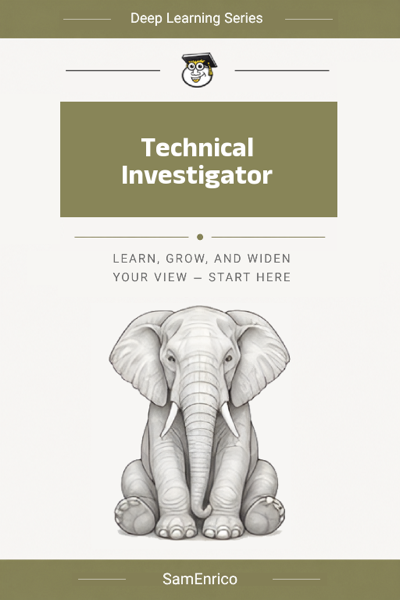
Non-FictionInformativeEducational
Technical Investigator eBook
A Coursebook on Technical Investigator
A Coursebook on Technical Investigator
Formats
Free sample
Chapter 1: The Hybrid Mandate–- On a humid Tuesday morning in Northern Virginia, a technical investigator named Sarah Chen pressed play on a surveillance recording for the hundredth time. The audio was garbled—HVAC noise, traffic bleed, and two voices she could barely separate. Her colleague had already dismissed the file as useless. But Sarah noticed something he had missed: a micro-second timing anomaly in the background hum that suggested the recording had been spliced. That single observation, born of equal parts technical knowledge and investigative discipline, would later unravel a corporate espionage ring spanning three continents.Sarah Chen is not a detective in the traditional sense.
She does not carry a badge or interview witnesses in an interrogation room. She is a forensic audio analyst, a certified GPS tracker installer, a chain-of-custody documentarian, and an expert witness. She is, in the modern lexicon, a technical investigator—and this book is her playbook.This chapter establishes the professional identity of the technical investigator as a hybrid role bridging criminal investigation, corporate security, and forensic engineering. It opens by contrasting traditional investigative roles—detectives who rely on witness statements, forensic technicians who process physical evidence—with the modern reality: an investigator must be equally comfortable with GPS trackers, cloud data requests, and chain-of-custody documentation. You will learn the integrated mission that defines this field, the three-legged stool upon which every technical operation rests, the legal boundaries that can make or break a case, and the ethical framework that separates legitimate investigation from harassment.The Integrated Mission: Two Sides of the Same Coin Drawing from U.S.
Secret Service (USSS) and UK Government Security role profiles, technical investigators serve two often-overlapping missions. The first is criminal investigation—gathering evidence for prosecution. This is the mission most people imagine when they think of investigative work: find the suspect, collect the evidence, build the case, testify in court. The second is protective security—preventing harm through threat detection and countermeasures. This mission is proactive rather than reactive.
It involves sweeping a hotel suite for bugs before a dignitary arrives, monitoring social media for threat indicators, and conducting Technical Surveillance Countermeasures (TSCM) to ensure sensitive conversations remain private.These two missions are not always aligned. Consider a protective sweep of a corporate boardroom. The TSCM specialist discovers a hidden listening device—a bug. In a purely protective mission, the specialist would remove the device, report the breach, and recommend countermeasures. But if the bug contains recorded conversations that reveal a crime (insider trading, for example), the investigator now faces a dilemma.
Using that recording as criminal evidence might require a warrant that was never obtained. The protective sweep that uncovered the bug may have been authorized under corporate policy, not criminal procedure. The tension between these missions is real, and navigating it requires both legal knowledge and ethical judgment.Throughout this book, you will learn to balance these missions. You will learn when to act as a criminal investigator gathering evidence for a future trial and when to act as a protective security professional preventing harm before it occurs. The best technical investigators are fluent in both roles.Consider the case of a government security team conducting a routine TSCM sweep of a sensitive conference room.
The team detected an active RF transmitter hidden inside a wall-mounted clock. The device was a commercial audio bug with cellular transmission capability. The team removed the device and, following protocol, preserved it in a Faraday bag. The agency's legal counsel asked the team to investigate who placed the bug. The team traced the device's SIM card to a private investigator known to work for a foreign competitor.
The device had recorded several conversations, including one in which a government official disclosed sensitive procurement information.Now the dilemma: The protective sweep was legally authorized under agency policy. But using the recorded conversations as criminal evidence (espionage) might require a warrant. The agency had not obtained a warrant before the sweep because the sweep was protective, not criminal. However, the agency argued that the device was discovered inadvertently during a lawful security inspection, and the recording was not intentionally intercepted under the Electronic Communications Privacy Act (ECPA). The legal resolution of this case varies by jurisdiction, but the ethical lesson is clear: technical investigators must be aware of the dual-use nature of their work.
The same tool—a spectrum analyzer and a Faraday bag—can serve protective or criminal missions. Knowing which mission you are on, and having the legal authority for that mission, is essential.The Three-Legged Stool: Legal Authority, Technical Capability, and Chain of Custody Every technical operation rests on three interdependent pillars. We call this the Three-Legged Stool because weakening any leg collapses the entire investigation.Legal Authority is the first leg. Without it, your evidence is suppressed, your case collapses, and you may face civil or criminal liability yourself. Legal authority comes in several forms: a warrant issued by a judge based on probable cause; consent from a person with authority to give it (the owner of a vehicle, the employer of a computer user under certain policies); exigent circumstances (imminent danger of death or serious injury, or imminent destruction of evidence); or statutory exceptions (such as the ECPA's provider exception).
The key point is that you must identify and document your legal authority before you deploy any technical tool. As you will learn later in this chapter, the "Fruit of the Poisonous Tree" doctrine means that evidence derived from an illegal search is inadmissible—even if that evidence would otherwise prove guilt beyond any doubt.Technical Capability is the second leg. This means properly calibrated equipment, trained operators, and validated software. A GPS tracker that drifts by 100 meters is useless for placing a suspect at a crime scene. A forensic imager that fails to create a bit-for-bit copy is not creating evidence—it is creating a liability.
Technical capability also means knowing the limitations of your tools. A consumer-grade audio recorder may not capture frequencies necessary for forensic authentication. A free version of forensic software may lack the carving algorithms needed to recover deleted files. Throughout this book, you will learn not just what tools to use, but how to validate their performance and document their limitations.Consider a real-world example. In a major fraud investigation, the prosecution's case relied heavily on GPS data from a tracker placed on the defendant's vehicle.
The defense moved to suppress the data, arguing that the GPS device had not been calibrated according to the manufacturer's specifications. The prosecution could not produce calibration records. The court ruled that without proof of technical capability—specifically, calibration—the GPS data was unreliable and therefore inadmissible. The case collapsed. The tracker itself was legally placed; the chain of custody was intact; but the technical capability leg had failed.
Never let this happen to you.Chain of Custody is the third leg. This is the documented history of every piece of evidence from the moment it is collected (or deployed, in the case of a covert device) to the moment it is presented in court. A missing signature on a chain-of-custody form can exclude evidence. A gap in the timeline—even a few minutes—can create…
This is the end of the free sample. Get the eBook to keep going. Buy now
About this book
Details
- Author
- Grogan Zenaida
- Publisher
- SamEnrico
- Language
- English
- Genre
- Non-Fiction, Informative, Educational
- Released
- 2026-06-02
- Pages (approx.)
- 149
- Available as
- eBook, Audiobook

Read better in the ZLOADR app
Your eBooks on your phone or tablet. Sign in with your SamEnrico account and start reading.
More by Grogan Zenaida
 Freckle Self Esteem WorkbookGrogan Zenaida$11.99
 De escalating Office ConflictsGrogan Zenaida$11.99
 Fuller Sam TabloidGrogan Zenaida$11.99
 Friend Group Self Esteem GuideGrogan Zenaida$11.99
 The Difficult Conversation with In LawsGrogan Zenaida$11.99
 The Shadow Warriors: The Secret Art of the Iron FistGrogan Zenaida$11.99
 UK Digital Services Tax GuideGrogan Zenaida$12.99
 Lessons Learned Prompt GuideGrogan Zenaida$12.99
 Understanding Mesomelic Dysplasia Thai TypeGrogan Zenaida$17.99
 How to Start a Sports Recreation Guide Service BusinessGrogan Zenaida$11.99
You may also like
 Hong Kong Handover 1997Dunn Johnnie$11.99
 Zumba For Postnatal Recovery CourseNeal Christian$11.99
 Zumba for BeginnersLadner Nikia$11.99
 YouTube Comment Mining GuideHumes Pandora$12.99
 Worry Box MeditationCarlin Rudy$11.99
 Workplace Stress MeditationNguyen Lynn$11.99
 Workplace Stress and Sleep RepairHawley Ivory$11.99
 Workplace Perfectionism CureDelaney Jeffry$11.99
 Workplace Injustice Anger GuideWallen Isabelle$11.99
 Work Addiction and Burnout LinkGreenwood Ester$11.99
 Women in Yoga and WellnessBeattie Galina$11.99
 Women in Stand Up ComedyChun Evangeline$11.99