
Non-FictionInformativeEducational
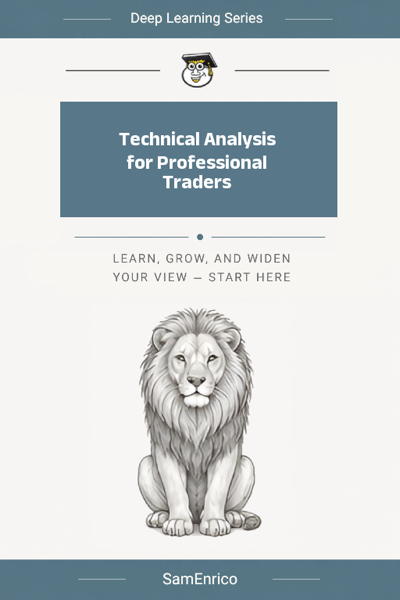
Technical Analysis for Professional Traders eBook
A Coursebook on Technical Analysis for Professiona
A Coursebook on Technical Analysis for Professional Traders
Formats
Free sample
Chapter 1: Probabilities Over Predictions--– The first thing you need to understand is that the chart in front of you is not a crystal ball. It never was. And the moment you stop treating it like one is the moment you stop losing money like an amateur. Professional technical analysis is not about being right. It is about being profitable over a series of trades, and those two objectives are not the same thing.
Being right feels good. Being profitable pays the bills. The retail trader chases the feeling. The professional trader chases the edge, even when it feels uncomfortable.This chapter dismantles the most dangerous illusion in all of trading: the fantasy of perfect forecasts. It replaces that fantasy with a probabilistic framework that every professional trader uses, whether they admit it or not.
You will learn why the three classic axioms of technical analysis are misunderstood by 90% of traders, how behavioral finance explains the patterns you see on your screen, and why thinking in probabilities changes everything about how you enter, manage, and exit trades. By the end of this chapter, you will never again ask “Is this trade going to work?” Instead, you will ask “What is the probability that this trade works given the conditions I see right now?” That shift in questioning is the dividing line between the trader who survives and the trader who blows up.The Three Axioms: What Everyone Gets Wrong Every introductory book on technical analysis lists the same three axioms. Price discounts everything. Prices move in trends. History repeats itself.
These statements are not wrong, but they are dangerously incomplete when taught to retail traders without the behavioral finance context that explains why they actually work.Price discounts everything means that all known information—earnings reports, geopolitical events, central bank decisions, whisper numbers, insider trading, fear, greed, and everything in between—is already reflected in the current price. The professional interpretation of this axiom is not “therefore I don’t need fundamentals.” The professional interpretation is “therefore the only thing that matters is how new information causes price to move from this equilibrium to the next, and the only way to measure that movement is through price action itself.” When a company reports blowout earnings and the stock drops, the retail trader screams that the market is irrational. The professional trader understands that the price had already discounted those earnings expectations weeks ago, and the actual move is a reaction to what was not already priced in. The chart is not ignoring fundamentals. The chart is the final vote count after all fundamentals have been considered.Prices move in trends is the second axiom, and it is the most misused.
The retail interpretation is “find a trend and jump on it.” The professional interpretation is far more nuanced. Trends exist because of three behavioral finance mechanisms that are hardwired into human decision making. First, herding: when traders see others buying, they buy, creating self-reinforcing price moves. Second, anchoring: traders anchor their expectations to recent prices, expecting trends to continue unless proven otherwise. Third, gradual information diffusion: news does not reach all market participants at the same time, so price adjusts slowly rather than instantly, creating exploitable serial correlation.
Trends are real, but they are not magical. They are behavioral artifacts. And like all human behaviors, they have limits, exhaustion points, and reversal conditions that can be measured.History repeats itself is the third axiom, and it is the one that most often leads traders astray. Retail traders hear this and think that the same pattern that worked yesterday will work identically today. That is not what repetition means.
What repeats is not the exact price levels or the exact pattern shapes. What repeats are the underlying human emotions—fear, greed, hope, regret—that created those patterns in the first place. A head and shoulders pattern in 1987 worked because traders who bought the top felt regret and sold on the break of the neckline. A head and shoulders pattern today works for exactly the same psychological reason. The geometry is secondary.
The psychology is primary.The Probabilistic Mindset: Thinking in Distributions, Not Outcomes Here is the single most important sentence in this entire book. A professional trader does not ask “Will this trade go up?” A professional trader asks “Given the conditions I see across price, volume, time, and intermarket factors, what is the probability distribution of possible outcomes over the next N bars?” That sentence contains everything that separates professionals from amateurs.Let me give you a concrete example. A retail trader sees a bullish engulfing candle at a support level. He thinks “That looks bullish. I’m going to buy.” He places a market order and hopes.
A professional trader sees the same candle and thinks “In my backtesting of similar conditions—bullish engulfing within 5% of a 200-day moving average, with volume above the 20-day average, during an uptrend on the weekly chart—this setup has produced a positive return 68% of the time over the next 10 bars, with an average win of 2.4R and an average loss of 1R. Therefore, I will take this trade with a position size that risks 1% of my capital, because a 68% edge with a 2.4 to 1 reward to risk ratio is a positive expectancy trade.”Notice the difference. The retail trader is thinking about being right on this trade. The professional trader is thinking about being profitable over a hundred trades. The retail trader feels fear because he cannot accept that he might lose.
The professional trader knows he will lose on 32 out of 100 similar trades and has structured his risk so that those losses do not matter.This is the probabilistic mindset. It is not cold or detached. It is simply mathematical. Every trade is a single iteration of a strategy that has a known edge. You do not know whether this iteration will be a winner or a loser.
Nobody does. But you do know that over many iterations, the edge will express itself. Your job is not to predict the outcome of this trade. Your job is to execute the strategy flawlessly and let the law of large numbers work for you.Why Most Traders Cannot Adopt This Mindset If the probabilistic mindset is so obviously superior, why do so few traders actually use it? The answer lies in cognitive biases that are hardwired into every human brain.
Understanding these biases is not optional. It is as fundamental as knowing how to place a stop loss.The first bias is the need for closure. Humans have an innate desire to resolve uncertainty. An open trade with unknown outcome creates psychological tension. The retail trader relieves that tension by convincing himself that the trade will work.
He looks for confirming evidence. He ignores contradictory signals. He turns a probability into a certainty inside his own mind. The moment he does that, he stops managing risk because he has already decided that risk is not real. This is how small losses become catastrophic losses.The second bias is loss aversion.
Decades of behavioral finance research, starting with Kahneman and Tversky, have shown that losses hurt approximately twice as much as equivalent gains feel good. A…
This is the end of the free sample. Get the eBook to keep going. Buy now
About this book
Details
- Author
- Moseley Arica
- Publisher
- SamEnrico
- Language
- English
- Genre
- Non-Fiction, Informative, Educational
- Released
- 2026-05-08
- Pages (approx.)
- 155
- Available as
- eBook, Audiobook

Read better in the ZLOADR app
Your eBooks on your phone or tablet. Sign in with your SamEnrico account and start reading.
More by Moseley Arica
 Napping for MenopauseMoseley Arica$11.99
 Parent Overdose Death RecoveryMoseley Arica$11.99
 Mixed Episode Recognition GuideMoseley Arica$11.99
 Startup Remote MetricsMoseley Arica$11.99
 The Doctor Office WaitMoseley Arica$11.99
 Jumia Cross Border GuideMoseley Arica$11.99
 Social Boundary SettingMoseley Arica$11.99
 Surviving Your Childs DeathMoseley Arica$11.99
 Back Pain MeditationMoseley Arica$11.99
 The Vanishing of Flight 772: The Last TransmissionMoseley Arica$11.99
 The Clay Spy of Enki: A God’s Double AgentMoseley Arica$11.99
 The Mole in the Kremlin: The Spy Who Outplayed the KGBMoseley Arica$11.99
You may also like
 Hong Kong Handover 1997Dunn Johnnie$11.99
 Zumba For Postnatal Recovery CourseNeal Christian$11.99
 Zumba for BeginnersLadner Nikia$11.99
 YouTube Comment Mining GuideHumes Pandora$12.99
 Worry Box MeditationCarlin Rudy$11.99
 Workplace Stress MeditationNguyen Lynn$11.99
 Workplace Stress and Sleep RepairHawley Ivory$11.99
 Workplace Perfectionism CureDelaney Jeffry$11.99
 Workplace Injustice Anger GuideWallen Isabelle$11.99
 Work Addiction and Burnout LinkGreenwood Ester$11.99
 Women in Yoga and WellnessBeattie Galina$11.99
 Women in Stand Up ComedyChun Evangeline$11.99