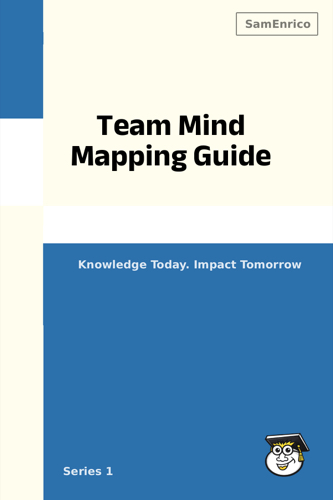
Team Mind Mapping Guide
Collaborative visual brainstorming techniques.
by Reyes Sergio
Collaborative visual brainstorming techniques.
Formats
About this book
Free sample
Chapter 1: The Meeting That Died--–- The conference room smelled of stale coffee and exhausted hope. Fourteen people sat around a long table, markers dry in their hands, a whiteboard blank and mocking before them. The project was six weeks behind schedule. The team had been "brainstorming" for forty-seven minutes. So far, they had produced exactly three ideas: one from the loudest voice in the room (a rehash of last quarter's failed strategy), one from the most senior executive (which everyone nodded at but no one believed in), and one from an intern who spoke so quietly that only two people heard it.
The other forty-four minutes had been consumed by cross-talk, digressions into unrelated problems, and an uncomfortable silence after someone's idea was met with "That won't work here."This scene repeats itself thousands of times every day, in every industry, on every continent. Smart, motivated people gather to solve problems together, and instead of generating breakthrough ideas, they produce frustration, fatigue, and mediocre outputs. The problem is not the people. The problem is not the intelligence or creativity of the individuals in the room. The problem is the method itself.Verbal brainstorming—the default mode of most team problem-solving—is scientifically broken.
Research spanning five decades has demonstrated that traditional group verbal brainstorming consistently underperforms both solo ideation and structured visual methods. Yet organizations continue to rely on it, mistaking the energy of conversation for the productivity of collaboration. This chapter dismantles the myths of verbal brainstorming, reveals the four specific ways it fails every team that uses it, and introduces the visual alternative that transforms how groups think together.The Myth of the Brainstorm In 1953, advertising executive Alex Osborn published a book called Applied Imagination, in which he introduced a technique he called "brainstorming." The rules were simple: generate as many ideas as possible, withhold criticism, welcome wild and unusual ideas, and build on the ideas of others. Osborn claimed that groups using his method would produce nearly twice as many ideas as individuals working alone.There was only one problem with this claim. It was never tested.…
This is the end of the free sample. Get the eBook to keep going. Buy now
Contents
- Chapter 1
- Chapter 2
- Chapter 3
- Chapter 4
- Chapter 5
- Chapter 6
- Chapter 7
- Chapter 8
- Chapter 9
- Chapter 10
- Chapter 11
- Chapter 12
Details
- Author
- Reyes Sergio
- Publisher
- SamEnrico
- Language
- English
- Genre
- Non-Fiction, Self-Help, Mind Mapping
- Released
- 2026-06-11
- Pages (approx.)
- 142
- Available as
- eBook, Audiobook

Read better in the ZLOADR app
Your eBooks on your phone or tablet. Sign in with your SamEnrico account and start reading.
More by Reyes Sergio
 Processed Food AddictionReyes Sergio$11.99
 Logical Fallacy Avoidance GuideReyes Sergio$11.99
 NVC for CaregiversReyes Sergio$11.99
 Monotasking MethodReyes Sergio$11.99
 Nap for Exam PerformanceReyes Sergio$11.99
 The Stress Erectile Dysfunction GuideReyes Sergio$11.99
 Blue Zone Moai CircleReyes Sergio$11.99
 Memrise Creator StoryReyes Sergio$11.99
 The Phantom of the Pacific: The Unsolved Murder on the Grandeur of the SeasReyes Sergio$11.99
 Soulful Struggle: The Unseen Battles of Diana Ross’s Rise to StardomReyes Sergio$11.99
 Nefertiti's Vanishing: The Lost Queen of the NileReyes Sergio$11.99
 The Mineral Guide to Mariposite (Variety of Phengite/muscovite)Reyes Sergio$11.99