
Non-FictionSelf-HelpPeak Performance
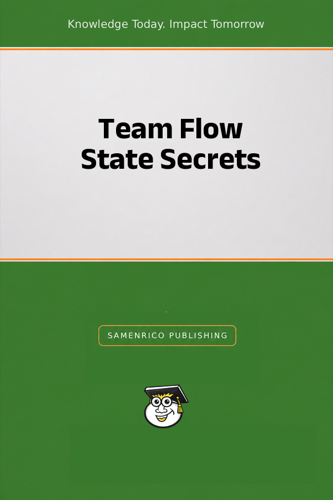
Team Flow State Secrets eBook
Enters collective flow where creativity feels effo
Enters collective flow where creativity feels effortless and time disappears.
Formats
Free sample
Chapter 1: The Syncing Species...--–- In 2019, a cardiac surgery team in Pittsburgh made a fatal error during a routine valve replacement. The procedure was textbook. The surgeons were board-certified. The equipment had been checked twice. And yet, a seventy-three-year-old man died on the table because two people failed to communicate a single piece of information that took less than four seconds to say.The official root cause analysis cited "communication breakdown." But that is a euphemism.
What actually broke was something far more fundamental than a phone tree or a checklist. What broke was the invisible field between the team members—the collective neural synchronization that allows human beings to move, think, and respond as one organism rather than eight individuals trapped in the same room.The anesthesiologist had noticed a subtle drop in blood pressure. The lead surgeon was focused on a calcified valve. The perfusionist was managing the heart-lung machine. In a team in flow, the anesthesiologist would have spoken, the surgeon would have heard, and the perfusionist would have adjusted—all within a single breath.
Instead, the anesthesiologist hesitated. The surgeon didn't look up. The perfusionist assumed everything was fine. And by the time anyone realized the mismatch, the window for intervention had closed.This is not a story about bad people. It is a story about a missing state—a state that most of us have experienced but almost none of us can name, let alone replicate on demand.
That state is team flow.The Experience You Know But Cannot Explain You have felt it before. Perhaps on a sports field, when the ball moved from hand to hand without anyone calling for it. Perhaps in a recording studio, when four musicians locked into a groove that felt like it was playing itself. Perhaps in a war room, during a crisis, when hours passed like minutes and the solution emerged as if from the air.That feeling—the disappearance of effort, the collapse of time, the sense that you are no longer a collection of "I"s but a single "we"—is not mystical. It is not luck.
It is not reserved for elite athletes or jazz prodigies. It is a biological state, measurable and trainable, that occurs when human brains learn to sync.And yet, for most of us, team flow remains an accident. We stumble into it during the final hour before a deadline. We chase it with pizza and late nights. We mourn it when it vanishes, assuming it will return only when the stars realign.
This book is the end of that assumption.The Great Individualist Mistake For the past forty years, the science of peak performance has been obsessed with the individual. Mihaly Csikszentmihalyi, the grandfather of flow research, spent decades studying artists, athletes, and chess masters who described a state of "autotelic" experience—activity done for its own sake, where challenge and skill balanced perfectly, where feedback was immediate, and where the self disappeared into the action.His work was revolutionary. It gave us the vocabulary for the zone. But it left a massive blind spot: what happens when the flow state is not inside one person but between people?The answer, which we are only now beginning to understand through neuroscience, is that team flow is not simply individual flow multiplied by the number of people in the room. It is an entirely different phenomenon, with different mechanisms, different triggers, and different failure modes.Individual flow requires clear goals, immediate feedback, and a balance between challenge and skill.
Team flow requires all of that—plus something else. Something stranger. Something that, until recently, we could only describe with metaphors like "chemistry" or "vibe."That something is neural entrainment.Your Brain on Sync In 2017, a research team led by Guillaume Dumas placed pairs of participants in front of computers and asked them to tap a finger in a specific rhythm. Alone, each person could do it easily. Together, something unexpected happened: their brains began to mirror each other.Using electroencephalography (EEG), Dumas observed that the participants' brain waves—specifically the alpha and theta frequencies associated with attention and creativity—began to synchronize.
Not because they were trying to. Not because they were talking. Simply because they were engaged in a shared task with a shared goal.This is neural entrainment. It is the same phenomenon that causes audiences to clap in unison at concerts, that makes soldiers fall into step without thinking, that allows improv troupes to finish each other's sentences. And it is the biological substrate of team flow.When your brain entrains with another person's brain, something remarkable happens to time.
The usual lag between intention and action—the approximately 200 milliseconds it takes for a thought to become a movement—compresses. In high-performing teams in flow, researchers have measured reaction times that approach the limits of neural conduction velocity. In plain English: you stop thinking and then acting. You simply act. And the person next to you acts with you.This is why the Pittsburgh surgical team failed.
Not because they were incompetent. Not because they were careless. But because their brains were not in sync. The anesthesiologist's brain registered the blood pressure drop. The surgeon's brain was elsewhere.
The perfusionist's brain was elsewhere. Four brains, four rhythms, four separate universes of attention. And in that fragmentation, a man died.The Field Between Us Joseph Jaworski, in his book Presence, describes this collective space as the "interpersonal field." He argues that teams do not simply contain individuals who happen to be in flow simultaneously. Rather, the team itself becomes an entity with its own properties—a field that can be strong or weak, coherent or fragmented.When the field is strong, team members report feeling that they can "read each other's minds." They finish each other's sentences. They anticipate moves before they happen.
They experience what Jaworski calls synchronicity: meaningful coincidences that seem too perfect to be random—the idea you were about to say appears from your colleague's mouth; the tool you need is handed to you before you ask.When the field is weak, team members report the opposite: talking past each other, repeating themselves, feeling unheard, and experiencing a subtle but exhausting sense of friction. Everything takes more effort. Every decision requires a meeting. Every meeting requires a follow-up. This is the baseline state of most teams.
And most leaders have no idea that a different state is possible.Cooperation Is Not Flow Here is a distinction that will matter for every chapter that follows: cooperation and co-action are not the same thing.Cooperation is what most teams do most of the time. You divide labor. I do task A, you do task B, and at the end we glue our pieces together. Cooperation is linear, sequential, and fundamentally additive. One plus one equals two.Co-action is something else entirely.
In co-action, team members do not divide the work. They share the work in real time, adjusting their actions based on the group's emergent direction. Co-action is simultaneous, recursive, and multiplicative. One plus one equals three.Consider an improv comedy troupe. They do not divide a scene into "your jokes" and "my jokes." They build…
This is the end of the free sample. Get the eBook to keep going. Buy now
About this book
Details
- Author
- Nabors Charmaine
- Publisher
- SamEnrico
- Language
- English
- Genre
- Non-Fiction, Self-Help, Peak Performance
- Released
- 2026-06-06
- Pages (approx.)
- 122
- Available as
- eBook, Audiobook

Read better in the ZLOADR app
Your eBooks on your phone or tablet. Sign in with your SamEnrico account and start reading.
More by Nabors Charmaine
 Sitting with SensationsNabors Charmaine$11.99
 Lagos Pop Up CostsNabors Charmaine$11.99
 Elder Law Attorney GuideNabors Charmaine$11.99
 Workplace Vacation PlanningNabors Charmaine$11.99
 SAD In Adolescents GuideNabors Charmaine$11.99
 Resilience for Product ManagersNabors Charmaine$11.99
 Reframing Anger StatementsNabors Charmaine$11.99
 The Royal Ballet of the Golden Age: Grace and Grandeur in the Courts of AfricaNabors Charmaine$11.99
 Where the Sun Never Sets: The Lost City of Helike’s TwinNabors Charmaine$11.99
 How to Produce Lawn Mower CoversNabors Charmaine$11.99
 Teamwork Agile WorkspaceNabors Charmaine$12.99
 Texas Nonprofit FilingNabors Charmaine$12.99
You may also like
 Hong Kong Handover 1997Dunn Johnnie$11.99
 Zumba For Postnatal Recovery CourseNeal Christian$11.99
 Zumba for BeginnersLadner Nikia$11.99
 YouTube Comment Mining GuideHumes Pandora$12.99
 Worry Box MeditationCarlin Rudy$11.99
 Workplace Stress MeditationNguyen Lynn$11.99
 Workplace Stress and Sleep RepairHawley Ivory$11.99
 Workplace Perfectionism CureDelaney Jeffry$11.99
 Workplace Injustice Anger GuideWallen Isabelle$11.99
 Work Addiction and Burnout LinkGreenwood Ester$11.99
 Women in Yoga and WellnessBeattie Galina$11.99
 Women in Stand Up ComedyChun Evangeline$11.99