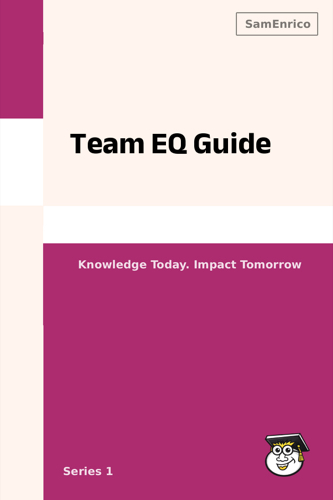
Team EQ Guide Audiobook
undefined
by Conner Jimmy
undefined
Formats
Free sample
Chapter 1: The EQ Illusion...--In 2015, a team of nine engineers at a Silicon Valley unicorn did something extraordinary. They shipped a product update that increased user retention by 34 percent in a single quarter. Their code was elegant, their velocity was unmatched, and their individual performance reviews sparkled with words like "brilliant," "dedicated," and "highly emotionally intelligent." Every single member of that team had scored above the 80th percentile on the standard emotional intelligence assessments their company had invested thousands of dollars to administer.Six months later, the team had disintegrated.Three engineers had quit, citing "a toxic culture" and "constant unresolved tension." Two more had requested transfers to other departments. The remaining four were barely speaking to each other, communicating almost exclusively through passive-aggressive Slack messages and terse Jira comments. The product that had launched so successfully was now riddled with technical debt because no one could agree on whose turn it was to fix the bugs.
Meetings that once crackled with creative energy had become silent standoffs where people stared at their screens and waited for someone else to speak first.What happened?The most common explanation—and the one that keeps HR consultants in business—is that these nine people were secretly not as emotionally intelligent as their test scores suggested. Maybe they faked the assessments. Maybe the assessments were flawed. Maybe, the story goes, the company simply hired the wrong people.That explanation is wrong. And it is dangerously wrong because it leads us to the wrong solution: more individual EQ training, more careful hiring, more personality assessments.
The truth is more uncomfortable and far more important. Those nine individuals were genuinely emotionally intelligent. They could regulate their own emotions. They could read social cues one-on-one. They could manage their stress and show up with empathy for a colleague in crisis.
What they could not do was transform those individual capabilities into a collective capability. They had high I-EQ (individual emotional intelligence). They had zero T-EQ (team emotional intelligence).The EQ Illusion—the belief that if you hire enough emotionally intelligent individuals, you will automatically get an emotionally intelligent team—is one of the most expensive and persistent myths in modern management. It costs companies billions of dollars annually in turnover, lost productivity, and failed initiatives. And it is completely, demonstrably false.The Anatomy of the Illusion To understand why individual EQ does not add up to team EQ, we must…
This is the end of the free sample. Get the Audiobook to keep going. Buy now
About this book
Details
- Author
- Conner Jimmy
- Publisher
- SamEnrico
- Language
- English
- Genre
- Non-Fiction, Self-Help / Teamwork
- Released
- 2026-06-06
- Pages (approx.)
- 152
- Available as
- eBook, Audiobook

Listen in the VoxFlicks app
Audiobooks and audio dramas wherever you go. Sign in with your SamEnrico account and press play.
More by Conner Jimmy
 Thiamine Wernicke PreventionConner Jimmy$11.99
 The Remote Writer Time GuideConner Jimmy$11.99
 Twitter Negative Thought GuideConner Jimmy$11.99
 AED Operation GuideConner Jimmy$11.99
 Non Celiac SensitivityConner Jimmy$11.99
 Medical Trauma TriggersConner Jimmy$11.99
 Electrical Burn ResponseConner Jimmy$11.99
 The Alchemist of the Enlightenment: Humphry Davy and the Birth of Modern ChemistryConner Jimmy$11.99
 The Siege of Marietta: The 1977 Hostage Standoff That Redefined Police NegotiationsConner Jimmy$11.99
 A Collector's Handbook to the Audi 60Conner Jimmy$11.99
 How to Produce Fish SuppliesConner Jimmy$11.99
 Subscription Price Escalator GuideConner Jimmy$12.99