
Non-FictionSelf-HelpCreative Blocks
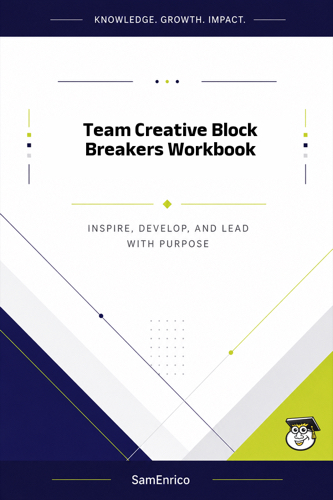
Team Creative Block Breakers Workbook eBook
Exercises to overcome collective creative stagnati
by Chambers Pam
Exercises to overcome collective creative stagnation and generate fresh ideas together.
Formats
Free sample
Chapter 1: The Collective Autopsy...--The moment you realize your team is creatively stuck feels less like a dramatic crash and more like a slow, suffocating fog. You still have meetings. You still produce deliverables. People nod, take notes, and say “good idea” with the same hollow enthusiasm they might offer to a moderately acceptable cup of coffee. But something essential has died.
The electricity is gone. The wild, unexpected, delightful collisions of thought that once produced breakthroughs have been replaced by a polite, grinding machinery of consensus and safety.You cannot point to a single villain. No one sabotaged the project. No one shouted down the room. The blockage is collective, which makes it invisible and maddening.
Each person assumes the others know what they are doing. Each person assumes the silence means agreement. And so the team continues to move forward—but forward toward mediocrity, not innovation.This is the problem that most creativity books fail to address. They hand you a set of individual exercises: write morning pages, take a walk, silence your inner critic. These are valuable practices, but they assume the block resides inside a single skull.
When an entire team stalls, the blockage is not located in any one person’s psychology. It lives in the space between people—in the unspoken rules, the buried resentments, the exhausted meeting formats, and the creeping fear that saying something truly new will make you look foolish.You cannot journal your way out of a team block. You cannot meditate away a toxic feedback loop. You need a different tool entirely: a diagnostic that treats the team as the patient.Welcome to the first chapter of the Team Creative Block Breakers Workbook. Before you try any exercise, before you run a single silent brainstorm or ugly prototype session, you must answer one question with brutal honesty: What kind of stuck are we?That is what this chapter delivers.
It is not a warm-up or an icebreaker. It is the foundational diagnostic that will determine every subsequent choice you make in this workbook. Skip it, and you risk applying the wrong medicine to the wrong disease—which is worse than doing nothing at all.The Three Languages of Stuck Over years of studying creative teams across industries—from software startups to advertising agencies to hospital emergency rooms—a clear pattern has emerged. When teams report feeling “blocked,” they are almost always describing one of three distinct types of blockage. These types feel different, sound different, and require completely different interventions.Tactical blocks are about resources, process, and logistics.
The team knows what it wants to create and has the psychological safety to take risks, but something external is in the way. The software crashes. The approval chain takes six weeks. The budget was cut. The timeline is impossible.
Tactical blocks feel like friction. You can name the obstacle: “We can’t move forward until legal signs off.” The frustration is real, but the solution is straightforward—fix the process, add the resource, remove the bottleneck.Psychological blocks are about fear, shame, perfectionism, and identity. The team has the resources and the timeline, but no one will speak. Or everyone speaks but only in safe, predictable ways. Or one person dominates because they are terrified of losing status.
Psychological blocks feel like a weight in the room. You cannot point to a missing budget or a broken tool. You can only feel the reluctance, the hesitation, the way good ideas get floated and then immediately withdrawn when no one cheers. These blocks are harder to name and harder to fix because they touch on vulnerability, ego, and the deep human need to belong.Environmental blocks are about the broader context in which the team operates. The organizational culture punishes failure.
Leadership sends mixed signals (“be creative, but don’t spend money or time”). Meetings are structured to reward the loudest voice. Feedback loops are toxic—praise is generic, criticism is personal. Environmental blocks feel like a weather system. You cannot change it with a single conversation.
It is the air the team breathes, and it has been polluted for years.Most teams assume they have a tactical block because tactical blocks are easier to talk about. “We need more time” is a respectable complaint. “We are afraid of looking stupid” is not. So teams ask for longer deadlines and bigger budgets, and then they are shocked when nothing changes. They had a psychological or environmental block all along, and they treated it with the wrong medicine.This chapter gives you a method to know the difference.The Creative Block Autopsy: A Step-by-Step Walkthrough The core exercise of this chapter is called the Creative Block Autopsy.
It borrows its name and some of its spirit from a medical autopsy—a careful, dispassionate examination of what went wrong, performed after the fact, with the goal of learning rather than blaming. But unlike a medical autopsy, this one is performed by the patient. The team examines itself.The exercise takes exactly sixty minutes. Do not rush it. Do not cut corners.
Do not let anyone leave early. The block you uncover will determine the success or failure of every subsequent chapter in this workbook.Preparation Before the Session You will need a large wall—at least six feet wide. Cover it with butcher paper or use a whiteboard. Draw three vertical columns, each two feet wide. Label the columns: TACTICAL, PSYCHOLOGICAL, ENVIRONMENTAL.Below each label, write brief examples to guide the team:TACTICAL: lack of time, missing tools, budget cuts, broken software, approval bottlenecks, unclear roles, insufficient data, remote collaboration friction PSYCHOLOGICAL: fear of failure, perfectionism, imposter syndrome, status anxiety, conflict avoidance, learned helplessness, creative exhaustion, loss of meaning ENVIRONMENTAL: toxic feedback culture, punishing failure, hierarchical pressure, meeting overload, mixed leadership signals, siloed information, reward systems that punish risk You will also need a stack of sticky notes—at least three per person, but more is better.
And you will need pens, not pencils. The permanence of ink matters psychologically. Pencils allow erasing, which allows self-censorship. Ink commits.Finally, you will need a timer and a facilitator. The facilitator can be a team member, but ideally it is someone who does not have a large stake in the content being discussed.
A neutral facilitator is better at noticing patterns that insiders miss.Phase One: Data Gathering (15 minutes)The facilitator begins by reading the following instructions aloud. Read them exactly. The wording has been tested and refined over dozens of sessions.“We are going to spend the next fifteen minutes in silence. I want each of you to think back over the last four weeks of this team’s work. Identify three specific moments when you felt the team stall, hesitate, or produce work that was less creative than you know you are capable of.
Do not judge these moments as good or bad. Just name them.“Write each moment on a separate sticky note. Use as few words as possible—a short phrase is enough. For example: ‘The Tuesday meeting when we spent forty minutes discussing fonts’ or ‘The moment after Sarah presented her concept and no one responded’ or ‘The feedback session where legal…
This is the end of the free sample. Get the eBook to keep going. Buy now
About this book
Details
- Author
- Chambers Pam
- Publisher
- SamEnrico
- Language
- English
- Genre
- Non-Fiction, Self-Help, Creative Blocks
- Released
- 2026-06-08
- Pages (approx.)
- 131
- Available as
- eBook, Audiobook

Read better in the ZLOADR app
Your eBooks on your phone or tablet. Sign in with your SamEnrico account and start reading.
More by Chambers Pam
 Living with End of MindChambers Pam$11.99
 The Enuresis Sleep GuideChambers Pam$11.99
 Calisthenics Breathing TechniqueChambers Pam$11.99
 Stress Management for HR ProfessionalsChambers Pam$11.99
 South African Professional ExodusChambers Pam$11.99
 Caribbean Submarine AttacksChambers Pam$11.99
 The Breast Cancer Complementary GuideChambers Pam$11.99
 The Parental Controls GuideChambers Pam$11.99
 Senior Exercise And Self ImageChambers Pam$11.99
 The Lion and the Eagle: The Crusader Kingdoms' Secret WarChambers Pam$11.99
 The Bone Whisperers of the Black ForestChambers Pam$11.99
 How to Start a Citrus (except Orange) Groves BusinessChambers Pam$11.99
You may also like
 Hong Kong Handover 1997Dunn Johnnie$11.99
 Zumba For Postnatal Recovery CourseNeal Christian$11.99
 Zumba for BeginnersLadner Nikia$11.99
 YouTube Comment Mining GuideHumes Pandora$12.99
 Worry Box MeditationCarlin Rudy$11.99
 Workplace Stress MeditationNguyen Lynn$11.99
 Workplace Stress and Sleep RepairHawley Ivory$11.99
 Workplace Perfectionism CureDelaney Jeffry$11.99
 Workplace Injustice Anger GuideWallen Isabelle$11.99
 Work Addiction and Burnout LinkGreenwood Ester$11.99
 Women in Yoga and WellnessBeattie Galina$11.99
 Women in Stand Up ComedyChun Evangeline$11.99