
Non-FictionSelf-HelpBusiness Creativity
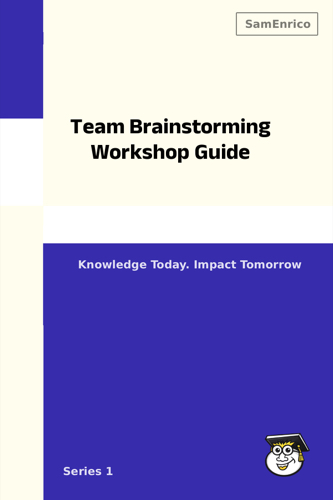
Team Brainstorming Workshop Guide eBook
Teaches structured ideation techniques that preven
by Spear Pilar
Teaches structured ideation techniques that prevent groupthink and maximize creative output.
Formats
Free sample
Chapter 1: The Silent Epidemic–- Every Monday morning, in thousands of conference rooms around the world, the same ritual unfolds with tragic predictability. A manager stands before a whiteboard, uncaps a marker with theatrical flourish, and announces, "Let's brainstorm." The team shifts uncomfortably in their chairs. The extroverts lean forward. The introverts sink back. The senior director crosses their arms.
Within thirty seconds, the first idea is shouted out—usually from the person with the highest salary or the loudest voice. Within two minutes, three other people have built on that first idea, not because it was good, but because it was there. Within ten minutes, the room has settled into a comfortable consensus around a solution that feels familiar, safe, and utterly unremarkable. The meeting ends. Everyone returns to their desks.
Nothing changes.This is not brainstorming. This is a ritualized failure that organizations have been practicing for eighty years, mistaking activity for productivity and noise for creativity. The problem is not that people lack good ideas. The problem is that the way we gather to generate ideas actively prevents those good ideas from ever being heard. We have built a system that rewards speed over depth, confidence over insight, and status over substance.
And we have done it so consistently, for so long, that we have forgotten there is another way.This book exists because the evidence is now overwhelming: traditional verbal brainstorming does not work. In fact, it works backward. Research spanning four decades shows that people generate more—and better—ideas when they work alone than when they work in traditional brainstorming groups. A group of six people working silently for twenty minutes will produce nearly twice as many unique ideas as the same six people talking for an hour. This finding has been replicated so many times that it is no longer controversial among researchers who study creativity.
And yet, ask any manager how they run an ideation session, and they will almost certainly describe the same broken process: people sitting around a table, taking turns or shouting out, anchoring on the first decent idea, and calling it a day.The cost of this failure is staggering. Teams that rely on traditional brainstorming leave 30 to 50 percent of their creative potential on the table. That is not a rounding error. That is the difference between incremental improvement and breakthrough innovation. That is the difference between a product that competes and a product that dominates.
That is the difference between a team that survives and a team that leads.This chapter exposes the three cognitive biases that make traditional brainstorming a guaranteed path to mediocrity. It reveals why your best ideas are probably dying in conference rooms right now. And it introduces the foundational principle that will guide every technique in this book: the separation of divergence from convergence, enforced by structured silence.The Birth of a Well-Intentioned Lie To understand why traditional brainstorming fails, we must first understand where it came from. In the late 1940s, advertising executive Alex Osborn wrote a book called Your Creative Power. Osborn was not a psychologist or a cognitive scientist.
He was a businessman who had noticed that some of his teams produced better campaigns than others. He observed that when people deferred judgment, focused on quantity, encouraged wild ideas, and built on each other's suggestions, they seemed to generate more creative work.From these observations, Osborn distilled four rules that became the foundation of modern brainstorming:Defer judgment – Do not criticize ideas during generation.Go for quantity – More ideas increase the odds of a good one.Encourage wild ideas – Unconventional thinking leads to breakthroughs.Build on others' ideas – Combination and improvement are powerful.These rules are not wrong. In fact, they are excellent principles for creative thinking. The problem is not Osborn's rules. The problem is how they have been implemented.
Osborn never claimed that shouting out ideas in a group was the most effective method. He was describing what he had observed, not what had been scientifically validated. And crucially, he was working in an era before we had the research tools to measure what actually happens inside a brainstorming session.When psychologists finally ran controlled experiments in the 1980s and 1990s, they discovered something that Osborn could not have anticipated. The very act of being in a group—even a group that follows his four rules perfectly—introduces cognitive and social dynamics that systematically reduce creative output.This is the great irony of traditional brainstorming. A process designed to unlock collective creativity instead activates three powerful forces that suppress it.
Those forces are groupthink, production blocking, and evaluation apprehension. Understanding each one is essential to escaping their grip.The First Saboteur: Groupthink Groupthink is the silent killer of creative diversity. It is the tendency for groups to prioritize harmony and consensus over critical evaluation and dissenting perspectives. The term was coined by psychologist Irving Janis in 1972 after studying several major policy disasters, including the Bay of Pigs invasion and the escalation of the Vietnam War. In each case, Janis found that highly cohesive groups had made catastrophic decisions because members suppressed their doubts to maintain the illusion of agreement.In a brainstorming context, groupthink manifests more subtly but no less destructively.
When one person offers an idea, others naturally want to be supportive. They nod. They smile. They say "good point" or "that's interesting." These small social reinforcements create a gravitational pull toward the ideas that have already been voiced. An idea that is spoken aloud becomes harder to challenge, not because it is better, but because challenging it would violate the social norm of politeness.Consider what happens in a typical brainstorming session.
The first idea is offered. Someone builds on it. Someone else adds a variation. Within five minutes, the group has converged on a conceptual neighborhood—a set of related ideas that all share similar assumptions. Ideas that fall outside that neighborhood feel risky to introduce.
They require effort to explain. They might make the speaker look foolish. So they stay inside the speaker's head, unspoken and unconsidered.Groupthink explains why brainstorming sessions so often produce ideas that are remarkably similar to what the organization is already doing. The group does not intend to be uncreative. The structure of the session simply makes it easier to say things that others will approve of and harder to say things that might meet resistance.The research on groupthink in creative settings is clear.
When groups are told to generate ideas, the first few ideas strongly predict the content of the next several dozen. Teams rarely recover from a weak or narrow start. The initial framing—often provided by the highest-status person in the room—becomes an anchor that the entire session orbits around.This is not a failure of individual intelligence or effort. It is a feature of how human social cognition works. We are wired to seek belonging.
We are wired to avoid social rejection. Brainstorming sessions, as traditionally conducted, expose these wires directly to the current of social pressure. The result is a short circuit of creative potential.The Second Saboteur: Production Blocking If groupthink explains what ideas get suppressed, production blocking explains how many…
This is the end of the free sample. Get the eBook to keep going. Buy now
About this book
Details
- Author
- Spear Pilar
- Publisher
- SamEnrico
- Language
- English
- Genre
- Non-Fiction, Self-Help, Business Creativity
- Released
- 2026-06-08
- Pages (approx.)
- 157
- Available as
- eBook, Audiobook

Read better in the ZLOADR app
Your eBooks on your phone or tablet. Sign in with your SamEnrico account and start reading.
More by Spear Pilar
 Truck Driver Nap GuideSpear Pilar$11.99
 EQ For Engineers GuideSpear Pilar$11.99
 Aerospace and Defense MultiplesSpear Pilar$11.99
 Bite Mark PhotographySpear Pilar$11.99
 Ramadan Student LifeSpear Pilar$11.99
 Craniosacral TherapySpear Pilar$11.99
 Panic Attack Hypnosis GuideSpear Pilar$11.99
 Jörmungandr and the Jade Serpent: A Norse-Dragon’s LamentSpear Pilar$11.99
 Galahad’s Lost Grail: The Knight’s Forbidden RevelationSpear Pilar$11.99
 Robins: Backyard BirdSpear Pilar$11.99
 How to Become a Salvage EngineerSpear Pilar$11.99
 A Collector's Handbook to the Volkswagen Type 1 Karmann-ghia CoupèSpear Pilar$11.99
You may also like
 Hong Kong Handover 1997Dunn Johnnie$11.99
 Zumba For Postnatal Recovery CourseNeal Christian$11.99
 Zumba for BeginnersLadner Nikia$11.99
 YouTube Comment Mining GuideHumes Pandora$12.99
 Worry Box MeditationCarlin Rudy$11.99
 Workplace Stress MeditationNguyen Lynn$11.99
 Workplace Stress and Sleep RepairHawley Ivory$11.99
 Workplace Perfectionism CureDelaney Jeffry$11.99
 Workplace Injustice Anger GuideWallen Isabelle$11.99
 Work Addiction and Burnout LinkGreenwood Ester$11.99
 Women in Yoga and WellnessBeattie Galina$11.99
 Women in Stand Up ComedyChun Evangeline$11.99