
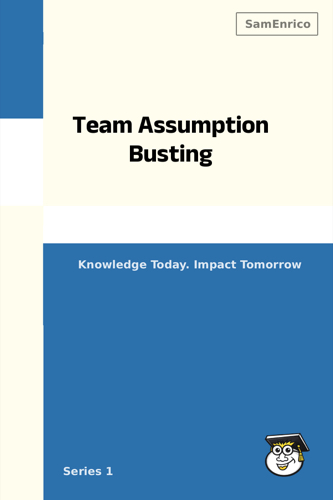
Team Assumption Busting eBook
Identifies and challenges hidden beliefs blocking
by Hook Ina
Identifies and challenges hidden beliefs blocking group creativity.
Formats
Free sample
Chapter 1: The Invisible Prison--–- The conference room smelled of stale coffee and exhausted ambition. Maya Chen, newly promoted director of product innovation at Stride Analytics, had just watched her team lose a $2 million contract to a startup called Velox that none of them had even heard of six months ago. The post-mortem meeting was supposed to identify what went wrong. Instead, it produced the usual suspects: budget constraints, aggressive timelines, an unexpected feature request from the client. But as Maya sat through ninety minutes of polite finger-pointing, something nagged at her.
None of the explanations made sense. Her team was smarter than Velox's team. They had more resources, more experience, deeper client relationships. And yet they had lost. Not because they failed to execute.
Because they failed to ask a single question that Velox had asked.The question was simple: "Why does regulatory approval take eighteen months?"Maya's team had assumed it did. Everyone in the healthcare analytics space assumed it did. The regulation hadn't changed in three years, but no one had checked. Velox, staffed largely by newcomers who didn't know the "rules," had actually read the updated guidelines. The eighteen-month assumption was based on a process that had been streamlined two years ago.
Maya's team had built an entire project plan around a rule that no longer existed. They had lost millions of dollars not because of incompetence, but because of an invisible belief that no one had bothered to question.This is the central problem of this book, and it is a problem that affects every team in every industry. The most dangerous assumptions are not the ones you know you are making. They are the ones you do not know you are making. They are the invisible rules that live in the space between "that's just how we do things" and "everyone knows that." They are the ghosts of past successes haunting present decisions.
And until you learn to see them, they will continue to steal your team's creativity, your competitive advantage, and your future.Welcome to the work of assumption busting.The Architecture of Invisible Prisons Every team operates within what we call an assumption architecture—a set of beliefs, rules, and habits that dictate what is possible, what is impossible, and what is not even worth discussing. This architecture is built over time, brick by brick, through a process that feels completely rational in the moment. A project succeeds, and the team learns "this approach works." A risk materializes, and the team learns "we must always account for X." A leader offers an opinion, and the team learns "that's how we think about problems."None of these lessons are wrong at the time they are learned. That is what makes them so dangerous. They are not mistakes.
They are adaptations. And every adaptation becomes a constraint once the environment changes.Consider the research from organizational psychologist Chris Argyris, who spent decades studying why smart teams make avoidable errors. His work on "defensive routines" revealed that teams develop unconscious protocols for avoiding embarrassment or threat. These protocols become so automatic that team members no longer notice they are following them. The result is a phenomenon Argyris called "skilled incompetence"—the ability to be very good at doing the wrong thing very efficiently.Maya's team was not lazy or stupid.
They were highly skilled at following rules that had expired. The eighteen-month regulatory assumption had been correct four years ago. It had saved them from disaster. And because it had saved them, they enshrined it as an unquestionable truth. The assumption moved from "a useful guideline" to "the way things are" to "so obvious we don't need to mention it." That final stage—the unspoken assumption—is where creativity goes to die.Cognitive Debt: The Hidden Tax on Team Creativity Let me introduce a concept that will serve as the foundation for everything that follows: cognitive debt.You are likely familiar with technical debt—the cost of choosing a quick, imperfect solution today that will require expensive fixes later.
Cognitive debt is the same idea applied to assumptions. Every time a team accepts an assumption without examination, they incur a debt. That debt accumulates interest in the form of missed opportunities, slower decisions, and ideas that never get generated because they were ruled out by a rule no one remembers creating.Cognitive debt has three distinct components, each of which bleeds value from your team.First, there is the debt of omission. Every assumption that goes unexamined closes off a category of potential solutions. When Maya's team assumed that regulatory approval took eighteen months, they did not simply plan for eighteen months.
They stopped considering any project that required faster approval. They eliminated an entire landscape of possibilities not because those possibilities were impossible, but because they believed them to be. The debt of omission is invisible because you cannot see the ideas you never had.Second, there is the debt of alignment. Teams waste enormous energy aligning around false premises. Meetings that should take thirty minutes take ninety because team members are arguing about solutions to a problem that does not exist, anchored by an assumption that no one has named.
The energy spent defending, clarifying, and reconciling around hidden beliefs is energy not spent on creation. This debt shows up as exhaustion, frustration, and the feeling that your team is running in place.Third, there is the debt of inertia. Once a team has operated under an assumption for years, changing that assumption becomes expensive not because of the change itself, but because of the identity disruption it causes. "We have always been the team that does X" is a statement not about process but about self-concept. The longer an assumption goes unchallenged, the more it becomes woven into the fabric of who the team thinks they are.
Challenging it feels like a betrayal of identity, which is why teams will work around a broken assumption rather than fix it.The research on cognitive inertia is sobering. A study of software development teams published in the Journal of Product Innovation Management found that teams with high "assumption rigidity" took 40% longer to deliver features and produced 60% fewer novel solutions than teams with regular assumption-review practices. The difference was not talent or resources. It was the willingness—and the structural ability—to question what everyone else accepted as true.Maya's team had accumulated years of cognitive debt. Each successful project added new assumptions to their invisible rulebook.
Each failure reinforced the importance of existing rules, even when those rules had nothing to do with the failure. They were not a broken team. They were a team drowning in unexamined beliefs.The Paradox of Experience There is a painful irony at the heart of team creativity. The very thing that makes teams valuable—their accumulated experience—also makes them blind.This is known as the expertise paradox. Psychologists studying problem-solving have found that experts are often worse than novices at generating novel solutions to problems in their domain.
The reason is not that experts lack intelligence or creativity. It is that experts have too many assumptions. They know what should work, what usually works, and what…
This is the end of the free sample. Get the eBook to keep going. Buy now
About this book
Details
- Author
- Hook Ina
- Publisher
- SamEnrico
- Language
- English
- Genre
- Non-Fiction, Self-Help, Critical Thinking
- Released
- 2026-06-11
- Pages (approx.)
- 146
- Available as
- eBook, Audiobook

Read better in the ZLOADR app
Your eBooks on your phone or tablet. Sign in with your SamEnrico account and start reading.
More by Hook Ina
 Protein HGH Synergy GuideHook Ina$11.99
 High School Stress Relief GuideHook Ina$11.99
 Coding Syntax PegsHook Ina$11.99
 Retirement Assets and PensionHook Ina$11.99
 Antwerp Diamond Police InterrogationHook Ina$11.99
 Nicotine During Pregnancy SolutionsHook Ina$11.99
 Menstrual Product GuideHook Ina$11.99
 Echoes of the Red Planet: The AI That Listened to MarsHook Ina$11.99
 The Shadow of Tenochtitlan: Cortes and the Fall of an Empire (1519-1521)Hook Ina$11.99
 The Silent Cartographers: Mapping the Grand Canyon’s Hidden Depths (1909-1911)Hook Ina$11.99
 Growing Ribes (Currant)Hook Ina$11.99
 AI Prompts for Sales Outreach and ProspectingHook Ina$11.99
You may also like
 Real vs Reel Social MediaKruger Norberto$11.99
 Chunking for Critical ThinkingMarino Darleen$11.99
 Mindfulness for Beginner NaysayersAlonso Palma$11.99
 Elaborative Interrogation MethodBruce Holley$11.99
 Critical Listening for Debates and ArgumentsPrather Candy$11.99
 Collaborative Assumption Busting GuideStanfield Clemmie$11.99
 The Logical Fallacy Persuasion GuideLink Cordell$11.99
 Devil Advocate Role AssignmentCurran Kym$11.99
 Critical Thinking in Teams GuideRoark Elroy$11.99
 The Eisenhower Matrix Critical DistinctionCasas Sandee$11.99
 Red Teaming Creative IdeasWhitley Reta$11.99
 Elaboration Study GuideKuykendall Fay$11.99