
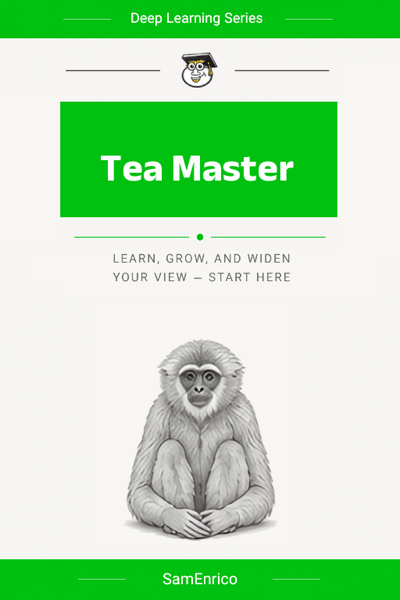
Tea Master eBook
A Coursebook on Tea Master
A Coursebook on Tea Master
Formats
Free sample
Chapter 1: The Leaf That Changed Everything...--You have never truly tasted tea. Not the real thing. Not the leaf that launched empires, funded revolutions, and taught monks how to sit still for a thousand years. What you have tasted—if you are like most people in the Western world—is the ghost of tea. A papery echo.
A brown-tinted memory of something that once was alive.That bitter, astringent cup you grab from the office break room at 2:00 PM when your eyelids start drooping? That is not tea. That is tea's corpse, embalmed in a paper bag, stuffed into a cardboard box, and left to rot on a supermarket shelf for eighteen months before you drowned it in boiling tap water and called it a beverage. The chalky, dusty powder inside that "premium" tea bag? Those are the sweepings from the floor of a factory in Sri Lanka or Kenya—the broken fannings and dust left over after the real tea has been sorted, graded, and shipped to people who actually know what they are doing.This is not snobbery.
This is not elitism. This is simply the truth, and the first lesson of becoming a Tea Master is learning to face uncomfortable truths about what you have been drinking and what you have been missing.I know this because I was you. For thirty years, I hated tea. I thought it was weak, watery, and pointless—a drink for people who could not handle coffee or who were pretending to be cultured. I would order a "chai latte" from Starbucks and feel sophisticated.
I would buy boxes of Earl Grey tea bags and wonder why it always tasted like soapy water with a whisper of perfume. I once threw away a perfectly good tin of loose-leaf oolong because I brewed it with boiling water, let it steep for ten minutes, and produced something so bitter and undrinkable that I assumed the tea itself was defective.I was the defective one. The tea was fine. I was the one who did not know how to listen.My conversion happened in a tiny alley in Taipei, behind a noodle shop, in a space no wider than a hallway. An old woman with hands like cracked leather gestured for me to sit on a wooden stool.
She did not speak English. I did not speak Mandarin. She simply placed a small clay pot in front of me, poured hot water over dark, twisted leaves, and waited twenty seconds. Then she poured a golden-amber liquid into a cup no larger than a thimble and nodded for me to drink.That first sip destroyed everything I thought I knew about tea. It was not bitter.
It was not astringent. It was floral and creamy and complex, with a finish that lingered on my tongue for a full minute, shifting from orchid to honey to something like fresh-baked bread. I looked at the old woman. She smiled. She poured another infusion—the same leaves, fresh water, another twenty seconds—and this time the tea tasted like stone fruit and wildflowers and morning mist over mountains I had never seen.I had no vocabulary for what I was experiencing.
I had spent my life drinking the ghost of tea, and now someone had handed me the living leaf.That was the moment I became a student of tea. And that is the moment this book hopes to create for you—not in a Taipei alley, but on your own kitchen counter, with your own hands, your own kettle, your own cup.The Great Lie of the Teabag Before we can become masters, we must first unlearn nearly everything the modern tea industry has taught us. This is not easy. The lies are comfortable. The lies are cheap.
The lies are available in every grocery store in America for $3.99 for a box of forty bags.The first lie is that tea is simply "dried leaves" and all dried leaves are roughly equivalent. This is like saying all wine is simply "fermented grapes" and a $5 bottle of jug wine is roughly equivalent to a 1982 Château Margaux. The difference between a floor-sweeping tea bag and a hand-picked, single-origin, masterfully processed loose-leaf tea is not a matter of degree. It is a matter of kind. They are different beverages that happen to share a plant family.The second lie is that tea should be brewed with boiling water and left to steep indefinitely.
This lie is perpetuated by the teabag industry because boiling water and long steeps extract more tannins and caffeine—which means more "bite" and "kick"—while simultaneously destroying the delicate aromatic compounds that make fine tea worth drinking. The result is a cup that is uniformly bitter, uniformly brown, and uniformly forgettable. But it is consistent. And the industry has trained you to believe that bitterness is simply what tea tastes like.The third lie is that all teas are essentially the same. Green tea is slightly grassy.
Black tea is slightly stronger. Herbal tea is for people who want to feel virtuous. This lie allows companies to buy cheap commodity tea from auction houses—blended from dozens of farms across three continents, aged in warehouses for years, stripped of all character—and sell it to you under names like "English Breakfast" or "Jasmine Green" as if those names meant something consistent.Here is the truth that the tea industry does not want you to know: real tea is one of the most chemically complex beverages on earth. A single cup of high-quality loose-leaf tea contains hundreds of aromatic compounds—aldehydes, ketones, esters, terpenes, and volatile organic compounds—many of which are also found in fine wine, aged whiskey, and even perfume. The difference between a 5teabaganda5 tea bag and a 5teabaganda50 loose-leaf tea is not marketing.
It is chemistry. It is agriculture. It is craftsmanship. And once you learn to taste the difference, you will never be able to un-taste it.What Tea Actually Is (And What It Is Not)Let us begin with a definition so fundamental that most tea drinkers never learn it. Tea is a specific plant: Camellia sinensis.
That is it. That is the whole thing. If a beverage does not come from the leaves of Camellia sinensis, it is not tea. It is a tisane—a herbal infusion—and there is nothing wrong with tisanes, but they are not tea. Chamomile is not tea.
Peppermint is not tea. Rooibos is not tea. These are delicious, pleasant, often healthful drinks, but they belong to a different category entirely, and confusing them with tea is like confusing grape juice with wine.Camellia sinensis comes in two primary varieties, and understanding the difference between them is your first step toward Tea Mastery.Camellia sinensis var. sinensis is the China plant. It has smaller leaves, tolerates colder climates, and produces teas that tend toward floral, vegetal, and delicate flavor profiles.
Most green teas, white teas, and oolongs come from sinensis varieties. The plant grows slowly at high altitudes, concentrating flavor compounds and developing complexity over decades or even centuries. Some sinensis tea trees in the Wuyi Mountains of China are over three hundred years…
This is the end of the free sample. Get the eBook to keep going. Buy now
About this book
Details
- Author
- Barclay Williemae
- Publisher
- SamEnrico
- Language
- English
- Genre
- Non-Fiction, Informative, Educational
- Released
- 2026-05-08
- Pages (approx.)
- 153
- Available as
- eBook, Audiobook

Read better in the ZLOADR app
Your eBooks on your phone or tablet. Sign in with your SamEnrico account and start reading.
More by Barclay Williemae
 First Day No English PanicBarclay Williemae$11.99
 Poverty Mindset ChildhoodBarclay Williemae$11.99
 Dream Quest JournalBarclay Williemae$11.99
 SEAL Milsim TrainingBarclay Williemae$11.99
 The Great Gold Swindle: Australia's First White-Collar Crime Wave (1920s)Barclay Williemae$11.99
 How to Produce Climbing Crash PadsBarclay Williemae$11.99
 Compliance Audit for Global TeamsBarclay Williemae$12.99
 A Beginners Guide to Puerto Rico (Volume 1)Barclay Williemae$11.99